An object with mass of 90kg is projected upward form the surface of the earth at...
An object with mass of 90kg is projected upward form the surface of
the earth at a velocity of 60m/s. If the Earth is subject to linear
drag(c=15kg/s), use the golden section search to determine the
maximum height the object attains.
In addition to the numerical solution, determine the analytic
solution and compare the two values.
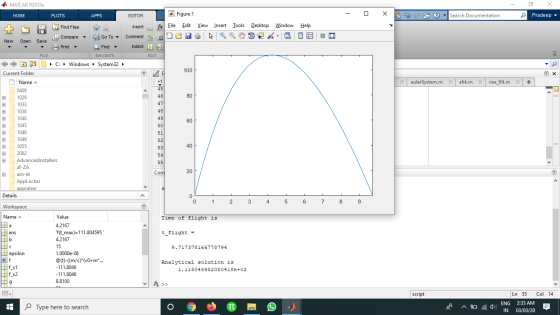
Determine the time of flight (use a root finding method)
Plot y vs t during the time of flight.
Homework Answers
`Hey,
Note: If you have any queries related the answer please do comment. I would be very happy to resolve all your queries.
clc%clears screen
clear all%clears history
close all%closes all files
format long;
c=15;
v0=60;
m=90;
g=9.81;
f=@(t) -((m/c)*(v0+m*g/c)*(1-exp(-c*t/m))-m*g*t/c);
a=0; % start of interval
b=10; % end of interval
epsilon=0.000001; % accuracy value
iter= 50; % maximum number of iterations
tau=double((sqrt(5)-1)/2); % golden proportion coefficient, around
0.618
k=0; % number of iterations
x1=a+(1-tau)*(b-a); % computing x values
x2=a+tau*(b-a);
f_x1=f(x1); % computing values in x points
f_x2=f(x2);
while ((abs(b-a)>epsilon) && (k<iter))
k=k+1;
if(f_x1<f_x2)
b=x2;
x2=x1;
x1=a+(1-tau)*(b-a);
f_x1=f(x1);
f_x2=f(x2);
else
a=x1;
x1=x2;
x2=a+tau*(b-a);
f_x1=f(x1);
f_x2=f(x2);
end
k=k+1;
end
% chooses minimum point
if(f_x1<f_x2)
sprintf('t_max=%f', x1)
sprintf('f(t_max)=%f ', -f_x1)
else
sprintf('t_max=%f', x2)
sprintf('f(t_max)=%f ', -f_x2)
end
disp('Time of flight is');
t_flight=fzero(f,10)
fplot(@(t) -f(t),[0,t_flight]);
disp('Analytical solution is');
tm=fminbnd(f,0,10);
disp(-f(tm));
Kindly revert for any queries
Thanks.
Add Answer to:
An object with mass of 90kg is projected upward form the surface of
the earth at...
Refer to the textbook or other references specified in the course syllabus, read about Golden-Section Search...
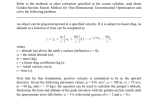 Refer to the textbook or other references specified in the course syllabus, read about Golden-Section Search Method for One-Dimensional Unconstrained Optimization and solve the following problem. An object can be projected upward at a specified velocity. If it is subject to linear drag, its altitude as a function of time can be computed as: 2= 20 + " (vo + mg) (1 – e-641m) mg, where z = altitude (m) above the earth's surface (defined as z = 0), zo...
An object of mass ? = 2 kg that moves horizontally at a velocity 8 m...
An object of mass ? = 2 kg that moves horizontally at a velocity 8 m / s enters a zone of length ? = 25 m where it experiences viscous friction numerically equal to one-tenth of its instantaneous speed; when leaving that zone it passes to another part where it only experiences the friction of Coulomb numerically equal to one twentieth of its weight. Find an expression for the speed and position of the object at any instant of...
Homework 5 (35 Points max) Please Submit all Matlab and Data files that you create for this homew...
 Homework 5 (35 Points max) Please Submit all Matlab and Data files that you create for this homework Problem 1 (max 20 Points): For the second-order drag model (see Eq.(1)), compute the velocity of a free-falling parachutist using Euler's method for the case where m80 kg and cd 0.25 kg/m. Perform the calculation from t 0 to 20 s with a step size of 1ms. Use an initial condition that the parachutist has an upward velocity of 20 m/s at...
Vibrational Motion Introduction If an object is following Hooke’s Law, then Fnet = -kx = ma...
Vibrational Motion Introduction If an object is following Hooke’s Law, then Fnet = -kx = ma Since acceleration is the second derivative of position with respect to time, the relationship can be written as the differential equation: kx = m δ2xδt2/{"version":"1.1","math":"<math xmlns="http://www.w3.org/1998/Math/MathML"><mi>k</mi><mi>x</mi><mo> </mo><mo>=</mo><mo> </mo><mi>m</mi><mo> </mo><mfrac bevelled="true"><mrow><msup><mi>δ</mi><mn>2</mn></msup><mi>x</mi></mrow><mrow><mi>δ</mi><msup><mi>t</mi><mn>2</mn></msup></mrow></mfrac></math>"} Methods for solving differential equations are beyond the scope of this course; in fact, a class in differential equations is usually a requirement for a degree in engineering or physics. However, the solution to this particular differential...
279 WORKED AND GUIDED PROBLEMS pendulum's period on Earth: 9.8m/S -25. The period of a 0.50-m...
 279 WORKED AND GUIDED PROBLEMS pendulum's period on Earth: 9.8m/S -25. The period of a 0.50-m lunar pendulum is therefore EVALUATE RESULT The longer period on the Moon n accelerations to sense because, as we found in part a, the gravitational accele TE gM 0.50 rn 1.6 m 3.5 s. = (b) We can use the general expression ixth that on Earth. get the desired ratio of periods without having to calculate the on the Moon, 1.6 m/s', is about...
write MATLAB scripts to solve differential equations. Computing 1: ELE1053 Project 3E:Solving Differential Equations Project Principle...
 write MATLAB scripts to solve differential equations.
Computing 1: ELE1053 Project 3E:Solving Differential Equations Project Principle Objective: Write MATLAB scripts to solve differential equations. Implementation: MatLab is an ideal environment for solving differential equations. Differential equations are a vital tool used by engineers to model, study and make predictions about the behavior of complex systems. It not only allows you to solve complex equations and systems of equations it also allows you to easily present the solutions in graphical form....
write MATLAB scripts to solve differential equations.
Computing 1: ELE1053 Project 3E:Solving Differential Equations Project Principle Objective: Write MATLAB scripts to solve differential equations. Implementation: MatLab is an ideal environment for solving differential equations. Differential equations are a vital tool used by engineers to model, study and make predictions about the behavior of complex systems. It not only allows you to solve complex equations and systems of equations it also allows you to easily present the solutions in graphical form....
Thank you very much. College Physics (PHYC 2053 & 2 E3 Incorrect. You step onto a...
 Thank you very much.
College Physics (PHYC 2053 & 2 E3 Incorrect. You step onto a hot beach time does it take for the impulse, which travels a distance of 1.65 m, to reach your brain? your bare feet. A nerve impulse, generated in your foot, travels through your nervous system at an average speed of 191 my's. How much ne Units m/s the tolerance is +/-4% LINK TO TEXT LINK TO TEXT Question Attempts: 1 of 3 used REP...
Thank you very much.
College Physics (PHYC 2053 & 2 E3 Incorrect. You step onto a hot beach time does it take for the impulse, which travels a distance of 1.65 m, to reach your brain? your bare feet. A nerve impulse, generated in your foot, travels through your nervous system at an average speed of 191 my's. How much ne Units m/s the tolerance is +/-4% LINK TO TEXT LINK TO TEXT Question Attempts: 1 of 3 used REP...
 Refer to the textbook or other references specified in the course syllabus, read about Golden-Section Search Method for One-Dimensional Unconstrained Optimization and solve the following problem. An object can be projected upward at a specified velocity. If it is subject to linear drag, its altitude as a function of time can be computed as: 2= 20 + " (vo + mg) (1 – e-641m) mg, where z = altitude (m) above the earth's surface (defined as z = 0), zo...
 Homework 5 (35 Points max) Please Submit all Matlab and Data files that you create for this homework Problem 1 (max 20 Points): For the second-order drag model (see Eq.(1)), compute the velocity of a free-falling parachutist using Euler's method for the case where m80 kg and cd 0.25 kg/m. Perform the calculation from t 0 to 20 s with a step size of 1ms. Use an initial condition that the parachutist has an upward velocity of 20 m/s at...
 279 WORKED AND GUIDED PROBLEMS pendulum's period on Earth: 9.8m/S -25. The period of a 0.50-m lunar pendulum is therefore EVALUATE RESULT The longer period on the Moon n accelerations to sense because, as we found in part a, the gravitational accele TE gM 0.50 rn 1.6 m 3.5 s. = (b) We can use the general expression ixth that on Earth. get the desired ratio of periods without having to calculate the on the Moon, 1.6 m/s', is about...
 write MATLAB scripts to solve differential equations.
Computing 1: ELE1053 Project 3E:Solving Differential Equations Project Principle Objective: Write MATLAB scripts to solve differential equations. Implementation: MatLab is an ideal environment for solving differential equations. Differential equations are a vital tool used by engineers to model, study and make predictions about the behavior of complex systems. It not only allows you to solve complex equations and systems of equations it also allows you to easily present the solutions in graphical form....
write MATLAB scripts to solve differential equations.
Computing 1: ELE1053 Project 3E:Solving Differential Equations Project Principle Objective: Write MATLAB scripts to solve differential equations. Implementation: MatLab is an ideal environment for solving differential equations. Differential equations are a vital tool used by engineers to model, study and make predictions about the behavior of complex systems. It not only allows you to solve complex equations and systems of equations it also allows you to easily present the solutions in graphical form....
 Thank you very much.
College Physics (PHYC 2053 & 2 E3 Incorrect. You step onto a hot beach time does it take for the impulse, which travels a distance of 1.65 m, to reach your brain? your bare feet. A nerve impulse, generated in your foot, travels through your nervous system at an average speed of 191 my's. How much ne Units m/s the tolerance is +/-4% LINK TO TEXT LINK TO TEXT Question Attempts: 1 of 3 used REP...
Thank you very much.
College Physics (PHYC 2053 & 2 E3 Incorrect. You step onto a hot beach time does it take for the impulse, which travels a distance of 1.65 m, to reach your brain? your bare feet. A nerve impulse, generated in your foot, travels through your nervous system at an average speed of 191 my's. How much ne Units m/s the tolerance is +/-4% LINK TO TEXT LINK TO TEXT Question Attempts: 1 of 3 used REP...
Most questions answered within 3 hours.
-
Where is the error in this code sequence?
String s1 = "Hello";
String s2 = "ello";...
asked 11 months ago -
Financial data for Joel de Paris, Inc., for last year
follow:
Joel de Paris, Inc.
Balance...
asked 11 months ago -
Consider this reaction:
Al2(SO4)3 (aq)+ BaCl3
(aq) Al2Cl6 (aq)- +
3BaSO4(s) . What is the...
asked 11 months ago -
Suppose that Savneet is considering increasing her
recent random sample from 20 car rentals to 40...
asked 11 months ago -
Trucks arrive at an unloading terminal at an average rate of 120
per hour.
Trucks arrive...
asked 11 months ago -
Why are methanol and ethanol completely soluble in water while
octanol is not very little soluble....
asked 11 months ago -
A facilities manager at a university reads in a research report
that the mean amount of...
asked 11 months ago -
When the CuSO4 is rehydrated by adding water to the anhydrous
compound, is this an endothermic...
asked 11 months ago -
A ray of sunlight is passing from diamond into crown glass; the
angle of incidence is...
asked 11 months ago -
A block of mass 0.249 kg is placed on top of a light, vertical
spring of...
asked 11 months ago -
how do the kidneys compensate in the presences of acidosis
a) trigger hyperventilate
b) reserve acid...
asked 11 months ago -
Question 501 pts
The rental rate of capital to the firm increases. Which of the
following...
asked 11 months ago