Given the following reagents: 15.50 ml of 0.335 MLead(IV) Nitrate and 25.00ml of 0.400MSodium Sulfide, If...
Given the following reagents: 15.50 ml of 0.335 MLead(IV) Nitrate and 25.00ml of 0.400MSodium Sulfide, If they were mixed:
- What is the resulting concentration of the Lead ion?
- What is the resulting concentration of the Sodium ion?
- What is the resulting concentration of the Nitrate ion?
Homework Answers
Molarity=Number of moles of solute/Volume of solution (L)
Number of moles of solute=Molarity x Volume (L)
Volume of Lead(IV) nitrate solution=15.50 mL=15.50 mL/1000 mL/L=0.01550 L (1 L=1000 mL)
Molarity of Lead (IV) nitrate solution=0.335 M
Number of moles of Lead (IV) nitrate=0.335 M x 0.01550
L=0.0051925 mol 0.005 mol
Lead (IV) nitrate dissociates as shown

So 1 mol Lead (IV) nitrate gives 1 mol Lead (IV) ions and 4 mol nitrate ions in solution
0.005 mol Lead (IV) nitrate gives 0.005 mol Lead (IV) ions and 4x0.005=0.020 mol nitrate ions in solution
Volume of Sodium sulfide solution=25.00 mL=25.00 mL/1000 mL/L=0.025 L
Molarity of Sodium sulfide solution=0.400 M
Number of moles of sodium sulfide=0.004 M x 0.025 L=0.010 mol
Sodium sulfide dissociates as shown

1 mol sodium sulfide gives 2 mol sodium ions in solution
0.010 mol sodium sulfide gives 2x0.010=0.020 mol sodium ions in solution
Total final volume after mixing up the two solutions=0.01550 L+0.025 L=0.0405 L
A) Resulting concentration of Lead (IV) ions=number of moles of Lead (IV) ions/Total volume of solution (L)=0.005 mol/0.0405 L=0.123 M
B) Resulting concentration of sodium ions=number of moles of sodium ions/Total volume of the solution (L)=0.020 mol/0.405 L=0.494 M
C)Resulting concentration of nitrate ions=number of moles of nitrate ions/Total volume of solution (L)=0.020 mol/0.0405 L=0.494 M
Add Answer to:
Given the following reagents: 15.50 ml of 0.335 MLead(IV)
Nitrate and 25.00ml of
0.400MSodium Sulfide, If...
MOLARITY REVIEW 1.) How many nitrate ions are present in a 25.00mL sample of a 2.50M...
MOLARITY REVIEW 1.) How many nitrate ions are present in a 25.00mL sample of a 2.50M calcium nitrate solution? 2.) How many mL of a 0.300M lead(II) nitrate solution are needed to react with 50.00mL of a 0.500M potassium chromate solution? (solution stoichiometry problem) 3.) How many mL of a 0.700M Ca(NO3)2 solution are necessary to react with 25.00mL of a 1.000M H2SO4 solution? 4.) 25.66mL of a solution hydroxide solution reacts with 22.55mL of a 0.888M phosphoric acid solution,...
1.Solid ammonium sulfide is slowly added to 150 mL of a 0.0663 M zinc nitrate solution....
1.Solid ammonium sulfide is slowly added to 150 mL of a 0.0663 M zinc nitrate solution. The concentration of sulfide ion required to just initiate precipitation is M. 2.Solid nickel(II) nitrate is slowly added to 175 mL of a 0.0655 M sodium sulfide solution. The concentration of nickel ion required to just initiate precipitation is M. 3.Solid sodium sulfate is slowly added to 175 mL of a 0.0515 M lead nitrate solution. The concentration of sulfate ion required to just initiate precipitation...
9 wo solutions consisting of 257.0 mL of 0. 5 M lead(IV) nitrate and 515,0 mL...
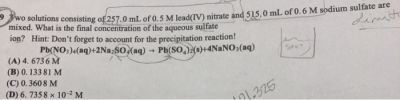 9 wo solutions consisting of 257.0 mL of 0. 5 M lead(IV) nitrate and 515,0 mL of 0.6 M sodium sulfate are mixed. What is the final concentration of the aqueous sulfate ion? Hint: Don't forget to account for the precipitation reaction! Pb(NOs)4(aq)+2Na2SO,(aq) Ph(SO)(0)+4NANO;(aq) dimt (A) 4.6736 M Sou (B) 0. 133 81 M (C) 0.3608 M (D) 6. 7358 x 10-2 M l325
1.Solid sodium sulfide is slowly added to 125 mL of a 0.0450 M silver nitrate solution....
1.Solid sodium sulfide is slowly added to 125 mL of a 0.0450 M silver nitrate solution. The concentration of sulfide ion required to just initiate precipitation is M. 2.Solid barium acetate is slowly added to 50.0 mL of a 0.0522 M ammonium sulfite solution. The concentration of barium ion required to just initiate precipitation is M. 3.Solid potassium hydroxide is slowly added to 150 mL of a 0.0329 M iron(III) nitrate solution. The concentration of hydroxide ion required to just initiate precipitation...
A 165.0 mL solution of 2.777 M strontium nitrate is mixed with 210.0 mL of a...
 A 165.0 mL solution of 2.777 M strontium nitrate is mixed with 210.0 mL of a 3.278 M sodium fluoride solution. Calculate the mass of the resulting strontium fluoride precipitate Number Assuming complete precipitation, calculate the final concentration of each ion. If the ion is no longer in solution, enter a zero for the concentration. Number Number 2+ Na Number Number
A sample of 1.45 g of lead (II) nitrate is mixed with 129 mL of 0.100M...
A sample of 1.45 g of lead (II) nitrate is mixed with 129 mL of 0.100M sodium sulfate solution. Part A: What is the concentration of SO42- ion that remains in solution after the reaction is complete? Part B: What is the concentration of Na+ ion that remains in solution after the reaction is complete? Part C: What is the concentration of NO3- ion that remains in solution after the reaction is complete?
A 185.0 mL solution of 2.714 M strontium nitrate is mixed with 215.0 mL of a...
A 185.0 mL solution of 2.714 M strontium nitrate is mixed with 215.0 mL of a 3.460 M sodium fluoride solution. Calculate the mass of the resulting strontium fluoride precipitate. mass: g Assuming complete precipitation, calculate the final concentration of each ion. If the ion is no longer in solution, enter a 0 for the concentration. [Na+]= M [NO−3]= M [Sr2+]= M [F−]= M
A 150.0 mL solution of 3.241 M strontium nitrate is mixed with 205.0 mL of a...
A 150.0 mL solution of 3.241 M strontium nitrate is mixed with 205.0 mL of a 3.569 M sodium fluoride solution. Calculate the mass of the resulting strontium fluoride precipitate. mass: g Assuming complete precipitation, calculate the final concentration of each ion. If the ion is no longer in solution, enter a 0 for the concentration. [Na+]= M [NO−3]= M [Sr2+]= M [F−]=
a) What is the resulting nitrate ion concentration of the diluted solution if 24.00 mL of...
a) What is the resulting nitrate ion concentration of the diluted solution if 24.00 mL of a 0.514 M sodium nitrate solution is diluted to a total volume of 350.00 mL? Note that this problem is asking for the concentration of the ion (after the salt dissolves) and not the concentration of the salt. Enter units. b) What is the resulting ammonium ion concentration of the diluted solution if 50.00 mL of a 0.572 M ammonium carbonate solution is diluted...
100.0 mL of 0.100 M sodium sulfide is mixed with 100.0 mL of 0.100 M chromium...
100.0 mL of 0.100 M sodium sulfide is mixed with 100.0 mL of 0.100 M chromium (III) nitrate. Calculate the mass of solid that forms and the concentration of the remaining species in solution: assume complete precipitation.
 9 wo solutions consisting of 257.0 mL of 0. 5 M lead(IV) nitrate and 515,0 mL of 0.6 M sodium sulfate are mixed. What is the final concentration of the aqueous sulfate ion? Hint: Don't forget to account for the precipitation reaction! Pb(NOs)4(aq)+2Na2SO,(aq) Ph(SO)(0)+4NANO;(aq) dimt (A) 4.6736 M Sou (B) 0. 133 81 M (C) 0.3608 M (D) 6. 7358 x 10-2 M l325
 A 165.0 mL solution of 2.777 M strontium nitrate is mixed with 210.0 mL of a 3.278 M sodium fluoride solution. Calculate the mass of the resulting strontium fluoride precipitate Number Assuming complete precipitation, calculate the final concentration of each ion. If the ion is no longer in solution, enter a zero for the concentration. Number Number 2+ Na Number Number
Most questions answered within 3 hours.
-
Where is the error in this code sequence?
String s1 = "Hello";
String s2 = "ello";...
asked 11 months ago -
Financial data for Joel de Paris, Inc., for last year
follow:
Joel de Paris, Inc.
Balance...
asked 11 months ago -
Consider this reaction:
Al2(SO4)3 (aq)+ BaCl3
(aq) Al2Cl6 (aq)- +
3BaSO4(s) . What is the...
asked 11 months ago -
Suppose that Savneet is considering increasing her
recent random sample from 20 car rentals to 40...
asked 11 months ago -
Trucks arrive at an unloading terminal at an average rate of 120
per hour.
Trucks arrive...
asked 11 months ago -
Why are methanol and ethanol completely soluble in water while
octanol is not very little soluble....
asked 11 months ago -
A facilities manager at a university reads in a research report
that the mean amount of...
asked 11 months ago -
When the CuSO4 is rehydrated by adding water to the anhydrous
compound, is this an endothermic...
asked 11 months ago -
A ray of sunlight is passing from diamond into crown glass; the
angle of incidence is...
asked 11 months ago -
A block of mass 0.249 kg is placed on top of a light, vertical
spring of...
asked 11 months ago -
how do the kidneys compensate in the presences of acidosis
a) trigger hyperventilate
b) reserve acid...
asked 11 months ago -
Question 501 pts
The rental rate of capital to the firm increases. Which of the
following...
asked 11 months ago