Problem 2: Contrast the regulation of glycogen phosphorylase by allosteric and covalent modification mechanisms.
Problem 2:
Contrast the regulation of glycogen phosphorylase by allosteric and covalent modification mechanisms.
Homework Answers

- The T state is less active because the active site is partially blocked. When R state is active
Regulation by allosterically
- the position of equilibrium of phosphorylase b between the T and R state is responsive to conditions in the cell.
- In high concentration of AMP, AMP binds to the binding site and stabilize the phosphorylase b in the R state.
- ATP aacts as negative allosteric effector competing with AMP to form T state. Thus the transition of phosphorylase b in T and R state is controlled by energy charge in muscle cells

Add Answer to:
Problem 2:
Contrast the regulation of glycogen phosphorylase by allosteric
and covalent modification mechanisms.
Which is not involved in the regulation of glycogen phosphorylase? A) Allosteric inhibition of phosphorylase by...
Which is not involved in the regulation of glycogen phosphorylase? A) Allosteric inhibition of phosphorylase by ATP B) Indirect, positive regulation by glucagon C) Phosphorylation of phosphorylase by protein kinase A (PKA) D) Direct and indirect regulation by protein phosphatase 1 (PP1) E) Indirect, negative regulation by protein phosphatase 2B (PP2B)
Explain two mechanisms of proteins regulation. Include one mechanism that uses covalent modification (include enzymes that...
Explain two mechanisms of proteins regulation. Include one mechanism that uses covalent modification (include enzymes that modify in your explanation) and one mechanism of allosteric regulation. Give specific examples of each.
Q5. The phosphorylase enzyme, which is involved in breakdown of glycogen to glucose, is controlled by...
 Q5. The phosphorylase enzyme, which is involved in breakdown of glycogen to glucose, is controlled by both allosteric mechanisms and posttranslational modification. A) Describe how the T to R transition and activity of glycogen phosphorylase would change under the following conditions: i) high AMP levels and activation of phosphoprotein phosphatase, ii) activation of phosphorylase kinase, ili) activation of phosphorylase kinase and high glucose levels. B) What properties would an uncompetitive inhibitor of glycogen phosphorylase have, what would the Lineweaver Burk...
What differences are there between covalent and allosteric modification?
What differences are there between covalent and allosteric modification?
I had this partially wrong too The muscle and liver forms of glycogen phosphorylase respond to...
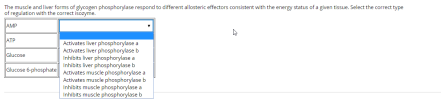 I had this partially wrong too
The muscle and liver forms of glycogen phosphorylase respond to different allosteric effectors consistent with the energy status of a given tissue. Select the correct type of regulation with the correct isozyme. AMP ATP Activates liver phosphorylase a Activates liver phosphorylase b Glucose Inhibits liver phosphorylase a Inhibits liver phosphorylase b Glucose 6-phosphate Activates muscle phosphorylase a Activates muscle phosphorylase b Inhibits muscle phosphorylase a | Inhibits muscle phosphorylase b
I had this partially wrong too
The muscle and liver forms of glycogen phosphorylase respond to different allosteric effectors consistent with the energy status of a given tissue. Select the correct type of regulation with the correct isozyme. AMP ATP Activates liver phosphorylase a Activates liver phosphorylase b Glucose Inhibits liver phosphorylase a Inhibits liver phosphorylase b Glucose 6-phosphate Activates muscle phosphorylase a Activates muscle phosphorylase b Inhibits muscle phosphorylase a | Inhibits muscle phosphorylase b
Describe how the opposing processes of glycogen breakdown and synthesis are reciprocally regulated by allosteric interactions...
Describe how the opposing processes of glycogen breakdown and synthesis are reciprocally regulated by allosteric interactions and the covalent modification of key enzymes.
Regulation of the rate of an enzyme-mediated metabolic pathway can be affected by _________________. A. covalent...
Regulation of the rate of an enzyme-mediated metabolic pathway can be affected by _________________. A. covalent modification of the enzyme B. allosteric modification of the enzyme C. concentration of the substrate D. A and B are correct E. A, B, and C are correct
The metabolism of fatty acids is regulated in the short term by allosteric modulators, covalent modification...
The metabolism of fatty acids is regulated in the short term by allosteric modulators, covalent modification and _________. Group of answer choices: A) Fluctuating nutrient availability B) Energy demands C) Changes in gene expression D) Hormones E) A, B and C are all correct
Regulation a) Please list two types of reversible covalent modification of proteins used for regulation b)...
 Regulation a) Please list two types of reversible covalent modification of proteins used for regulation b) How is chymotrypsin activated in the digestive system? c) Why is phosphorylation an effective means of regulating protein activity? d) What is the cascade for zymogen activation in the digestive system? e) What posttranslational modification does prothrombin undergo before it is converted to thrombin 1) What is the function of vitamin K?
A pharmaceutical research group is studying the allosteric regulation mechanisms for an enzyme involved in kidney...
A pharmaceutical research group is studying the allosteric regulation mechanisms for an enzyme involved in kidney cancer. They perform a number of different assays and make the following observations. Using these observations, determine whether the model is most consistent with a. induced-fit/sequential b. MWC/symmetry c. both models Observations: -the enzyme's allostertic activator binds to an allosteric site located 1.5 nanometers away from the active site. -when the allosteric activator binds to the allosteric site, NMR signals indicate that a significiant...
 Q5. The phosphorylase enzyme, which is involved in breakdown of glycogen to glucose, is controlled by both allosteric mechanisms and posttranslational modification. A) Describe how the T to R transition and activity of glycogen phosphorylase would change under the following conditions: i) high AMP levels and activation of phosphoprotein phosphatase, ii) activation of phosphorylase kinase, ili) activation of phosphorylase kinase and high glucose levels. B) What properties would an uncompetitive inhibitor of glycogen phosphorylase have, what would the Lineweaver Burk...
 I had this partially wrong too
The muscle and liver forms of glycogen phosphorylase respond to different allosteric effectors consistent with the energy status of a given tissue. Select the correct type of regulation with the correct isozyme. AMP ATP Activates liver phosphorylase a Activates liver phosphorylase b Glucose Inhibits liver phosphorylase a Inhibits liver phosphorylase b Glucose 6-phosphate Activates muscle phosphorylase a Activates muscle phosphorylase b Inhibits muscle phosphorylase a | Inhibits muscle phosphorylase b
I had this partially wrong too
The muscle and liver forms of glycogen phosphorylase respond to different allosteric effectors consistent with the energy status of a given tissue. Select the correct type of regulation with the correct isozyme. AMP ATP Activates liver phosphorylase a Activates liver phosphorylase b Glucose Inhibits liver phosphorylase a Inhibits liver phosphorylase b Glucose 6-phosphate Activates muscle phosphorylase a Activates muscle phosphorylase b Inhibits muscle phosphorylase a | Inhibits muscle phosphorylase b
 Regulation a) Please list two types of reversible covalent modification of proteins used for regulation b) How is chymotrypsin activated in the digestive system? c) Why is phosphorylation an effective means of regulating protein activity? d) What is the cascade for zymogen activation in the digestive system? e) What posttranslational modification does prothrombin undergo before it is converted to thrombin 1) What is the function of vitamin K?
Most questions answered within 3 hours.
-
Where is the error in this code sequence?
String s1 = "Hello";
String s2 = "ello";...
asked 10 months ago -
Financial data for Joel de Paris, Inc., for last year
follow:
Joel de Paris, Inc.
Balance...
asked 10 months ago -
Consider this reaction:
Al2(SO4)3 (aq)+ BaCl3
(aq) Al2Cl6 (aq)- +
3BaSO4(s) . What is the...
asked 10 months ago -
Suppose that Savneet is considering increasing her
recent random sample from 20 car rentals to 40...
asked 10 months ago -
Trucks arrive at an unloading terminal at an average rate of 120
per hour.
Trucks arrive...
asked 10 months ago -
Why are methanol and ethanol completely soluble in water while
octanol is not very little soluble....
asked 10 months ago -
A facilities manager at a university reads in a research report
that the mean amount of...
asked 10 months ago -
When the CuSO4 is rehydrated by adding water to the anhydrous
compound, is this an endothermic...
asked 10 months ago -
A ray of sunlight is passing from diamond into crown glass; the
angle of incidence is...
asked 10 months ago -
A block of mass 0.249 kg is placed on top of a light, vertical
spring of...
asked 10 months ago -
how do the kidneys compensate in the presences of acidosis
a) trigger hyperventilate
b) reserve acid...
asked 10 months ago -
Question 501 pts
The rental rate of capital to the firm increases. Which of the
following...
asked 10 months ago