Regulation of the rate of an enzyme-mediated metabolic pathway can be affected by _________________. A. covalent...
Regulation of the rate of an enzyme-mediated metabolic pathway can be affected by _________________.
A. covalent modification of the enzyme
B. allosteric modification of the enzyme
C. concentration of the substrate
D. A and B are correct
E. A, B, and C are correct
Homework Answers
Answer - E. A, B, and C are correct
Covalent modification are of enzyme-catalyse alternation of protein includes add or removal of chemical group. So, it changes the chemical properties of the site.
Allosteric enzymes are generally multi-subunit enzymes. Binding of a ligand modulator to one subunit results in a conformational change in other subunit. So any modification in allosteric area leads to affect the enzyme rate.
Add Answer to:
Regulation of the rate of an enzyme-mediated metabolic pathway
can be affected by _________________.
A. covalent...
Consider the second enzyme in a metabolic pathway with three enzymes working in series. If the...
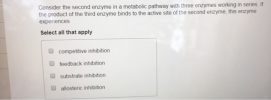 Consider the second enzyme in a metabolic pathway with three enzymes working in series. If the product of the third enzyme binds to the active site of the second enzyme, this enzyme experiences Select all that apply competitive inhibition feedback inhibition substrate inhibition allosteric inhibition
Which of the following is the most common method of regulation for a regulatory enzyme in...
Which of the following is the most common method of regulation for a regulatory enzyme in a metabolic pathway? Select one: a. Phosphorylation b. It is the first enzyme in the series c. It is an allosteric enzyme d. A product from the end of a pathway inhibits the enzyme, which operates higher up in the pathway.
6 Cells also regulate enzyme function using dhac inhibition in this type of regulation, metabolic pathway...
 6 Cells also regulate enzyme function using dhac inhibition in this type of regulation, metabolic pathway etabolic pathway will inhibit the function of an eneme in an early phase of the metabolic path produces it. lon. In this type of regulation, the end product of a early phase of the metabolic pathway that What is the advantage of using feedback inhibition to regulate enzymes for cells? b. Cellular respiration is the process of generating ATP by breaking down sugar completely...
The rate-limiting enzyme of the pyrimidine nucleotide synthesis pathway is controlled by many different allosteric regulator...
The rate-limiting enzyme of the pyrimidine nucleotide synthesis pathway is controlled by many different allosteric regulator molecules. Which is involved in this regulation? Select one: a. UTP b. ATP c. CTP d. All of these e. None of these
ICE Chapter 7 .) Match each Catalytic Mechanism or Enzyme Mediated Reaction to its description: a....
 ICE Chapter 7 .) Match each Catalytic Mechanism or Enzyme Mediated Reaction to its description: a. Act as molecular switches by turning on/off cell signaling and gene expression Acid-Base Catalysis b. Isomerizations, condensations, and Covalent Catalysis dehydrations (hydrolysis) c Nucleophile group on the enzyme attacks an electrophile substrate, forming an enzyme- Metal lon Catalysis substrate intermediate d. Proton transfer involving water or a functional group Coenzyme Dependent Redox Reactions e. Include dehyd rogenases. Involves NAD /NADH, NADP*/NAD PH, FAD/FADH2, FMN/FMNH2...
Which of the following statements are true about competitive enzyme inhibitors? a)They cause irreversible covalent modification...
Which of the following statements are true about competitive enzyme inhibitors? a)They cause irreversible covalent modification of the target enzyme. b)They lead to a decrease in apparent Km. c)All of these d)They have significant affinity for the enzyme-substrate complex. e)Their effect on reaction rate can be overcome at high substrate concentrations. f)They lead to a decrease in apparent Vmax. g)None of these
Please answer all of those questions 7. Which of the followings is correct about the mechanisms of enzymatic reactions? General acid-base mechanism b. Metal elements mediated mechanism a. Covalent bo...
 Please answer all of those questions
7. Which of the followings is correct about the mechanisms of enzymatic reactions? General acid-base mechanism b. Metal elements mediated mechanism a. Covalent bonding mediated mechanism d. All above c. e. None a bove Which of the followings is correct about the meaning of the constant (Km) of Michaelis-Menten equation of enzyme catalyzed reactions? a. The constant and Michaelis-Menten equation is applicable only to the stage of reaction immediately after mixing of substrate(s) with...
Please answer all of those questions
7. Which of the followings is correct about the mechanisms of enzymatic reactions? General acid-base mechanism b. Metal elements mediated mechanism a. Covalent bonding mediated mechanism d. All above c. e. None a bove Which of the followings is correct about the meaning of the constant (Km) of Michaelis-Menten equation of enzyme catalyzed reactions? a. The constant and Michaelis-Menten equation is applicable only to the stage of reaction immediately after mixing of substrate(s) with...
The statements below describe a metabolism pathway and its regulation. 1. Substrate A can form B...
 The statements below describe a metabolism pathway and its regulation. 1. Substrate A can form B 2. Substrate B can form either C or D. 3. Substrate C can form either F or G 4. Substrate D can form E. 5. Substrate E can form G. 6. Substrate F can form J 7. Substrate G can form H. 8. Substrate H can form K. 9. Product K inhibits the reaction of G to form H. 10. Product G inhibits the...
Chapter 8. Enzyme Regulation and Inhibition 1. Competitive inhibitors are always of which type? a) allosteric...
 Chapter 8. Enzyme Regulation and Inhibition 1. Competitive inhibitors are always of which type? a) allosteric b) irreversible c) reversible d) suicide 2. DIFP is: a) a competitive inhibitor b) an allosteric inhibitor c) a noncompetitive inhibitor d) a suicide inhibitor 3. Competitive inhibitors: a) bind to the active site b) bind to the enzyme-substrate complex c) bind outside the active site and decrease substrate binding d) bind outside the active site and decrease rate of catalysis.
high and detecting one product at a time Question 77 The initial velocity of an enzyme...
 high and detecting one product at a time Question 77 The initial velocity of an enzyme reaction (vo) describes A) The concentration of the enzyme at maximal velocity B) The concentration of substrate at maximal velocity C) The concentration of both at the start of the reaction D) The rate of the reaction when the substrate and enzyme are first med Question 78 What is the shape of a typical plot of initial rate vs substrate concentration tres kinetics? A)...
 Consider the second enzyme in a metabolic pathway with three enzymes working in series. If the product of the third enzyme binds to the active site of the second enzyme, this enzyme experiences Select all that apply competitive inhibition feedback inhibition substrate inhibition allosteric inhibition
 6 Cells also regulate enzyme function using dhac inhibition in this type of regulation, metabolic pathway etabolic pathway will inhibit the function of an eneme in an early phase of the metabolic path produces it. lon. In this type of regulation, the end product of a early phase of the metabolic pathway that What is the advantage of using feedback inhibition to regulate enzymes for cells? b. Cellular respiration is the process of generating ATP by breaking down sugar completely...
 ICE Chapter 7 .) Match each Catalytic Mechanism or Enzyme Mediated Reaction to its description: a. Act as molecular switches by turning on/off cell signaling and gene expression Acid-Base Catalysis b. Isomerizations, condensations, and Covalent Catalysis dehydrations (hydrolysis) c Nucleophile group on the enzyme attacks an electrophile substrate, forming an enzyme- Metal lon Catalysis substrate intermediate d. Proton transfer involving water or a functional group Coenzyme Dependent Redox Reactions e. Include dehyd rogenases. Involves NAD /NADH, NADP*/NAD PH, FAD/FADH2, FMN/FMNH2...
 Please answer all of those questions
7. Which of the followings is correct about the mechanisms of enzymatic reactions? General acid-base mechanism b. Metal elements mediated mechanism a. Covalent bonding mediated mechanism d. All above c. e. None a bove Which of the followings is correct about the meaning of the constant (Km) of Michaelis-Menten equation of enzyme catalyzed reactions? a. The constant and Michaelis-Menten equation is applicable only to the stage of reaction immediately after mixing of substrate(s) with...
Please answer all of those questions
7. Which of the followings is correct about the mechanisms of enzymatic reactions? General acid-base mechanism b. Metal elements mediated mechanism a. Covalent bonding mediated mechanism d. All above c. e. None a bove Which of the followings is correct about the meaning of the constant (Km) of Michaelis-Menten equation of enzyme catalyzed reactions? a. The constant and Michaelis-Menten equation is applicable only to the stage of reaction immediately after mixing of substrate(s) with...
 The statements below describe a metabolism pathway and its regulation. 1. Substrate A can form B 2. Substrate B can form either C or D. 3. Substrate C can form either F or G 4. Substrate D can form E. 5. Substrate E can form G. 6. Substrate F can form J 7. Substrate G can form H. 8. Substrate H can form K. 9. Product K inhibits the reaction of G to form H. 10. Product G inhibits the...
 Chapter 8. Enzyme Regulation and Inhibition 1. Competitive inhibitors are always of which type? a) allosteric b) irreversible c) reversible d) suicide 2. DIFP is: a) a competitive inhibitor b) an allosteric inhibitor c) a noncompetitive inhibitor d) a suicide inhibitor 3. Competitive inhibitors: a) bind to the active site b) bind to the enzyme-substrate complex c) bind outside the active site and decrease substrate binding d) bind outside the active site and decrease rate of catalysis.
 high and detecting one product at a time Question 77 The initial velocity of an enzyme reaction (vo) describes A) The concentration of the enzyme at maximal velocity B) The concentration of substrate at maximal velocity C) The concentration of both at the start of the reaction D) The rate of the reaction when the substrate and enzyme are first med Question 78 What is the shape of a typical plot of initial rate vs substrate concentration tres kinetics? A)...
Most questions answered within 3 hours.
-
Where is the error in this code sequence?
String s1 = "Hello";
String s2 = "ello";...
asked 11 months ago -
Financial data for Joel de Paris, Inc., for last year
follow:
Joel de Paris, Inc.
Balance...
asked 11 months ago -
Consider this reaction:
Al2(SO4)3 (aq)+ BaCl3
(aq) Al2Cl6 (aq)- +
3BaSO4(s) . What is the...
asked 11 months ago -
Suppose that Savneet is considering increasing her
recent random sample from 20 car rentals to 40...
asked 11 months ago -
Trucks arrive at an unloading terminal at an average rate of 120
per hour.
Trucks arrive...
asked 11 months ago -
Why are methanol and ethanol completely soluble in water while
octanol is not very little soluble....
asked 11 months ago -
A facilities manager at a university reads in a research report
that the mean amount of...
asked 11 months ago -
When the CuSO4 is rehydrated by adding water to the anhydrous
compound, is this an endothermic...
asked 11 months ago -
A ray of sunlight is passing from diamond into crown glass; the
angle of incidence is...
asked 11 months ago -
A block of mass 0.249 kg is placed on top of a light, vertical
spring of...
asked 11 months ago -
how do the kidneys compensate in the presences of acidosis
a) trigger hyperventilate
b) reserve acid...
asked 11 months ago -
Question 501 pts
The rental rate of capital to the firm increases. Which of the
following...
asked 11 months ago