Describe, with the aid of diagrams, the mechanisms of action (65%), pharmacokinetics and side effects of...
Describe, with the aid of diagrams, the mechanisms of action (65%), pharmacokinetics and side effects of β-lactam drugs, giving a drug example. (Pharmacology)
Homework Answers
Answer : 1) Beta lactam group contains vast number of individual antibiotics having a common beta lactam ring in their structure . Penicillin is the most historically famous member of this group.Beta lactam antibiotics are bactericidal and act by binding with penicillin binding protein.This binding prevents synthesis of peptidoglycan, an essential component of bacterial cell wall. Absence of peptidoglycan make bacteria susceptible for lysis thus killing the bacteria .
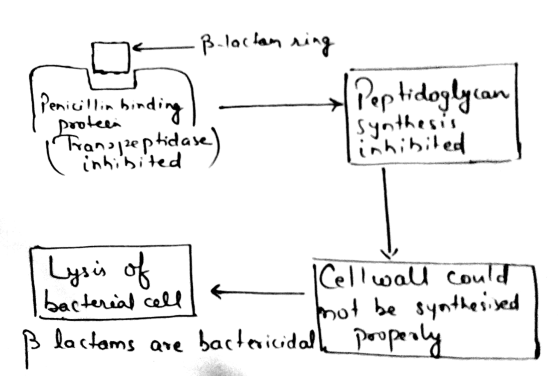
2) Pharmacokinetics of penicillin - Different penicillins have different bioavailabilty. Penicillin G has bioavailabilty of less than 30 %. They have low protein binding capacity. Penicillin G has about 65%protein binding . Peak plasma time is 0.5 - 1 hour.They are mostly metabolised in liver and excreted in urine.
3) Adverse effects of penicillin -
*Diarrhoea
*Nausea and vomiting
*Hypersensitivity reaction ranging from mild to life threatening anaphylaxis
*Interstitial nephritis
* Jarisch Herxheimer reaction - Fever , shivering myalgia which may progress to shock, seen in syphilis patients treated with penicillin
* Can precipitate seizure
* Haemolytic anemia.
Add Answer to:
Describe, with the aid of diagrams, the mechanisms of action
(65%), pharmacokinetics and side effects of...
With the aid of diagrams, describe the mechanisms that the cell uses to control intracellular calcium...
With the aid of diagrams, describe the mechanisms that the cell uses to control intracellular calcium levels. Name two drugs that affect these processes, indicating their mechanism of action and effect on calcium levels. Pharmacology
pharmacology is the study of drugs, their action, dosage, therapeutic uses, and their side effects. drugs...
pharmacology is the study of drugs, their action, dosage, therapeutic uses, and their side effects. drugs for therapy and directly linked to the pathophysiology of a particular disease. because of the importance, and many uses of pharmacology in patient care, it is important to recognize the diffrence between expected manifestations of a disease and tge expected effects of drug therapy. research credible published medical literature regarding a clinically indicated drug your choice. discuss your findings.
Write an essay on histamine as an inflammatory mediator (65%), and outline the mechanism of action...
Write an essay on histamine as an inflammatory mediator (65%), and outline the mechanism of action and uses of drugs that affect histaminergic inflammatory signalling (35%). Give specific drug examples in your answer. (Pharmacology)
(2A4 pages) With the aid of diagrams, describe how the body’s adaptive immune system responds to...
(2A4 pages) With the aid of diagrams, describe how the body’s adaptive immune system responds to an infection. (Pharmacology)
Describe the rational drug choice, pharmacokinetics/dynamics, interactions, side effects, monitoring, and patient education for one of...
Describe the rational drug choice, pharmacokinetics/dynamics, interactions, side effects, monitoring, and patient education for one of the following: Eczema Psoriasis Allergic dermatitis Fungal infection (feet, groin, vagina, ringworm) Include lifespan information (for instance, does treatment differ in a child versus an older adult versus a man versus a female). Include a description of the categories of topical steroids with selection rationale to include cream versus lotion, and so on. You can include tables in addition to narrative. Integrate two evidence-based...
antibacterial drugs and describe their target and their mechanisms of action.
antibacterial drugs and describe their target and their mechanisms of action.
Discuss the pharmacokinetics of children 1 year old or older. Discuss reasons pediatric patients are subject...
Discuss the pharmacokinetics of children 1 year old or older. Discuss reasons pediatric patients are subject to adverse drug reactions when drug levels rise too high. Discuss dosage determination, noting that pediatric doses have been established for some drugs but not for others and, therefore, for drugs that do not have established pediatric doses, the doses can be extrapolated from adult doses. Discuss the appropriate steps in determining exposure to teratogens. Discuss drug therapy during breast-feeding and the potential risks...
18. Explain the basic differences, in terms of sites and mechanisms of action, among centrally acting...
 18. Explain the basic differences, in terms of sites and mechanisms of action, among centrally acting muscle relaxants, baclofen, diazepam, and dantrolene. State how these different mechanisms and site of action relate to the drugs' clinical uses. 19. Mr. Urlacher has been diagnosed as having MS. As part of his treatment, he is given baclofen (Lioresal) for muscle spasticity. He is your assigned patient fir the morning. Your clinical instructor has informed you that Mr. Urlacher has many questions about...
Discuss the consequences of drug–drug interactions, the basic mechanisms of drug–drug interactions, and the critical steps...
Discuss the consequences of drug–drug interactions, the basic mechanisms of drug–drug interactions, and the critical steps in minimizing adverse drug–drug interactions. Focus on the liver as an example of a drug-metabolizing system and explain why it is such a crucial organ in many drug–drug interactions. Discuss the effect of food on drug absorption, on drug metabolism (e.g., grapefruit juice), and on drug toxicity and action, as well as the timing of drug administration with respect to meals. Give examples of...
(2 A4 pages) Describe, with the aid of diagrams, the process of RNA transcription, including the...
(2 A4 pages) Describe, with the aid of diagrams, the process of RNA transcription, including the enzyme(s) involved (90%) and give two examples of drugs/toxins that affect the process (10%).
 18. Explain the basic differences, in terms of sites and mechanisms of action, among centrally acting muscle relaxants, baclofen, diazepam, and dantrolene. State how these different mechanisms and site of action relate to the drugs' clinical uses. 19. Mr. Urlacher has been diagnosed as having MS. As part of his treatment, he is given baclofen (Lioresal) for muscle spasticity. He is your assigned patient fir the morning. Your clinical instructor has informed you that Mr. Urlacher has many questions about...
Most questions answered within 3 hours.
-
Where is the error in this code sequence?
String s1 = "Hello";
String s2 = "ello";...
asked 11 months ago -
Financial data for Joel de Paris, Inc., for last year
follow:
Joel de Paris, Inc.
Balance...
asked 11 months ago -
Consider this reaction:
Al2(SO4)3 (aq)+ BaCl3
(aq) Al2Cl6 (aq)- +
3BaSO4(s) . What is the...
asked 11 months ago -
Suppose that Savneet is considering increasing her
recent random sample from 20 car rentals to 40...
asked 11 months ago -
Trucks arrive at an unloading terminal at an average rate of 120
per hour.
Trucks arrive...
asked 11 months ago -
Why are methanol and ethanol completely soluble in water while
octanol is not very little soluble....
asked 11 months ago -
A facilities manager at a university reads in a research report
that the mean amount of...
asked 11 months ago -
When the CuSO4 is rehydrated by adding water to the anhydrous
compound, is this an endothermic...
asked 11 months ago -
A ray of sunlight is passing from diamond into crown glass; the
angle of incidence is...
asked 11 months ago -
A block of mass 0.249 kg is placed on top of a light, vertical
spring of...
asked 11 months ago -
how do the kidneys compensate in the presences of acidosis
a) trigger hyperventilate
b) reserve acid...
asked 11 months ago -
Question 501 pts
The rental rate of capital to the firm increases. Which of the
following...
asked 11 months ago