1) What’s the purpose of an electric field and how is its value dependent on the...
1) What’s the purpose of an electric field and how is its value dependent on the amount of charge and distance between the charge and point in space?
Homework Answers
1.electric field is a region around the charge particle in which its influence felt. With in that region only it exerts force on the other charge . outside it won't exert force . magnitude of influence is different for different points in nonuniform field . that magnitude of influence is given by intensity of electric field .
(Definition) intensity of electric field at point in electric field is defined as force acting on unit positive test charge placed at that point
Electric field is different for different points . on a 'q' charge if 'F' force is acting at a point in field then electric field at that point is

Electric field due to point charge is nonuniform. Electric field due to charge 'q' at a distance 'r' from it is

2 . electric field present around the charge either positive or negative charge .it is a vector . electric fied measured in newtons per coulomb .
Electric potential at point in a field is defined as work done in moving a a unit positive test charge for infinity to that point
It is scalar . if 'w' is done in bringing a charge 'q' from infinity to a point then potential at that point is defined as

Voltage is S.I unit of potential
3. Electric field lines do not pass in side the conductor . because conductors contains free changes .end at surface and perpendicular to the surface .
Insulator contains bounded charge in atoms . however a insulator
can have electric field inside it 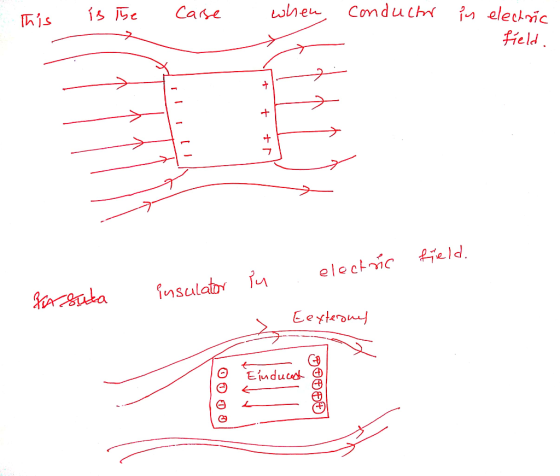
Add Answer to:
1) What’s the purpose of an electric field and how is its value
dependent on the...
1. A particle with a charge of +4.20 nC is in a uniform electric field E⃗ directed...
1. A particle with a charge of +4.20 nC is in a uniform electric field E⃗ directed to the negative x direction. It is released from rest, and after it has moved 6.00 cm , its kinetic energy is found to be 1.50×10⁻⁶ J . a. What work was done by the electric force? b. What was the change in electric potential over the distance that the charge moved? c. What is the magnitude of E? d. What was the change...
Question 15 Dielectric breakdown, also known as lightening, occurs in air when the electric field exceeds...
Question 15 Dielectric breakdown, also known as lightening, occurs in air when the electric field exceeds 3 x 10⁶ V/m. An automobile spark plug consists of two metal conductors separated by a distance of 0.72 mm. What is the minimum potential difference between these conductors that is needed for dielectric breakdown (a spark) in the spark plug, expressed in volts? . Question 16. A charge moves a distance of 1.5 m at an angle of 100° with respect to a...
1- For a uniform electric field, how is the electric potential energy similar to the gravitational...
1- For a uniform electric field, how is the electric potential energy similar to the gravitational potential energy in a uniform gravitational? 2-If a positive charge and a negative charge moving the same way in an electric field have the same change in electric potential energy? 3-For a positive charge moving in an electric field, which direction of motion will cause the electric potential energy to increase? Decrease? Stay constant? 4-How would the answers to the previous question be different...
3.1 Pre-lab In the lab on electric potential and electric field lines, you noted that charged...
 3.1 Pre-lab In the lab on electric potential and electric field lines, you noted that charged par- ticles produce electric fields and these electric fields, in turn, act on charged par- ticles. However, you then proceeded to produce an electric field geometry using conductors held at a particular electric potential. What happened to the electric charges? Electric charge and electric potential are closely related to each other. Putting charge on a conductor raises its electric potential. It is usually much...
1. Describe a uniform electric field. 2. Explain a practical method to create a uniform electric...
 1. Describe a uniform electric field. 2. Explain a practical method to create a uniform electric field. 3. In the electrode configuration of Figure 3-a, notice that the equipotential lines are circles which are closer to each other near the point terminal. Explain. (Hint: refer to the relation of the electric field around a point charge, and the relation where DV is the difference in potential between any two points, and r is the distance between them.) 4. In principle,...
Electric Potential Difference Homework Electric Potential Difference 1) Pages 85-87 in the homework tutorial do the...
 Electric Potential Difference
Homework Electric Potential Difference 1) Pages 85-87 in the homework tutorial do the problems 1 &2, skip problem 3 2) In the figure is an electric dipole, with-5 V applied to the negative conductor, shown on the left-side and + 5 V applied to the positive conductor, shown on the right-side. With the voltage applied between the conductors the resulting equipotential lines are mapped out a) Accurately draw the electric field lines between the two conductors 1.0...
Electric Potential Difference
Homework Electric Potential Difference 1) Pages 85-87 in the homework tutorial do the problems 1 &2, skip problem 3 2) In the figure is an electric dipole, with-5 V applied to the negative conductor, shown on the left-side and + 5 V applied to the positive conductor, shown on the right-side. With the voltage applied between the conductors the resulting equipotential lines are mapped out a) Accurately draw the electric field lines between the two conductors 1.0...
Electric Fields Problem Statement A 5.0-uC point charge is placed at the 0.00 cm mark of...
 Electric Fields Problem Statement A 5.0-uC point charge is placed at the 0.00 cm mark of a meter stick and a -4.0-uC point charge is placed at the 50 cm mark. At what point on a line joining the two charges is the electric field due to these charges equal to zero? Visual Representation • Draw a sketch of the charge distribution. • Establish a coordinate system and show the locations of the charges. • Identify the point P at...
Electric Fields Problem Statement A 5.0-4C point charge is placed at the 0.00 cm mark of...
 Electric Fields Problem Statement A 5.0-4C point charge is placed at the 0.00 cm mark of a meter stick and a 4.0-point charge is placed at the 50 cm mark. At what point on a line joining the two charges is the electric field due to these charges equal to zero? . Visual Representation . Draw a sketch of the charge distribution Establish a coordinate system and show the locations of the charges. Identify the point P at which you...
Electric Fields Problem Statement A 5.0-LC point charge is placed at the 0.00 cm mark of...
 Electric Fields Problem Statement A 5.0-LC point charge is placed at the 0.00 cm mark of a meter stick and a -4.0-LC point charge is placed at the 50 cm mark. At what point on a line joining the two charges is the electric field due to these charges equal to zero? Visual Representation • Draw a sketch of the charge distribution. • Establish a coordinate system and show the locations of the charges. • Identify the point at which...
The Electric Potential of the Earth The Earth has a vertical electric field with a magnitude...
The Electric Potential of the Earth The Earth has a vertical electric field with a magnitude of approximately 100 V/mV/m near its surface. What is the magnitude of the potential difference between a point on the ground and a point on the same level as the top of the Washington Monument (555 ft high)?
 3.1 Pre-lab In the lab on electric potential and electric field lines, you noted that charged par- ticles produce electric fields and these electric fields, in turn, act on charged par- ticles. However, you then proceeded to produce an electric field geometry using conductors held at a particular electric potential. What happened to the electric charges? Electric charge and electric potential are closely related to each other. Putting charge on a conductor raises its electric potential. It is usually much...
 1. Describe a uniform electric field. 2. Explain a practical method to create a uniform electric field. 3. In the electrode configuration of Figure 3-a, notice that the equipotential lines are circles which are closer to each other near the point terminal. Explain. (Hint: refer to the relation of the electric field around a point charge, and the relation where DV is the difference in potential between any two points, and r is the distance between them.) 4. In principle,...
 Electric Potential Difference
Homework Electric Potential Difference 1) Pages 85-87 in the homework tutorial do the problems 1 &2, skip problem 3 2) In the figure is an electric dipole, with-5 V applied to the negative conductor, shown on the left-side and + 5 V applied to the positive conductor, shown on the right-side. With the voltage applied between the conductors the resulting equipotential lines are mapped out a) Accurately draw the electric field lines between the two conductors 1.0...
Electric Potential Difference
Homework Electric Potential Difference 1) Pages 85-87 in the homework tutorial do the problems 1 &2, skip problem 3 2) In the figure is an electric dipole, with-5 V applied to the negative conductor, shown on the left-side and + 5 V applied to the positive conductor, shown on the right-side. With the voltage applied between the conductors the resulting equipotential lines are mapped out a) Accurately draw the electric field lines between the two conductors 1.0...
 Electric Fields Problem Statement A 5.0-uC point charge is placed at the 0.00 cm mark of a meter stick and a -4.0-uC point charge is placed at the 50 cm mark. At what point on a line joining the two charges is the electric field due to these charges equal to zero? Visual Representation • Draw a sketch of the charge distribution. • Establish a coordinate system and show the locations of the charges. • Identify the point P at...
 Electric Fields Problem Statement A 5.0-4C point charge is placed at the 0.00 cm mark of a meter stick and a 4.0-point charge is placed at the 50 cm mark. At what point on a line joining the two charges is the electric field due to these charges equal to zero? . Visual Representation . Draw a sketch of the charge distribution Establish a coordinate system and show the locations of the charges. Identify the point P at which you...
 Electric Fields Problem Statement A 5.0-LC point charge is placed at the 0.00 cm mark of a meter stick and a -4.0-LC point charge is placed at the 50 cm mark. At what point on a line joining the two charges is the electric field due to these charges equal to zero? Visual Representation • Draw a sketch of the charge distribution. • Establish a coordinate system and show the locations of the charges. • Identify the point at which...
Most questions answered within 3 hours.
-
Where is the error in this code sequence?
String s1 = "Hello";
String s2 = "ello";...
asked 11 months ago -
Financial data for Joel de Paris, Inc., for last year
follow:
Joel de Paris, Inc.
Balance...
asked 11 months ago -
Consider this reaction:
Al2(SO4)3 (aq)+ BaCl3
(aq) Al2Cl6 (aq)- +
3BaSO4(s) . What is the...
asked 11 months ago -
Suppose that Savneet is considering increasing her
recent random sample from 20 car rentals to 40...
asked 11 months ago -
Trucks arrive at an unloading terminal at an average rate of 120
per hour.
Trucks arrive...
asked 11 months ago -
Why are methanol and ethanol completely soluble in water while
octanol is not very little soluble....
asked 11 months ago -
A facilities manager at a university reads in a research report
that the mean amount of...
asked 11 months ago -
When the CuSO4 is rehydrated by adding water to the anhydrous
compound, is this an endothermic...
asked 11 months ago -
A ray of sunlight is passing from diamond into crown glass; the
angle of incidence is...
asked 11 months ago -
A block of mass 0.249 kg is placed on top of a light, vertical
spring of...
asked 11 months ago -
how do the kidneys compensate in the presences of acidosis
a) trigger hyperventilate
b) reserve acid...
asked 11 months ago -
Question 501 pts
The rental rate of capital to the firm increases. Which of the
following...
asked 11 months ago