In practical 5 you exposed an unknown bacteria to four different bacteriophage. Susceptibility of the bacteria...
In practical 5 you exposed an unknown bacteria to four different bacteriophage. Susceptibility of the bacteria will be determined by observing for the production of plaques. Describe how these plaques are formed
Homework Answers
Bacteriophage are the virus that infect bacteria . To determine the susceptibility of bacteria to bacteriphage. If the plaques are formed, it is the region which represents visible cell culture known as plaques. The plaques are formed when bacteriophage replicate and spread , hence plaque represent the region of destruction in the bacteria culture. This plaque will grow big till bacteria is growing .
Add Answer to:
In practical 5 you exposed an unknown bacteria to four different
bacteriophage. Susceptibility of the bacteria...
3. Each bacterial species shows different antibiotic susceptibility. What can you say about the bacteria that...
3. Each bacterial species shows different antibiotic susceptibility. What can you say about the bacteria that you grew?
This is a question from unknown bacteria lab, please help to answer if you know but...
 This is a question from unknown bacteria lab, please help to
answer if you know but don't if you not sure
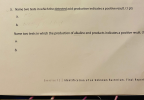
5. Name two tests in which the detected acid production indicates a positive result. (1 pt) a. b. Met Name two tests in which the production of alkaline end products indicates a positive result. (1 a. b. Exercise 12 | Identification of an unknown Bacterium. Final Report
This is a question from unknown bacteria lab, please help to
answer if you know but don't if you not sure
5. Name two tests in which the detected acid production indicates a positive result. (1 pt) a. b. Met Name two tests in which the production of alkaline end products indicates a positive result. (1 a. b. Exercise 12 | Identification of an unknown Bacterium. Final Report
Practice Questions 1. You were given a bacteria for unknown investigation. To begin with, you performed...
Practice Questions 1. You were given a bacteria for unknown investigation. To begin with, you performed a Methyl Red test after inoculating and incubating them for 48 hours. You obtained no color change after addition of Methyl Red. You proceed forward and performed Voges Proskauer test. For this particular test, you obtained a red color change after addition of Barritt solution A and B. From the result, what kind of inference can you draw from the 2 results obtained about...
Procedure Four different colors of beads, representing four species of bacteria, all possible residents of the...
Procedure Four different colors of beads, representing four species of bacteria, all possible residents of the microbiome, will be utilized. The species differ naturally in their resistance to a particular antibiotic. Three different antibiotic treatment regimens will be modeled: following doctor’s orders ending antibiotic treatment early skipping Day 3 of treatment Your initial population of bacteria is represented as follows: 40 beads that represent Species 1, the most susceptible to the antibiotic (susceptible on Day 1 of treatment) 30 beads...
2. Now suppose that you want to determine the amount of bacteria in four different food...
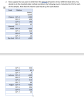 2. Now suppose that you want to determine the amount of bacteria in four different food items. You decide to do the standard plate method and obtain the following counts. Calculate the CFU for each of the samples. Note that the volume used was 50 ul for each dilution Food Dilution Colony count >300 450 190 45 Cheese 10^-4 10^-5 10^-6 10^-7 Ground meat 10^-4 10^-5 10^-6 10^-7 Dry fruit 10^-4 >300 348 54 10 >300 10^-5 10^-6 10^-7 Lettuce...
2. List and briefly describe the four phases (stages) of microbial growth. You may also draw...
 2. List and briefly describe the four phases (stages) of microbial growth. You may also draw a growth curve, but you must still describe each of the four stages (NOT JUST LABEL GROWTH CURVE). 3. Briefly describe the method of assessing the amount of microbial growth you would use in each of the following samples: A. You have to determine how many living bacteria are present in a city pool: B. You have a cloudy broth and you need to...
You have a collection of different dollar bills: Three $1 bills Four $5 bills Two $20...
You have a collection of different dollar bills: Three $1 bills Four $5 bills Two $20 bills You buy a scoop of ice cream for $0.75, and you choose one of the bills at random to pay for it. How much change can you expect to get (On average how much change do you get back)?
For today's assignment you will choose four different electronic devices and four different consumer products (other...
For today's assignment you will choose four different electronic devices and four different consumer products (other than electronics) of your choice and answer the following for each: 1) The year it was introduced and its initial or introductory price 2) What is the price now? 3) Where is it located in the product life-cycle? (what period, your opinion) 4) Is it being replaced (discontinued or discounted) by a newer version? 5) In your opinion (if it has not happened yet)...
As a student radiographer, you are exposed to many different situations in the health care field....
As a student radiographer, you are exposed to many different situations in the health care field. On this particular day, you were asked to observe in intervential radiography. The technologist has asked if you could assist with the preprocedural vital signs on Mr. Hawkins. Eager to be a part of the team, you take Mr. Hawkins to the area where vital signs are taken. As you try to carry on a light conversation and outwardly attempt to seem confident, you...
Questions 3, 4, & 5 pls (3) You will titrate a solution of an unknown acid...
 Questions 3, 4, & 5 pls
(3) You will titrate a solution of an unknown acid (HX(aq)) by adding NaOH(aq). Suppose that 25 mL of 0.5 M NaOH(aq) is needed to reach the equivalence point. How many moles of HX were present initially? Show the calculation. (4) You will titrate acid solutions by adding 0.2-0.3-mL or 2-3-mL portions of NaOH(aq). When should you add the smaller volume? (5) The concentration of an aqueous solution of NaOH cannot be accurately determined...
Questions 3, 4, & 5 pls
(3) You will titrate a solution of an unknown acid (HX(aq)) by adding NaOH(aq). Suppose that 25 mL of 0.5 M NaOH(aq) is needed to reach the equivalence point. How many moles of HX were present initially? Show the calculation. (4) You will titrate acid solutions by adding 0.2-0.3-mL or 2-3-mL portions of NaOH(aq). When should you add the smaller volume? (5) The concentration of an aqueous solution of NaOH cannot be accurately determined...
 This is a question from unknown bacteria lab, please help to
answer if you know but don't if you not sure
5. Name two tests in which the detected acid production indicates a positive result. (1 pt) a. b. Met Name two tests in which the production of alkaline end products indicates a positive result. (1 a. b. Exercise 12 | Identification of an unknown Bacterium. Final Report
This is a question from unknown bacteria lab, please help to
answer if you know but don't if you not sure
5. Name two tests in which the detected acid production indicates a positive result. (1 pt) a. b. Met Name two tests in which the production of alkaline end products indicates a positive result. (1 a. b. Exercise 12 | Identification of an unknown Bacterium. Final Report
 2. Now suppose that you want to determine the amount of bacteria in four different food items. You decide to do the standard plate method and obtain the following counts. Calculate the CFU for each of the samples. Note that the volume used was 50 ul for each dilution Food Dilution Colony count >300 450 190 45 Cheese 10^-4 10^-5 10^-6 10^-7 Ground meat 10^-4 10^-5 10^-6 10^-7 Dry fruit 10^-4 >300 348 54 10 >300 10^-5 10^-6 10^-7 Lettuce...
 2. List and briefly describe the four phases (stages) of microbial growth. You may also draw a growth curve, but you must still describe each of the four stages (NOT JUST LABEL GROWTH CURVE). 3. Briefly describe the method of assessing the amount of microbial growth you would use in each of the following samples: A. You have to determine how many living bacteria are present in a city pool: B. You have a cloudy broth and you need to...
 Questions 3, 4, & 5 pls
(3) You will titrate a solution of an unknown acid (HX(aq)) by adding NaOH(aq). Suppose that 25 mL of 0.5 M NaOH(aq) is needed to reach the equivalence point. How many moles of HX were present initially? Show the calculation. (4) You will titrate acid solutions by adding 0.2-0.3-mL or 2-3-mL portions of NaOH(aq). When should you add the smaller volume? (5) The concentration of an aqueous solution of NaOH cannot be accurately determined...
Questions 3, 4, & 5 pls
(3) You will titrate a solution of an unknown acid (HX(aq)) by adding NaOH(aq). Suppose that 25 mL of 0.5 M NaOH(aq) is needed to reach the equivalence point. How many moles of HX were present initially? Show the calculation. (4) You will titrate acid solutions by adding 0.2-0.3-mL or 2-3-mL portions of NaOH(aq). When should you add the smaller volume? (5) The concentration of an aqueous solution of NaOH cannot be accurately determined...
Most questions answered within 3 hours.
-
Where is the error in this code sequence?
String s1 = "Hello";
String s2 = "ello";...
asked 10 months ago -
Financial data for Joel de Paris, Inc., for last year
follow:
Joel de Paris, Inc.
Balance...
asked 10 months ago -
Consider this reaction:
Al2(SO4)3 (aq)+ BaCl3
(aq) Al2Cl6 (aq)- +
3BaSO4(s) . What is the...
asked 10 months ago -
Suppose that Savneet is considering increasing her
recent random sample from 20 car rentals to 40...
asked 10 months ago -
Trucks arrive at an unloading terminal at an average rate of 120
per hour.
Trucks arrive...
asked 10 months ago -
Why are methanol and ethanol completely soluble in water while
octanol is not very little soluble....
asked 10 months ago -
A facilities manager at a university reads in a research report
that the mean amount of...
asked 10 months ago -
When the CuSO4 is rehydrated by adding water to the anhydrous
compound, is this an endothermic...
asked 10 months ago -
A ray of sunlight is passing from diamond into crown glass; the
angle of incidence is...
asked 10 months ago -
A block of mass 0.249 kg is placed on top of a light, vertical
spring of...
asked 10 months ago -
how do the kidneys compensate in the presences of acidosis
a) trigger hyperventilate
b) reserve acid...
asked 10 months ago -
Question 501 pts
The rental rate of capital to the firm increases. Which of the
following...
asked 10 months ago