Which of the following descriptions are correct about the “equivalence point” and the “end point”? correct...
Which of the following descriptions are correct about the
“equivalence point” and the “end point”?
correct incorrect At the end point, a physical property
of the solution suffers a sudden change.
correct incorrect At the equivalence point of a Mohr
titration, [Ag+] is independent of the original
concentrations or volumes.
correct incorrect At the equivalence point, the quantity
of added titrant is the exact amount necessary for stoichiometric
reaction with the analyte.
correct incorrect Equivalence point cannot be shown on
the precipitation titration curve.
Homework Answers

Add Answer to:
Which of the following descriptions are correct about the
“equivalence point” and the “end point”?
correct...
Constants | Periodic Table Learning Goal: To calculate the pH at the equivalence point for various...
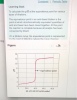 Constants | Periodic Table Learning Goal: To calculate the pH at the equivalence point for various types of titrations. The equivalence point in an acid-base titration is the point at which stoichiometrically equivalent quantities of acid and base have been mixed together. At this point the reaction is complete because all analyte has been consumed by titrant. On a titration curve, the equivalence point is represented hv the noint of inflection (where the curve changes ring Figure 1o1 12 10...
1. What is the definition of an 'equivalence point' in an acid/base titration? (1 point) 2....
 1. What is the definition of an 'equivalence point' in an acid/base titration? (1 point) 2. In part one of the experiment, you will prepare the acid solutions being titrated from a stock solution. Describe how you will accurately prepare 10.00 mL of 0.100 M HCl solution using a 1.00 M HCl stock solution. In your response to this question, be very specific about the quantities of stock solution and deionized water to be used in the dilution and the...
Workshop 5: Titration Curves A pH or titration curve can be produced by plotting the pH...
 Workshop 5: Titration Curves A pH or titration curve can be produced by plotting the pH of a solution (containing an analyte) versus the volume of added The equivalence or end point of a titration occurs when enough titrant has been added to consume all the acid or base initially present in the analyte.You know you have reached the endpoint when you see a significant change in the pH of the solution. Part Lets begin by analyzing a titration curve...
It's a weak acid strong base titration Experiment 4: Identification of an unknown acid by titration...
 It's a weak acid strong base titration
Experiment 4: Identification of an unknown acid by titration Page 2 of 15 Background In this experiment, you will use both qualitative and quantitative properties to determine an unknown acid's identity and concentration. To do this analysis, you will perform a titration of your unknown acid sample-specifically a potentiometric titration where you use a pH meter and record pH values during the titration, combined with a visual titration using a color indi- cator...
It's a weak acid strong base titration
Experiment 4: Identification of an unknown acid by titration Page 2 of 15 Background In this experiment, you will use both qualitative and quantitative properties to determine an unknown acid's identity and concentration. To do this analysis, you will perform a titration of your unknown acid sample-specifically a potentiometric titration where you use a pH meter and record pH values during the titration, combined with a visual titration using a color indi- cator...
Calculate the pH for each of the following cases in the titration of 25.0 mL of 0.230 M pyridine, C5H5N(aq) with 0.230 M HBr(aq) Number 9.3 (a) before addition of any HBr Number 5.23 (b) after additi...
 Calculate the pH for each of the following cases in the titration of 25.0 mL of 0.230 M pyridine, C5H5N(aq) with 0.230 M HBr(aq) Number 9.3 (a) before addition of any HBr Number 5.23 (b) after addition of 12.5 mL of HBr With equal concentrations of monoprotic titrant and added volumes are equal (25.0 mL of HBr added) So at point (c), we are 24.0/50.0 = 96.0% of the way to umber analyte, the equivalence point would occur when the...
Question 3 (1 point) Which of the following is correct for the equivalence point in an...
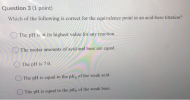 Question 3 (1 point) Which of the following is correct for the equivalence point in an acid-base titration? The pH is at its highest value for any reaction. The molar amounts of acid and base are equal. The pH is 7.0 The pH is equal to the pk, of the weak acid. The pH is equal to the pKb of the weak base.
Help, how to graphically find the equivalence point volume for the titration of NH3 + HCl...
 Help, how to graphically find the equivalence point volume for
the titration of NH3 + HCl
NH3 actual concentration is 0.098M
Part B: Titration of a weak base with a strong acid Pipette 25.00 mL of 0.1 M (record the exact molarity) ammonia into a clean 400 ml beaker after first placing a magnetic stirring bar on the bottom of the beaker. Add ~150 mL of deionized water and 2 drops of the indicator methyl red. Place the beaker on...
Help, how to graphically find the equivalence point volume for
the titration of NH3 + HCl
NH3 actual concentration is 0.098M
Part B: Titration of a weak base with a strong acid Pipette 25.00 mL of 0.1 M (record the exact molarity) ammonia into a clean 400 ml beaker after first placing a magnetic stirring bar on the bottom of the beaker. Add ~150 mL of deionized water and 2 drops of the indicator methyl red. Place the beaker on...
Equivalence Point for Titration #1: 24.96 mL Equivalence Point for Titration #2: 25.40 mL Equivalence Point...
 Equivalence Point for Titration #1: 24.96
mL
Equivalence Point for Titration #2: 25.40
mL
Equivalence Point for Titration #3: 25.20
mL
Midpoint pH for Titration #3: 9.80
QUESTIONS:
4) Set up the calculation required to determine
the concentration of the NaOH solution via titration of a given
amount of KHP. Include all numbers except the given mass of
KHP.
5) Set up the calculation required to determine
the concentration of the unknown strong acid via titration with a
known volume...
Equivalence Point for Titration #1: 24.96
mL
Equivalence Point for Titration #2: 25.40
mL
Equivalence Point for Titration #3: 25.20
mL
Midpoint pH for Titration #3: 9.80
QUESTIONS:
4) Set up the calculation required to determine
the concentration of the NaOH solution via titration of a given
amount of KHP. Include all numbers except the given mass of
KHP.
5) Set up the calculation required to determine
the concentration of the unknown strong acid via titration with a
known volume...
I dont not expect anyone to create the spreadsheet, however I am totally lost on the...
 I
dont not expect anyone to create the spreadsheet, however I am
totally lost on the calculations and values that must be added, so
any help on that would be greatly appreciated!
INTRODUCTION An acid-base titration is a procedure for carrying out a neutralization reaction between an acid solution and a base solution by the controlled addition (from a burette) of one of the solutions, known as the titrant, to the other solution. For such a titration, a graph of...
I
dont not expect anyone to create the spreadsheet, however I am
totally lost on the calculations and values that must be added, so
any help on that would be greatly appreciated!
INTRODUCTION An acid-base titration is a procedure for carrying out a neutralization reaction between an acid solution and a base solution by the controlled addition (from a burette) of one of the solutions, known as the titrant, to the other solution. For such a titration, a graph of...
just need help with questions 3. a & b always rate!!! Introduction Titration is a common...
 just need help with questions 3. a & b
always rate!!!
Introduction Titration is a common analytical technique that is used to verify the concentrations of chemicals before they are sold as commercial products, in a process known as quality control. In this lab, you will be using a redox titration to find the concentration of the strong oxidizing agent hypochlorite (CIO) which is the active ingredient in bleach. Oxidizing and reducing agents are often determined using a redox titration....
just need help with questions 3. a & b
always rate!!!
Introduction Titration is a common analytical technique that is used to verify the concentrations of chemicals before they are sold as commercial products, in a process known as quality control. In this lab, you will be using a redox titration to find the concentration of the strong oxidizing agent hypochlorite (CIO) which is the active ingredient in bleach. Oxidizing and reducing agents are often determined using a redox titration....
 Constants | Periodic Table Learning Goal: To calculate the pH at the equivalence point for various types of titrations. The equivalence point in an acid-base titration is the point at which stoichiometrically equivalent quantities of acid and base have been mixed together. At this point the reaction is complete because all analyte has been consumed by titrant. On a titration curve, the equivalence point is represented hv the noint of inflection (where the curve changes ring Figure 1o1 12 10...
 1. What is the definition of an 'equivalence point' in an acid/base titration? (1 point) 2. In part one of the experiment, you will prepare the acid solutions being titrated from a stock solution. Describe how you will accurately prepare 10.00 mL of 0.100 M HCl solution using a 1.00 M HCl stock solution. In your response to this question, be very specific about the quantities of stock solution and deionized water to be used in the dilution and the...
 Workshop 5: Titration Curves A pH or titration curve can be produced by plotting the pH of a solution (containing an analyte) versus the volume of added The equivalence or end point of a titration occurs when enough titrant has been added to consume all the acid or base initially present in the analyte.You know you have reached the endpoint when you see a significant change in the pH of the solution. Part Lets begin by analyzing a titration curve...
 It's a weak acid strong base titration
Experiment 4: Identification of an unknown acid by titration Page 2 of 15 Background In this experiment, you will use both qualitative and quantitative properties to determine an unknown acid's identity and concentration. To do this analysis, you will perform a titration of your unknown acid sample-specifically a potentiometric titration where you use a pH meter and record pH values during the titration, combined with a visual titration using a color indi- cator...
It's a weak acid strong base titration
Experiment 4: Identification of an unknown acid by titration Page 2 of 15 Background In this experiment, you will use both qualitative and quantitative properties to determine an unknown acid's identity and concentration. To do this analysis, you will perform a titration of your unknown acid sample-specifically a potentiometric titration where you use a pH meter and record pH values during the titration, combined with a visual titration using a color indi- cator...
 Calculate the pH for each of the following cases in the titration of 25.0 mL of 0.230 M pyridine, C5H5N(aq) with 0.230 M HBr(aq) Number 9.3 (a) before addition of any HBr Number 5.23 (b) after addition of 12.5 mL of HBr With equal concentrations of monoprotic titrant and added volumes are equal (25.0 mL of HBr added) So at point (c), we are 24.0/50.0 = 96.0% of the way to umber analyte, the equivalence point would occur when the...
 Question 3 (1 point) Which of the following is correct for the equivalence point in an acid-base titration? The pH is at its highest value for any reaction. The molar amounts of acid and base are equal. The pH is 7.0 The pH is equal to the pk, of the weak acid. The pH is equal to the pKb of the weak base.
 Help, how to graphically find the equivalence point volume for
the titration of NH3 + HCl
NH3 actual concentration is 0.098M
Part B: Titration of a weak base with a strong acid Pipette 25.00 mL of 0.1 M (record the exact molarity) ammonia into a clean 400 ml beaker after first placing a magnetic stirring bar on the bottom of the beaker. Add ~150 mL of deionized water and 2 drops of the indicator methyl red. Place the beaker on...
Help, how to graphically find the equivalence point volume for
the titration of NH3 + HCl
NH3 actual concentration is 0.098M
Part B: Titration of a weak base with a strong acid Pipette 25.00 mL of 0.1 M (record the exact molarity) ammonia into a clean 400 ml beaker after first placing a magnetic stirring bar on the bottom of the beaker. Add ~150 mL of deionized water and 2 drops of the indicator methyl red. Place the beaker on...
 Equivalence Point for Titration #1: 24.96
mL
Equivalence Point for Titration #2: 25.40
mL
Equivalence Point for Titration #3: 25.20
mL
Midpoint pH for Titration #3: 9.80
QUESTIONS:
4) Set up the calculation required to determine
the concentration of the NaOH solution via titration of a given
amount of KHP. Include all numbers except the given mass of
KHP.
5) Set up the calculation required to determine
the concentration of the unknown strong acid via titration with a
known volume...
Equivalence Point for Titration #1: 24.96
mL
Equivalence Point for Titration #2: 25.40
mL
Equivalence Point for Titration #3: 25.20
mL
Midpoint pH for Titration #3: 9.80
QUESTIONS:
4) Set up the calculation required to determine
the concentration of the NaOH solution via titration of a given
amount of KHP. Include all numbers except the given mass of
KHP.
5) Set up the calculation required to determine
the concentration of the unknown strong acid via titration with a
known volume...
 I
dont not expect anyone to create the spreadsheet, however I am
totally lost on the calculations and values that must be added, so
any help on that would be greatly appreciated!
INTRODUCTION An acid-base titration is a procedure for carrying out a neutralization reaction between an acid solution and a base solution by the controlled addition (from a burette) of one of the solutions, known as the titrant, to the other solution. For such a titration, a graph of...
I
dont not expect anyone to create the spreadsheet, however I am
totally lost on the calculations and values that must be added, so
any help on that would be greatly appreciated!
INTRODUCTION An acid-base titration is a procedure for carrying out a neutralization reaction between an acid solution and a base solution by the controlled addition (from a burette) of one of the solutions, known as the titrant, to the other solution. For such a titration, a graph of...
 just need help with questions 3. a & b
always rate!!!
Introduction Titration is a common analytical technique that is used to verify the concentrations of chemicals before they are sold as commercial products, in a process known as quality control. In this lab, you will be using a redox titration to find the concentration of the strong oxidizing agent hypochlorite (CIO) which is the active ingredient in bleach. Oxidizing and reducing agents are often determined using a redox titration....
just need help with questions 3. a & b
always rate!!!
Introduction Titration is a common analytical technique that is used to verify the concentrations of chemicals before they are sold as commercial products, in a process known as quality control. In this lab, you will be using a redox titration to find the concentration of the strong oxidizing agent hypochlorite (CIO) which is the active ingredient in bleach. Oxidizing and reducing agents are often determined using a redox titration....
Most questions answered within 3 hours.
-
Where is the error in this code sequence?
String s1 = "Hello";
String s2 = "ello";...
asked 10 months ago -
Financial data for Joel de Paris, Inc., for last year
follow:
Joel de Paris, Inc.
Balance...
asked 10 months ago -
Consider this reaction:
Al2(SO4)3 (aq)+ BaCl3
(aq) Al2Cl6 (aq)- +
3BaSO4(s) . What is the...
asked 10 months ago -
Suppose that Savneet is considering increasing her
recent random sample from 20 car rentals to 40...
asked 10 months ago -
Trucks arrive at an unloading terminal at an average rate of 120
per hour.
Trucks arrive...
asked 10 months ago -
Why are methanol and ethanol completely soluble in water while
octanol is not very little soluble....
asked 10 months ago -
A facilities manager at a university reads in a research report
that the mean amount of...
asked 10 months ago -
When the CuSO4 is rehydrated by adding water to the anhydrous
compound, is this an endothermic...
asked 10 months ago -
A ray of sunlight is passing from diamond into crown glass; the
angle of incidence is...
asked 10 months ago -
A block of mass 0.249 kg is placed on top of a light, vertical
spring of...
asked 10 months ago -
how do the kidneys compensate in the presences of acidosis
a) trigger hyperventilate
b) reserve acid...
asked 10 months ago -
Question 501 pts
The rental rate of capital to the firm increases. Which of the
following...
asked 10 months ago