Two point charges, q1 = 1.4 ✕ 10−7 C and q2 = −5.4 ✕ 10−8 C,...
Two point charges, q1 = 1.4 ✕ 10−7 C and q2 = −5.4 ✕ 10−8 C, are held 33.0 cm apart. (Assume q2 is on the right.)
a. What is the electric field (in N/C) at a point 5.0 cm from the negative charge and along the line between the two charges?
magnitude__________ N/C
b. What is the force (in N) on an electron placed at that point?
magnitude__________N
Homework Answers
Charges are placed 33cm apart
a. What is the electric field at a point 5.0 cm from the negative charge and along the line between the two charges?
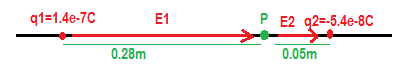
Electric field direction is radially outwards for a positive charge and radially inwards for a negative charge.
Net Electric field at point P, 
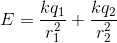



(a) ANSWER :
==================================
b. What is the force on an electron placed at that point?
Force, 
In this case, the charge is an electron


(b) ANSWER : 
===================================
Two point charges q1=2.1*10^(-8) and q2=-4q1 are fixed in two places 50 cm apart. The point...
Two point charges q1=2.1*10^(-8) and q2=-4q1 are fixed in two places 50 cm apart. The point charge q1 is at the right side of q2. Find the point at which the electric field is zero, along the straight line passing through the two charges. The point is? a)50cm to the right of q1 b)50cm to the left of q2 c)100cm to the right of q2 d)100 cm to the left of q2
Two point charges, q1 = 100 nC and q2 = −60 nC, are held 15.0 cm...
Two point charges, q1 = 100 nC and q2 = −60 nC, are held 15.0 cm apart. What is the electric field at a point 5.0 cm from the negative charge and along the line between the two charges? A. 278 kN/C B. 351 kN/C C. 306 kN/C D. 323 kN/C
Point charges q1 56 pC and q2·-29 C are placed 1.0 m apart. Assume that q2...
 Point charges q1 56 pC and q2·-29 C are placed 1.0 m apart. Assume that q2 is placed to the right of q1 and that right is the positive direction. Indicate the direction with the signs of your answers. (a) What is the electric field (in N/C) at a point midway between them? N/C (b) What is the force (in N) on a charge q3 15 uC situated there?
Two point charges (q1 = -4.5?C and q2 = 8.7 ?C) are fixed along the x-axis,...
 Two point charges (q1 = -4.5?C and q2 =
8.7 ?C) are fixed along the x-axis, separated by a distance d = 8.6
cm. Point P is located at (x,y) = (d,d).
1)
What is Ex(P), the value of the x-component of the
electric field produced by q1 and q2 at point
P?N/C
2)
What is Ey(P), the value of the y-component of the
electric field produced by q1 and q2 at point
P?N/C
3)
A third point charge q3...
Two point charges (q1 = -4.5?C and q2 =
8.7 ?C) are fixed along the x-axis, separated by a distance d = 8.6
cm. Point P is located at (x,y) = (d,d).
1)
What is Ex(P), the value of the x-component of the
electric field produced by q1 and q2 at point
P?N/C
2)
What is Ey(P), the value of the y-component of the
electric field produced by q1 and q2 at point
P?N/C
3)
A third point charge q3...
Answer both questions, multiple choice Two positive charges Q1 and Q2 are placed 10 cm apart...
 Answer both questions, multiple choice
Two positive charges Q1 and Q2 are placed 10 cm apart along the x-axis. Q1 is at the origin with a value equal to 5 mu C and Q3 = 7 mu C. A test charge Qo = - 3 mu C is placed at 3.7 cm from Q1. The Electrostatic Potential Difference between point A and B is A small sphere of mass 5.1 g hangs vertically from an insulating thread. A horizontal electric...
Answer both questions, multiple choice
Two positive charges Q1 and Q2 are placed 10 cm apart along the x-axis. Q1 is at the origin with a value equal to 5 mu C and Q3 = 7 mu C. A test charge Qo = - 3 mu C is placed at 3.7 cm from Q1. The Electrostatic Potential Difference between point A and B is A small sphere of mass 5.1 g hangs vertically from an insulating thread. A horizontal electric...
Two point charges, q1 = + 10C and q2 = - 15 C, are separated by...
Two point charges, q1 = + 10C and q2 = - 15 C, are separated by a distance 5.0 cm. (a) Find the magnitude of the electric force, and (b)what type of electric force will act between these point charges?
Two point charges q1 and q2 arefixed at the two corners of a square, as...
 Two point charges q1 and q2 are
fixed at the two corners of a square, as shown in the figure. The
length of each side of the square is 0.5 m. A negative
charge of q= -0.5μC is placed at corner A.a) Determine the magnitude and the direction of the electric
force F1 exerted on charge q by charge
q1.b) Determine the magnitude and the direction of the electric
force F2 exerted on charge q by charge
q2.c) Determine the magnitude...
Two point charges q1 and q2 are
fixed at the two corners of a square, as shown in the figure. The
length of each side of the square is 0.5 m. A negative
charge of q= -0.5μC is placed at corner A.a) Determine the magnitude and the direction of the electric
force F1 exerted on charge q by charge
q1.b) Determine the magnitude and the direction of the electric
force F2 exerted on charge q by charge
q2.c) Determine the magnitude...
Two charges Q1 = -6 x 10^-8 C and Q2 = -6 x 10^-8 C, are...
Two charges Q1 = -6 x 10^-8 C and Q2 = -6 x 10^-8 C, are held in place at a separation 0.16 m. What is the strength of the electric field due to Q1 and Q2 at the point halfway between the two charges?
Two point charges q1 and q2 are held 4.00 cm apart. An electron released at a...
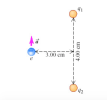 Two point charges q1 and q2 are
held 4.00 cm apart. An electron released at a point that is
equidistant from both charges (see the figure (Figure 1)) undergoes
an initial acceleration of 8.65×10^18 m/s2 directly upward in the
figure, parallel to the line connecting q1 and q2. Find the
magnitude and sign of q1 and q2.
di Cl 6-3.00cm 寸 8. 42
Two point charges q1 and q2 are
held 4.00 cm apart. An electron released at a point that is
equidistant from both charges (see the figure (Figure 1)) undergoes
an initial acceleration of 8.65×10^18 m/s2 directly upward in the
figure, parallel to the line connecting q1 and q2. Find the
magnitude and sign of q1 and q2.
di Cl 6-3.00cm 寸 8. 42
Two charges, 91 = +10 nC and q2 =-30 nC are 20 cm apart. Where (other...
 Two charges, 91 = +10 nC and q2 =-30 nC are 20 cm apart. Where (other than infinity) can a proton be placed so as to experience no net force? O left of charge 91 o on the line joining q1 and q2 O right of charge 92 O at a point P on the right bisector of the line joining the two charges
 Point charges q1 56 pC and q2·-29 C are placed 1.0 m apart. Assume that q2 is placed to the right of q1 and that right is the positive direction. Indicate the direction with the signs of your answers. (a) What is the electric field (in N/C) at a point midway between them? N/C (b) What is the force (in N) on a charge q3 15 uC situated there?
 Two point charges (q1 = -4.5?C and q2 =
8.7 ?C) are fixed along the x-axis, separated by a distance d = 8.6
cm. Point P is located at (x,y) = (d,d).
1)
What is Ex(P), the value of the x-component of the
electric field produced by q1 and q2 at point
P?N/C
2)
What is Ey(P), the value of the y-component of the
electric field produced by q1 and q2 at point
P?N/C
3)
A third point charge q3...
Two point charges (q1 = -4.5?C and q2 =
8.7 ?C) are fixed along the x-axis, separated by a distance d = 8.6
cm. Point P is located at (x,y) = (d,d).
1)
What is Ex(P), the value of the x-component of the
electric field produced by q1 and q2 at point
P?N/C
2)
What is Ey(P), the value of the y-component of the
electric field produced by q1 and q2 at point
P?N/C
3)
A third point charge q3...
 Answer both questions, multiple choice
Two positive charges Q1 and Q2 are placed 10 cm apart along the x-axis. Q1 is at the origin with a value equal to 5 mu C and Q3 = 7 mu C. A test charge Qo = - 3 mu C is placed at 3.7 cm from Q1. The Electrostatic Potential Difference between point A and B is A small sphere of mass 5.1 g hangs vertically from an insulating thread. A horizontal electric...
Answer both questions, multiple choice
Two positive charges Q1 and Q2 are placed 10 cm apart along the x-axis. Q1 is at the origin with a value equal to 5 mu C and Q3 = 7 mu C. A test charge Qo = - 3 mu C is placed at 3.7 cm from Q1. The Electrostatic Potential Difference between point A and B is A small sphere of mass 5.1 g hangs vertically from an insulating thread. A horizontal electric...
 Two point charges q1 and q2 are
fixed at the two corners of a square, as shown in the figure. The
length of each side of the square is 0.5 m. A negative
charge of q= -0.5μC is placed at corner A.a) Determine the magnitude and the direction of the electric
force F1 exerted on charge q by charge
q1.b) Determine the magnitude and the direction of the electric
force F2 exerted on charge q by charge
q2.c) Determine the magnitude...
Two point charges q1 and q2 are
fixed at the two corners of a square, as shown in the figure. The
length of each side of the square is 0.5 m. A negative
charge of q= -0.5μC is placed at corner A.a) Determine the magnitude and the direction of the electric
force F1 exerted on charge q by charge
q1.b) Determine the magnitude and the direction of the electric
force F2 exerted on charge q by charge
q2.c) Determine the magnitude...
 Two point charges q1 and q2 are
held 4.00 cm apart. An electron released at a point that is
equidistant from both charges (see the figure (Figure 1)) undergoes
an initial acceleration of 8.65×10^18 m/s2 directly upward in the
figure, parallel to the line connecting q1 and q2. Find the
magnitude and sign of q1 and q2.
di Cl 6-3.00cm 寸 8. 42
Two point charges q1 and q2 are
held 4.00 cm apart. An electron released at a point that is
equidistant from both charges (see the figure (Figure 1)) undergoes
an initial acceleration of 8.65×10^18 m/s2 directly upward in the
figure, parallel to the line connecting q1 and q2. Find the
magnitude and sign of q1 and q2.
di Cl 6-3.00cm 寸 8. 42
 Two charges, 91 = +10 nC and q2 =-30 nC are 20 cm apart. Where (other than infinity) can a proton be placed so as to experience no net force? O left of charge 91 o on the line joining q1 and q2 O right of charge 92 O at a point P on the right bisector of the line joining the two charges
Most questions answered within 3 hours.
-
Where is the error in this code sequence?
String s1 = "Hello";
String s2 = "ello";...
asked 11 months ago -
Financial data for Joel de Paris, Inc., for last year
follow:
Joel de Paris, Inc.
Balance...
asked 11 months ago -
Consider this reaction:
Al2(SO4)3 (aq)+ BaCl3
(aq) Al2Cl6 (aq)- +
3BaSO4(s) . What is the...
asked 11 months ago -
Suppose that Savneet is considering increasing her
recent random sample from 20 car rentals to 40...
asked 11 months ago -
Trucks arrive at an unloading terminal at an average rate of 120
per hour.
Trucks arrive...
asked 11 months ago -
Why are methanol and ethanol completely soluble in water while
octanol is not very little soluble....
asked 11 months ago -
A facilities manager at a university reads in a research report
that the mean amount of...
asked 11 months ago -
When the CuSO4 is rehydrated by adding water to the anhydrous
compound, is this an endothermic...
asked 11 months ago -
A ray of sunlight is passing from diamond into crown glass; the
angle of incidence is...
asked 11 months ago -
A block of mass 0.249 kg is placed on top of a light, vertical
spring of...
asked 11 months ago -
how do the kidneys compensate in the presences of acidosis
a) trigger hyperventilate
b) reserve acid...
asked 11 months ago -
Question 501 pts
The rental rate of capital to the firm increases. Which of the
following...
asked 11 months ago