You feed pigs pyruvate that is isotopically labeled with 14C only at its methyl group (all...
- You feed pigs pyruvate that is isotopically labeled with 14C only at its methyl group (all other positions use standard natural abundance of 12C). Assuming that all of the pyruvate enters the TCA cycle, how many rounds of the TCA cycle are required before 14C is first released? Describe how you came to this conclusion..
- Mammals lack the ability to biosynthesize glucose from acetyl-CoA, if a BALB/c mouse is given food containing 14C-labeled acetate, after some period of time it is possible to measure 14C in glycogen that is purified from the muscle tissue of the mouse. Knowing what you know about metabolism, please explain how this occurs.
Homework Answers
a) During the fourth rounds of TCA cycle, 14C will be first released.
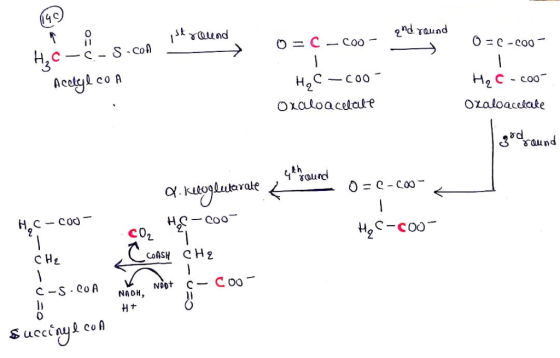
b) Acetate enters the TCA cycle by combining with oxaloacetic acid and forms citric acid. Citric acid goes through the TCA cycle till Oxaloacetate. Oxaloacetate can generate Phosphoenol pyruvate which generates glucose through the gluconeogenesis. Glycogen can be generated from glucose now. So, if you feed a mouse 14C-labeled acetate, it will generate glycogen, where you will be able to measure 14C.
Add Answer to:
You feed pigs pyruvate that is isotopically labeled with 14C
only at its methyl group (all...
1. You have acetate that is isotopically labelled (13C) at carbon 1 and radiolabeled (14C) at carbon...
 1. You have acetate that is isotopically labelled
(13C) at carbon 1 and radiolabeled (14C) at
carbon 2. Assume all the acetate gets incorporated into
Acetyl-CoA. Calculate the % of each labelled carbon that
gets released in the first five rounds of the TCA cycle and at what
enzymatic step they get released.
2. Document (on extra pages attached to this sheet)
your work. Note: you don’t have to include
every step if you are clever.
1. You have acetate that is isotopically labelled (c) at...
1. You have acetate that is isotopically labelled
(13C) at carbon 1 and radiolabeled (14C) at
carbon 2. Assume all the acetate gets incorporated into
Acetyl-CoA. Calculate the % of each labelled carbon that
gets released in the first five rounds of the TCA cycle and at what
enzymatic step they get released.
2. Document (on extra pages attached to this sheet)
your work. Note: you don’t have to include
every step if you are clever.
1. You have acetate that is isotopically labelled (c) at...
You are carrying out an experiment in the lab to study the citric acid cycle. To do this, you add 14C-labeled pyruvate at carbon 3 (this is the methyl carbon) to metabolically active mitochondria. Bas...
You are carrying out an experiment in the lab to study the citric acid cycle. To do this, you add 14C-labeled pyruvate at carbon 3 (this is the methyl carbon) to metabolically active mitochondria. Based on your knowledge of the citric acid cycle, what is the location of the 14C-label in oxaloacetate after one turn of the cycle? How many turns of the cycle are required to release all of the14C-label as CO2? Be sure to justify your answers by...
 1. You have acetate that is isotopically labelled
(13C) at carbon 1 and radiolabeled (14C) at
carbon 2. Assume all the acetate gets incorporated into
Acetyl-CoA. Calculate the % of each labelled carbon that
gets released in the first five rounds of the TCA cycle and at what
enzymatic step they get released.
2. Document (on extra pages attached to this sheet)
your work. Note: you don’t have to include
every step if you are clever.
1. You have acetate that is isotopically labelled (c) at...
1. You have acetate that is isotopically labelled
(13C) at carbon 1 and radiolabeled (14C) at
carbon 2. Assume all the acetate gets incorporated into
Acetyl-CoA. Calculate the % of each labelled carbon that
gets released in the first five rounds of the TCA cycle and at what
enzymatic step they get released.
2. Document (on extra pages attached to this sheet)
your work. Note: you don’t have to include
every step if you are clever.
1. You have acetate that is isotopically labelled (c) at...
Most questions answered within 3 hours.
-
Where is the error in this code sequence?
String s1 = "Hello";
String s2 = "ello";...
asked 10 months ago -
Financial data for Joel de Paris, Inc., for last year
follow:
Joel de Paris, Inc.
Balance...
asked 10 months ago -
Consider this reaction:
Al2(SO4)3 (aq)+ BaCl3
(aq) Al2Cl6 (aq)- +
3BaSO4(s) . What is the...
asked 10 months ago -
Suppose that Savneet is considering increasing her
recent random sample from 20 car rentals to 40...
asked 10 months ago -
Trucks arrive at an unloading terminal at an average rate of 120
per hour.
Trucks arrive...
asked 10 months ago -
Why are methanol and ethanol completely soluble in water while
octanol is not very little soluble....
asked 10 months ago -
A facilities manager at a university reads in a research report
that the mean amount of...
asked 10 months ago -
When the CuSO4 is rehydrated by adding water to the anhydrous
compound, is this an endothermic...
asked 10 months ago -
A ray of sunlight is passing from diamond into crown glass; the
angle of incidence is...
asked 10 months ago -
A block of mass 0.249 kg is placed on top of a light, vertical
spring of...
asked 10 months ago -
how do the kidneys compensate in the presences of acidosis
a) trigger hyperventilate
b) reserve acid...
asked 10 months ago -
Question 501 pts
The rental rate of capital to the firm increases. Which of the
following...
asked 10 months ago