Benford’s Law is an observation about the distribution of the frequencies of the first digits of...
Benford’s Law is an observation about the distribution of the frequencies of the first digits of the numbers in many different data sets. It is frequently found that the first digits are not uniformly distributed, but follow the logarithmic distribution P(d) = log10 ((d + 1)/d)
That is, numbers starting with 1 are more common than those starting with 2, and so on, with those starting with 9 the least common. The probabilities follow:
1 0.301
2 0.176
3 0.125
4 0.097
5 0.079
6 0.067
7 0.058
8 0.051
9 0.046
Benford’s Law is most accurate for data sets which span several orders of magnitude and can be proved to be exact for some infinite sequences of numbers.
1 Demonstrate in Python that the first digits of the first 500 Fibonacci numbers follow Benford’s Law quite closely.
Homework Answers
Please find the code below. Thumbs up if you like the solution.
# Program to display the Fibonacci sequence up to n-th term
where n is provided by the user
nterms = 500
# first two terms
n1 = 0
n2 = 1
count = 0
lst=[]
# check if the number of terms is valid
if nterms <= 0:
print("Please enter a positive integer")
elif nterms == 1:
print("Fibonacci sequence upto",nterms,":")
print(n1)
else:
print("Fibonacci sequence upto",nterms,":")
while count < nterms:
print(n1,end=' , \n')
#Creating a list with the starting of each fibonacci number.
numStr = str(n1)
numStr = int(numStr[0])
lst.append(numStr)
nth = n1 + n2
# update values
n1 = n2
n2 = nth
count += 1
# Initializing the counters.
counter1 = 0
counter2 = 0
counter3 = 0
counter4 = 0
counter5 = 0
counter6 = 0
counter7 = 0
counter8 = 0
counter9 = 0
#Counting the unique numbers in the list
for items in lst:
if items == 1:
counter1 +=1
if items == 2:
counter2 +=1
if items == 3:
counter3 +=1
if items == 4:
counter4 +=1
if items == 5:
counter5 +=1
if items == 6:
counter6 +=1
if items == 7:
counter7 +=1
if items == 8:
counter8 +=1
if items == 9:
counter9 +=1
#Dividing the probabilities by 1000 as dividing by 500 would give double the value as that of values in Benford's Law
print('Probability of 1 = ', counter1/1000)
print('Probability of 2 = ', counter2/1000)
print('Probability of 3 = ', counter3/1000)
print('Probability of 4 = ', counter4/1000)
print('Probability of 5 = ', counter5/1000)
print('Probability of 6 = ', counter6/1000)
print('Probability of 7 = ', counter7/1000)
print('Probability of 8 = ', counter8/1000)
print('Probability of 9 = ', counter9/1000)
Let me know if this works for you.
Add Answer to:
Benford’s Law is an observation about the distribution of the
frequencies of the first digits of...
Benford's Law states the relative frequencies of the first digits in a dataset of naturally occurring...
 Benford's Law states the relative frequencies of the first digits in a dataset of naturally occurring random numbers will follow the trend seen in the table. Benford's law is used to detect fraud in accounting and other fields. We will consider three business called Business A, B, and C. We have their accounts payable database and have given the relative frequencies of the first digit for each item in their accounts payable. Relative Frequency First Benfords Business Business Business Digit...
Bentood's law first nou zero numher in a snolom distrihatin of it's " 56 PlXex)] 0.301...
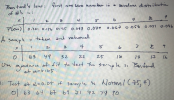 Bentood's law first nou zero numher in a snolom distrihatin of it's " 56 PlXex)] 0.301 0.176 0.125 0.097 0,079 0.067 0.056 0.051 0.046 A seuple i taken and returned x 1 1 2 3 4 5 6 7 & q ol &3 49 32 22 25 18 13 17 16 Use Goodness of fit to test the sample ? Benfond I at a=6.05. 1: Test at &=0.05 if sample & Normal (754) ol 63 64 67 69 71 72...
Benford’s Law gives the distribution of leading digits in a variety of different data sets. An...
Benford’s Law gives the distribution of leading digits in a variety of different data sets. An investigator for the Brooklyn district attorney analyzed the digits of the amounts of 784 checks issued by seven suspect companies. Leading digit 1 2 3 4 5 6 7 8 9 Benford’s Law 30.1% 17.6 12.5 9.7 7.9 6.7 5.8 5.1 4.6 Observed counts 0 15 0 76 479 183 8 23 0 1. Consider the claim that the amounts on those checks have...
The first signifcant digit in any number must be 1.2. 3. 4. 5.0.7.8. or e. It was discovered that Srst digits do not occur with equal frequency Probabilities of occurrence to the first digit in a num...
 The first signifcant digit in any number must be 1.2. 3. 4. 5.0.7.8. or e. It was discovered that Srst digits do not occur with equal frequency Probabilities of occurrence to the first digit in a number are shown in the accompanying table. The probability distribution is now known as Benford's Law. For exampe te o own g der but on represents the frst digits n 220 al eged y fraudulent check wrtten to ฮ bogus oompany by an employee...
6. Creating a bar graph and Benford's Law Aa Aa Here's an interesting exercise: Write down...
 6. Creating a bar graph and Benford's Law Aa Aa Here's an interesting exercise: Write down all the numbers you see on the front page of your college newspaper (excluding the page number). Calculate the proportion of numbers beginning with 1 and the proportion of numbers beginning with 4. Which proportion is greater? Your intuition may suggest that you are equally likely to find both kinds of numbers, so the proportions should be roughly the same. However, more often than...
The first significant digit in any number must be 1, 2, 3, 4, 5, 6, 7,...
 The first significant digit in any number must be 1, 2, 3, 4, 5, 6, 7, 8, or 9. It was discovered that first digits do not occur with equal frequency. Probabilities of occurrence to the first digit in a number are shown in the accompanying table. The probability distribution is now known as Benford's Law. For example, the following distribution represents the first digits in 194 allegedly fraudulent checks written to a bogus company by an employee attempting to...
5) A book claims that more hockey players are born in January through March than in October through December. The following data show the number of players selected in a draft of new players for a hoc...
5) A book claims that more hockey players are born in January through March than in October through December. The following data show the number of players selected in a draft of new players for a hockey league according to their birth month. Is there evidence to suggest that hockey players' birthdates are not uniformly distributed throughout the year? Use the level of significancealpha equalsα=0.05Birth MonthObserved CountExpected CountJanuary-March60April-June51July-September26October-December374) A traffic safety company publishes reports about motorcycle fatalities and helmet use....
5) A book claims that more hockey players are born in January through March than in...
5) A book claims that more hockey players are born in January through March than in October through December. The following data show the number of players selected in a draft of new players for a hockey league according to their birth month. Is there evidence to suggest that hockey players' birthdates are not uniformly distributed throughout the year? Use the level of significance alpha equalsα=0.05 Birth Month Observed Count Expected Count January-March 60 April-June 51 July-September 26 October-December 37...
A random sample of 40 adults with no children under the age of 18 years results...
 A random sample of 40 adults with no children under the age of 18 years results in a mean daily leisure time of 5.31 hours, with a standard deviation of 2.49 hours. A random sample of 40 adults with children under the age of 18 results in a mean dailyleisure time of 4.02 hours, with a standard deviation of 1.97 hours. Construct and interpret a 90% confidence interval for the mean difference in leisure time between adults with no children...
Recall that Benford's Law claims that numbers chosen from very large data files tend to have "1" as the first nonzero di...
 Recall that Benford's Law claims that numbers chosen from very
large data files tend to have "1" as the first nonzero digit
disproportionately often. In fact, research has shown that if you
randomly draw a number from a very large data file, the probability
of getting a number with "1" as the leading digit is about 0.301.
Now suppose you are an auditor for a very large corporation. The
revenue report involves millions of numbers in a large computer
file....
Recall that Benford's Law claims that numbers chosen from very
large data files tend to have "1" as the first nonzero digit
disproportionately often. In fact, research has shown that if you
randomly draw a number from a very large data file, the probability
of getting a number with "1" as the leading digit is about 0.301.
Now suppose you are an auditor for a very large corporation. The
revenue report involves millions of numbers in a large computer
file....
 Benford's Law states the relative frequencies of the first digits in a dataset of naturally occurring random numbers will follow the trend seen in the table. Benford's law is used to detect fraud in accounting and other fields. We will consider three business called Business A, B, and C. We have their accounts payable database and have given the relative frequencies of the first digit for each item in their accounts payable. Relative Frequency First Benfords Business Business Business Digit...
 Bentood's law first nou zero numher in a snolom distrihatin of it's " 56 PlXex)] 0.301 0.176 0.125 0.097 0,079 0.067 0.056 0.051 0.046 A seuple i taken and returned x 1 1 2 3 4 5 6 7 & q ol &3 49 32 22 25 18 13 17 16 Use Goodness of fit to test the sample ? Benfond I at a=6.05. 1: Test at &=0.05 if sample & Normal (754) ol 63 64 67 69 71 72...
 The first signifcant digit in any number must be 1.2. 3. 4. 5.0.7.8. or e. It was discovered that Srst digits do not occur with equal frequency Probabilities of occurrence to the first digit in a number are shown in the accompanying table. The probability distribution is now known as Benford's Law. For exampe te o own g der but on represents the frst digits n 220 al eged y fraudulent check wrtten to ฮ bogus oompany by an employee...
 6. Creating a bar graph and Benford's Law Aa Aa Here's an interesting exercise: Write down all the numbers you see on the front page of your college newspaper (excluding the page number). Calculate the proportion of numbers beginning with 1 and the proportion of numbers beginning with 4. Which proportion is greater? Your intuition may suggest that you are equally likely to find both kinds of numbers, so the proportions should be roughly the same. However, more often than...
 The first significant digit in any number must be 1, 2, 3, 4, 5, 6, 7, 8, or 9. It was discovered that first digits do not occur with equal frequency. Probabilities of occurrence to the first digit in a number are shown in the accompanying table. The probability distribution is now known as Benford's Law. For example, the following distribution represents the first digits in 194 allegedly fraudulent checks written to a bogus company by an employee attempting to...
 A random sample of 40 adults with no children under the age of 18 years results in a mean daily leisure time of 5.31 hours, with a standard deviation of 2.49 hours. A random sample of 40 adults with children under the age of 18 results in a mean dailyleisure time of 4.02 hours, with a standard deviation of 1.97 hours. Construct and interpret a 90% confidence interval for the mean difference in leisure time between adults with no children...
 Recall that Benford's Law claims that numbers chosen from very
large data files tend to have "1" as the first nonzero digit
disproportionately often. In fact, research has shown that if you
randomly draw a number from a very large data file, the probability
of getting a number with "1" as the leading digit is about 0.301.
Now suppose you are an auditor for a very large corporation. The
revenue report involves millions of numbers in a large computer
file....
Recall that Benford's Law claims that numbers chosen from very
large data files tend to have "1" as the first nonzero digit
disproportionately often. In fact, research has shown that if you
randomly draw a number from a very large data file, the probability
of getting a number with "1" as the leading digit is about 0.301.
Now suppose you are an auditor for a very large corporation. The
revenue report involves millions of numbers in a large computer
file....
Most questions answered within 3 hours.
-
Where is the error in this code sequence?
String s1 = "Hello";
String s2 = "ello";...
asked 10 months ago -
Financial data for Joel de Paris, Inc., for last year
follow:
Joel de Paris, Inc.
Balance...
asked 10 months ago -
Consider this reaction:
Al2(SO4)3 (aq)+ BaCl3
(aq) Al2Cl6 (aq)- +
3BaSO4(s) . What is the...
asked 10 months ago -
Suppose that Savneet is considering increasing her
recent random sample from 20 car rentals to 40...
asked 10 months ago -
Trucks arrive at an unloading terminal at an average rate of 120
per hour.
Trucks arrive...
asked 10 months ago -
Why are methanol and ethanol completely soluble in water while
octanol is not very little soluble....
asked 10 months ago -
A facilities manager at a university reads in a research report
that the mean amount of...
asked 10 months ago -
When the CuSO4 is rehydrated by adding water to the anhydrous
compound, is this an endothermic...
asked 10 months ago -
A ray of sunlight is passing from diamond into crown glass; the
angle of incidence is...
asked 10 months ago -
A block of mass 0.249 kg is placed on top of a light, vertical
spring of...
asked 10 months ago -
how do the kidneys compensate in the presences of acidosis
a) trigger hyperventilate
b) reserve acid...
asked 10 months ago -
Question 501 pts
The rental rate of capital to the firm increases. Which of the
following...
asked 10 months ago