Suppose that the governemnt increases expenditure and that prices are completely sticky. Explain how this affects...
Homework Answers
If the government increases the expenditure, that will increase the income of the people in the market and that will lead to a higher demand in the market, as the prices are sticky the real wages in the market will fall. The nominal price of the goods in the market will increase. At a lower real wages the firm will be making a higher profit and they will invest and hire more people leading to higher employment and output in the market.
NO, this answer doesn't depend on the behavior of the central bank.
Add Answer to:
Suppose that the governemnt increases expenditure and that prices
are completely sticky. Explain how this affects...
3. Suppose that prices are completely rigid, so that the nominal and the real interest rate...
 3. Suppose that prices are completely rigid, so that the nominal and the real interest rate are necessarily equal. Money-market equilibrium is therefore given b L(r,Y). a. Suppose that government purchases increase, and that the central bank adjusts the money supply to keep the interest rate unchanged. i. Does the money supply rise or fall? ii. What happens to consumption and investment? b. Suppose that government purchases increase, and that the central bank adjusts the money supply to keep output...
In the long run: O prices are sticky O real GDP is completely demand-determined. O increases...
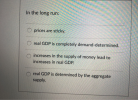 In the long run: O prices are sticky O real GDP is completely demand-determined. O increases in the supply of money lead to increases in real GDP O real GDP is determined by the aggregate supply
4. Suppose that we are in a world where short-term prices are sticky, but not fixed....
 4. Suppose that we are in a world where short-term prices are sticky, but not fixed. The government decides to increase expenditure by 1 and increase taxes by .5. A) What will happen to output in the short-run? B) Describe the graphical impact that these policies will have within the AD-AS model. Represent them as a single adjustment please. C) What is the short-run impact on output and prices? D) What is the long-run impact on output and prices?
5. Suppose that instead of following the interest rate rule r=r(Y), the central bank keeps the...
 5. Suppose that instead of following the interest rate rule r=r(Y), the central bank keeps the money supply constant. That is, suppose M = M. In addition, suppose that prices are completely rigid, so that the nominal and the real interest rate are necessarily equal; money-market equilibrium is therefore given by M/= = L(r,Y). a. Suppose that the money market is in equilibrium when r = ro and Yo. Now suppose Y rises to Y). For the money market to...
Question 4) Consider an economy with two kinds of firms : Firms with sticky prices have...
Question 4) Consider an economy with two kinds of firms : Firms with sticky prices have ?? Firms with flexible prices ?? A) Derive the following SRAS that we discussed in the class. You have to explain your steps and assumption clearly ( 10 points) ?=?̅ + α (P – EP), Where α = s/[(1-s)a] , and s=0.5 is the fraction of firms with sticky prices; a=0.5 is just a parameter. ?̅= 200 B) How do you interpret the SRAS?...
Question 4) Consider an economy with two kinds of firms : • Firms with sticky prices...
 Question 4) Consider an economy with two kinds of firms : • Firms with sticky prices have ps • Firms with flexible prices pf A) Derive the following SRAS that we discussed in the class. You have to explain your steps and assumption clearly ( 10 points) Y=Y +a (P-EP), Where a = s/[(1-s)a), and s=0.5 is the fraction of firms with sticky prices; a=0.5 is just a parameter. Y=200 B) How do you interpret the SRAS? (5 points) C)...
2. Suppose that we are in a world where short-term prices are sticky, but not fixed....
 2. Suppose that we are in a world where short-term prices are sticky, but not fixed. The Fed decides that it wants to increase output. A.) According to the Phillips curve, what is the short-run/long-run tradeoff that the Fed is making in this situation? (quid pro quo, Clarice?) B.) What must the Fed do to the money supply? C.) Describe the graphical changes that take place in the market for real money. D.) In the short-run, what happens to interest...
Consider a standard Keynesian economy with partially sticky prices. Suppose the economy experiences an increase in...
Consider a standard Keynesian economy with partially sticky prices. Suppose the economy experiences an increase in the precautionary money demand. Using graphs and written discussion, examine the economy dynamics in the wake of the shock. For full credit, be sure to address: • Capture the timing in your written discussion • If a curve shifts, explain why/economic intuition • If a market is in disequilibrium, explain how it returns to equilibrium • Explain, if possible, the final outcome in terms...
Describe an example of speculation in a market explain how speculation affects market prices. Use a...
Describe an example of speculation in a market explain how speculation affects market prices. Use a supply and demand diagram as part of your explanation
Answer the following completely. Include examples where appropriate. (a) Explain the Central Limit Theorem. (b) How...
Answer the following completely. Include examples where appropriate. (a) Explain the Central Limit Theorem. (b) How would you explain it to a student in a freshman-level statistics class? (c) How have we used it so far? (d) Which operations/calculations depend on it? In what way?
 3. Suppose that prices are completely rigid, so that the nominal and the real interest rate are necessarily equal. Money-market equilibrium is therefore given b L(r,Y). a. Suppose that government purchases increase, and that the central bank adjusts the money supply to keep the interest rate unchanged. i. Does the money supply rise or fall? ii. What happens to consumption and investment? b. Suppose that government purchases increase, and that the central bank adjusts the money supply to keep output...
 In the long run: O prices are sticky O real GDP is completely demand-determined. O increases in the supply of money lead to increases in real GDP O real GDP is determined by the aggregate supply
 4. Suppose that we are in a world where short-term prices are sticky, but not fixed. The government decides to increase expenditure by 1 and increase taxes by .5. A) What will happen to output in the short-run? B) Describe the graphical impact that these policies will have within the AD-AS model. Represent them as a single adjustment please. C) What is the short-run impact on output and prices? D) What is the long-run impact on output and prices?
 5. Suppose that instead of following the interest rate rule r=r(Y), the central bank keeps the money supply constant. That is, suppose M = M. In addition, suppose that prices are completely rigid, so that the nominal and the real interest rate are necessarily equal; money-market equilibrium is therefore given by M/= = L(r,Y). a. Suppose that the money market is in equilibrium when r = ro and Yo. Now suppose Y rises to Y). For the money market to...
 Question 4) Consider an economy with two kinds of firms : • Firms with sticky prices have ps • Firms with flexible prices pf A) Derive the following SRAS that we discussed in the class. You have to explain your steps and assumption clearly ( 10 points) Y=Y +a (P-EP), Where a = s/[(1-s)a), and s=0.5 is the fraction of firms with sticky prices; a=0.5 is just a parameter. Y=200 B) How do you interpret the SRAS? (5 points) C)...
 2. Suppose that we are in a world where short-term prices are sticky, but not fixed. The Fed decides that it wants to increase output. A.) According to the Phillips curve, what is the short-run/long-run tradeoff that the Fed is making in this situation? (quid pro quo, Clarice?) B.) What must the Fed do to the money supply? C.) Describe the graphical changes that take place in the market for real money. D.) In the short-run, what happens to interest...
Most questions answered within 3 hours.
-
Where is the error in this code sequence?
String s1 = "Hello";
String s2 = "ello";...
asked 10 months ago -
Financial data for Joel de Paris, Inc., for last year
follow:
Joel de Paris, Inc.
Balance...
asked 10 months ago -
Consider this reaction:
Al2(SO4)3 (aq)+ BaCl3
(aq) Al2Cl6 (aq)- +
3BaSO4(s) . What is the...
asked 10 months ago -
Suppose that Savneet is considering increasing her
recent random sample from 20 car rentals to 40...
asked 10 months ago -
Trucks arrive at an unloading terminal at an average rate of 120
per hour.
Trucks arrive...
asked 10 months ago -
Why are methanol and ethanol completely soluble in water while
octanol is not very little soluble....
asked 10 months ago -
A facilities manager at a university reads in a research report
that the mean amount of...
asked 10 months ago -
When the CuSO4 is rehydrated by adding water to the anhydrous
compound, is this an endothermic...
asked 10 months ago -
A ray of sunlight is passing from diamond into crown glass; the
angle of incidence is...
asked 10 months ago -
A block of mass 0.249 kg is placed on top of a light, vertical
spring of...
asked 10 months ago -
how do the kidneys compensate in the presences of acidosis
a) trigger hyperventilate
b) reserve acid...
asked 10 months ago -
Question 501 pts
The rental rate of capital to the firm increases. Which of the
following...
asked 10 months ago