What are marginal benefit and marginal cost? How do they relate to demand and supply? Explain...
What are marginal benefit and marginal cost? How do they relate to demand and supply?
Explain market efficiency using marginal benefit and marginal cost.
Describe consumer and producer surplus. Draw a graph and use it to identify consumer and producer surplus.
Homework Answers
QUESTION : What are marginal benefit and marginal cost? How do they relate to demand and supply?
In order to produce an addition unit of an output, the cost incurred by a firm or a producer can be termed as marginal cost. Similarly, the benefit received from consuming an additional unit of a particular good or service by a consumer can be defined as marginal benefit. If a consumer consume more and more of a particular good or service, the marginal benefit associated with it will decline. Marginal benefit curve is similar to demand curve. As quantity consumed increases, the marginal benefit will decline along with each additional unit consumed. Supply of a firm is closely dependent on its marginal cost. The cost of producing each additional unit of a good is considered by a firm or producer while deciding his quantity to be supplied. This cost is marginal cost.
Add Answer to:
What are
marginal benefit and marginal cost? How do they relate to demand
and supply?
Explain...
Illustrate (draw a graph) consumer and producer surplus using demand and supply graph and explain how total surplus (consumer surplus plus producer surplus) can be maximised at the equilibrium level.
Illustrate (draw a graph) consumer and producer surplus using demand and supply graph and explain how total surplus (consumer surplus plus producer surplus) can be maximised at the equilibrium level.
]Malaysia is an exporter for world petroleum market. Using demand and supply graph, draw(draw a graph) and explain the petroleum market in Malaysia before and after international trade, assuming the world price for petroleum is above the Malaysia petroleu
]Malaysia is an exporter for world petroleum market. Using demand and supply graph, draw(draw a graph) and explain the petroleum market in Malaysia before and after international trade, assuming the world price for petroleum is above the Malaysia petroleum market before open for international trade. Now that Malaysia is open for international trade, identify, and show the change in consumer surplus, producer surplus, and total surplus.
c. Use a supply and demand diagram to show how that response will change the combined...
 c. Use a supply and demand diagram to show how that response will change the combined amount of consumer surplus and producer surplus in the market for cashews. Instructions: Use the "Surplus, tool" provided to identify the initial surplus. Click on the "Surplus j' tool and then click somewhere in the graph. Click and drag the endpoints of the triangle to show total of the consumer surplus and producer surplus at the original price and quantity Next, use the "Surplus2...
3. The demand in a market is Q (P) 150-3P. The supply in the market is...
 3. The demand in a market is Q (P) 150-3P. The supply in the market is QS(P)- 3P- 30 (a) Find the competitive equilibrium in the market (P*, Q*) (b) Determine the levels of Consumer, Producer and Total Surplus in the competitive equilibrium (c) Consumption of the good leads to a negative externality. The external marginal benefit function is mbeQw . Draw a graph that shows the Demand, Supply and the Social Marginal Benefits. where measures units consumed in the...
EXERCISE 4 EQUILIBRIUM The demand curve for a product is given by Qo=400-20P and the supply...
 EXERCISE 4 EQUILIBRIUM The demand curve for a product is given by Qo=400-20P and the supply curve for a product is given by Qs=16P-32 a) illustrate the demand curve and the supply curve on the same graph b) find the equilibrium price and quantity c) find numerical values for the consumer surplus and the producer surplus e) Identify the total willingness to pay for the equilibrium quantity f) identify the total cost of supplying the equilibrium quantity g) draw a...
Consider a market with demand and supply functions: Supply function: ? = 40? − 40 Demand...
Consider a market with demand and supply functions: Supply function: ? = 40? − 40 Demand function: ? = 200 − 20? a. Draw the demand-supply curves. Find equilibrium price and quantity. Find consumer surplus, producer surplus, and total surplus in the graph. b. Calculate exact size of consumer surplus, producer surplus, and total surplus, respectively. Welfare effects of a price control. The government sets a price floor at $5. c. Find the market price and quantity traded, and the...
A.Draw a graph showing the demand, marginal revenue, and marginal cost curves for a typical monopolist,...
A.Draw a graph showing the demand, marginal revenue, and marginal cost curves for a typical monopolist, indicating the profit-maximizing price and level of output. Then, identify the competitive price and level of output. B.Making specific reference to your graph for Part A, identify the welfare costs of monopoly. Specifically, show how consumer and producer surplus are different under monopoly vs. competition, as well as any deadweight loss.
Assume that the supply and demand equations for beer in Canada are: QD = 60 –...
Assume that the supply and demand equations for beer in Canada are: QD = 60 – 6P QS = 4P – 20 a. Graph the demand and supply equations. b. Calculate the equilibrium price and quantity. c. Label the consumer surplus and producer surplus at the equilibrium. d. Calculate consumer surplus, producer surplus and total surplus at the equilibrium. e. Now suppose a price floor of $9 is implemented. Calculate the shortage/surplus that occurs at this price. f. Label the...
ECON 2012 Homework 4 Due: 3/5 P=3Q+15 and P=-Q+ 55 1. Identify which equation is supply...
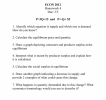 ECON 2012 Homework 4 Due: 3/5 P=3Q+15 and P=-Q+ 55 1. Identify which equation is supply and which one is demand. How do you know? 2. Calculate the equilibrium price and quantity. 3. Draw a graph depicting consumer and producer surplus at the equilibrium 4. Interpret what is meant by producer surplus and explain how it is calculated. 5. Calculate the social surplus at equilibrium 6. Draw another graph indicating a decrease in supply and provide 2 examples of what...
Suppose supply and demand for air-conditioners in the little Hawaiian town of Paia (Maui) are given...
Suppose supply and demand for air-conditioners in the little Hawaiian town of Paia (Maui) are given by the following equations: Qs=P-300 QD=2100-3P where the price is expressed US$, and quantity represents air conditioning units. a) Please find the equilibrium price and quantity and draw the supply and demand graph. Do not worry about the scale, just represent the relevant information. b) Please compute the consumer surplus, producer surplus and total surplus and identify them in your graph. c) Searching for...
 c. Use a supply and demand diagram to show how that response will change the combined amount of consumer surplus and producer surplus in the market for cashews. Instructions: Use the "Surplus, tool" provided to identify the initial surplus. Click on the "Surplus j' tool and then click somewhere in the graph. Click and drag the endpoints of the triangle to show total of the consumer surplus and producer surplus at the original price and quantity Next, use the "Surplus2...
 3. The demand in a market is Q (P) 150-3P. The supply in the market is QS(P)- 3P- 30 (a) Find the competitive equilibrium in the market (P*, Q*) (b) Determine the levels of Consumer, Producer and Total Surplus in the competitive equilibrium (c) Consumption of the good leads to a negative externality. The external marginal benefit function is mbeQw . Draw a graph that shows the Demand, Supply and the Social Marginal Benefits. where measures units consumed in the...
 EXERCISE 4 EQUILIBRIUM The demand curve for a product is given by Qo=400-20P and the supply curve for a product is given by Qs=16P-32 a) illustrate the demand curve and the supply curve on the same graph b) find the equilibrium price and quantity c) find numerical values for the consumer surplus and the producer surplus e) Identify the total willingness to pay for the equilibrium quantity f) identify the total cost of supplying the equilibrium quantity g) draw a...
 ECON 2012 Homework 4 Due: 3/5 P=3Q+15 and P=-Q+ 55 1. Identify which equation is supply and which one is demand. How do you know? 2. Calculate the equilibrium price and quantity. 3. Draw a graph depicting consumer and producer surplus at the equilibrium 4. Interpret what is meant by producer surplus and explain how it is calculated. 5. Calculate the social surplus at equilibrium 6. Draw another graph indicating a decrease in supply and provide 2 examples of what...
Most questions answered within 3 hours.
-
Where is the error in this code sequence?
String s1 = "Hello";
String s2 = "ello";...
asked 10 months ago -
Financial data for Joel de Paris, Inc., for last year
follow:
Joel de Paris, Inc.
Balance...
asked 10 months ago -
Consider this reaction:
Al2(SO4)3 (aq)+ BaCl3
(aq) Al2Cl6 (aq)- +
3BaSO4(s) . What is the...
asked 10 months ago -
Suppose that Savneet is considering increasing her
recent random sample from 20 car rentals to 40...
asked 10 months ago -
Trucks arrive at an unloading terminal at an average rate of 120
per hour.
Trucks arrive...
asked 10 months ago -
Why are methanol and ethanol completely soluble in water while
octanol is not very little soluble....
asked 10 months ago -
A facilities manager at a university reads in a research report
that the mean amount of...
asked 10 months ago -
When the CuSO4 is rehydrated by adding water to the anhydrous
compound, is this an endothermic...
asked 10 months ago -
A ray of sunlight is passing from diamond into crown glass; the
angle of incidence is...
asked 10 months ago -
A block of mass 0.249 kg is placed on top of a light, vertical
spring of...
asked 10 months ago -
how do the kidneys compensate in the presences of acidosis
a) trigger hyperventilate
b) reserve acid...
asked 10 months ago -
Question 501 pts
The rental rate of capital to the firm increases. Which of the
following...
asked 10 months ago