Where does progenitor cells (neuroblasts and glioblasts) proliferate?
Where does progenitor cells (neuroblasts and glioblasts) proliferate?
Homework Answers
The cells of the central nervous system originate from the ventricular zone of the neural tube—that is, the layer of neuroepithelial cells lining the central cavity of the tube. These cells differentiate and proliferate into neuroblasts and glioblasts.

To better understand it, keep reading-
By 18 days after fertilization, the ectoderm of the embryonic disk thickens along what will become the dorsal midline of the body, forming the neural plate and, slightly later, the primordial eye, ear, and nose. The neural plate elongates, and its lateral edges rise and unite in the midline to form the neural tube, which will develop into the central nervous system. The neural tube detaches from the skin ectoderm and sinks beneath the surface. At this stage, groupings of ectodermal cells, called neural crests, develop as a column on each side of the neural tube. The cephalic (head) portion of the neural tube differentiates into the prosencephalon (forebrain), mesencephalon (midbrain), and rhombencephalon (hindbrain), and the caudal portion becomes the spinal cord. The neural crests develop into most of the elements (e.g., ganglia and nerves) of the peripheral nervous system. This stage is reached at the end of the first embryonic month.
The cells of the central nervous system originate from the ventricular zone of the neural tube—that is, the layer of neuroepithelial cells lining the central cavity of the tube. These cells differentiate and proliferate into neuroblasts, which are the precursors of neurons, and glioblasts, from which neuroglia develop. With a few exceptions, the neuroblasts, glioblasts, and their derived cells do not divide and multiply once they have migrated from the ventricular zone into the gray and white matter of the nervous system. Most neurons are generated before birth, although not all are fully differentiated. (One exception is the neurons of the olfactory nerve, which are generated continuously throughout life.) This effectively implies that an individual is born with a full complement of nerve cells.
Add Answer to:
Where does progenitor cells (neuroblasts and glioblasts)
proliferate?
Some pathogens proliferate within extracellular tissue spaces. Other proliferate within cells. Describe 4 examples of how...
Some pathogens proliferate within extracellular tissue spaces. Other proliferate within cells. Describe 4 examples of how the innate immune system deals with intracellular infections, and 4 examples how innate immune system deals with extracellular infections. 4 Marks.
(3 points) If Cdc25a levels in the progenitor cells in the maturation zone were to be...
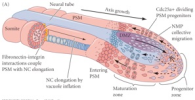 (3 points) If Cdc25a levels in the progenitor cells in
the maturation zone were to be reduced by half using morpholinos
specific to Cdc25a mRNA, what do you think would happen to
(a) axis elongation, (b) neural tube formation, and (c) somite
formation (be specific about the phenotype you
predict)?
Neural tube Axis growth Cac25a+ dividing PSM progenitors PSM NMP collective migration Somite Fibronectin-integrin interactions couple PSM with NC elongation Entering PSM NC elongation by vacuole inflation Progenitor
(3 points) If Cdc25a levels in the progenitor cells in
the maturation zone were to be reduced by half using morpholinos
specific to Cdc25a mRNA, what do you think would happen to
(a) axis elongation, (b) neural tube formation, and (c) somite
formation (be specific about the phenotype you
predict)?
Neural tube Axis growth Cac25a+ dividing PSM progenitors PSM NMP collective migration Somite Fibronectin-integrin interactions couple PSM with NC elongation Entering PSM NC elongation by vacuole inflation Progenitor
Which of the following is true of morphollactic regeneration in hydra? Cells need to proliferate to...
Which of the following is true of morphollactic regeneration in hydra? Cells need to proliferate to regeneration new tissues and structures Wnt3 is the apical organizer and is necessary for formation of the hypostome (head structure). When cut in half, the foot half can regenerate but not the head half When cut in half, the head half can regenerate but not the foot half
The common lymphoid progenitor cell gives rise to all of the following cell lines EXCEPT: A....
The common lymphoid progenitor cell gives rise to all of the following cell lines EXCEPT: A. dendritic cells. B. megakaryocytes C. natural killer cells D. pre-pro B cells E. T-cell progenitor
Question 8 Cancer cells (select all that apply) O proliferate uncontrollably O are always inherited have...
 Question 8 Cancer cells (select all that apply) O proliferate uncontrollably O are always inherited have genetic mutations is responsive to penicillin lose their ability to commit cell suicide express more sialic acid than normal cells O undergo extreme mitosis
F) In the case of most animal cells, such as most of your cells, where does...
 F) In the case of most animal cells, such as most of your cells, where does the majority of ATP that is used in reactions in the cytosol and nucleus come from? (State the location where most of this ATP is made, AND whether it is substrate-level phosphorylation, oxidative phosphorylation, or photophosphorylation.) G) In the case of the leaf cells of a plant, where does the majority of ATP that is used in reactions in the cytosol and nucleus come...
Topic is AIDS 1.) Where in the body (what tissues, organ, cells) does the AIDS pathogen...
Topic is AIDS 1.) Where in the body (what tissues, organ, cells) does the AIDS pathogen affect? 2.) What damage does the pathogen inflict? 3.) How is this damage inflicted? Is there direct chemical damage? Is it a toxin produced? Does the immune system response cause damage? 4.) What is the time sequence of the disease (length of incubation, prodrome, illness, decline, and convalescence? 5.) What are the major signs and symptoms?
QUESTION 37 Where does glycolysis take place in eukaryotic and prokaryotic cells A. In the mitochondria...
 QUESTION 37 Where does glycolysis take place in eukaryotic and prokaryotic cells A. In the mitochondria of eukaryotes and on the plasma membrane of prokaryotes B. In the cytosol of eukaryotes and on the plasma membrane of prokaryotes C. In the mitochondria of eukaryotes and in the cytosol of prokaryotes D. On the plasma membrane of eukaryotes and in the cytosol of prokaryotes E. In the cytosol of both F. On the plasma membranes of both OOOO
QUESTION 37 Where does glycolysis take place in eukaryotic and prokaryotic cells A. In the mitochondria...
 QUESTION 37 Where does glycolysis take place in eukaryotic and prokaryotic cells A. In the mitochondria of eukaryotes and on the plasma membrane of prokaryotes B. In the cytosol of eukaryotes and on the plasma membrane of prokaryotes C. In the mitochondria of eukaryotes and in the cytosol of prokaryotes D. On the plasma membrane of eukaryotes and in the cytosol of prokaryotes E. In the cytosol of both F. On the plasma membranes of both OO
(and the book) discussed several characteristics specific to cancer cells that are critical for their ability...
 (and the book) discussed several characteristics specific to cancer cells that are critical for their ability to proliferate and become invasive cancers, essentially out-competing normal, well-behaved cells. List two of these abnormal characteristics and explain how each of them can contribute to cancer development.
 (3 points) If Cdc25a levels in the progenitor cells in
the maturation zone were to be reduced by half using morpholinos
specific to Cdc25a mRNA, what do you think would happen to
(a) axis elongation, (b) neural tube formation, and (c) somite
formation (be specific about the phenotype you
predict)?
Neural tube Axis growth Cac25a+ dividing PSM progenitors PSM NMP collective migration Somite Fibronectin-integrin interactions couple PSM with NC elongation Entering PSM NC elongation by vacuole inflation Progenitor
(3 points) If Cdc25a levels in the progenitor cells in
the maturation zone were to be reduced by half using morpholinos
specific to Cdc25a mRNA, what do you think would happen to
(a) axis elongation, (b) neural tube formation, and (c) somite
formation (be specific about the phenotype you
predict)?
Neural tube Axis growth Cac25a+ dividing PSM progenitors PSM NMP collective migration Somite Fibronectin-integrin interactions couple PSM with NC elongation Entering PSM NC elongation by vacuole inflation Progenitor
 Question 8 Cancer cells (select all that apply) O proliferate uncontrollably O are always inherited have genetic mutations is responsive to penicillin lose their ability to commit cell suicide express more sialic acid than normal cells O undergo extreme mitosis
 F) In the case of most animal cells, such as most of your cells, where does the majority of ATP that is used in reactions in the cytosol and nucleus come from? (State the location where most of this ATP is made, AND whether it is substrate-level phosphorylation, oxidative phosphorylation, or photophosphorylation.) G) In the case of the leaf cells of a plant, where does the majority of ATP that is used in reactions in the cytosol and nucleus come...
 QUESTION 37 Where does glycolysis take place in eukaryotic and prokaryotic cells A. In the mitochondria of eukaryotes and on the plasma membrane of prokaryotes B. In the cytosol of eukaryotes and on the plasma membrane of prokaryotes C. In the mitochondria of eukaryotes and in the cytosol of prokaryotes D. On the plasma membrane of eukaryotes and in the cytosol of prokaryotes E. In the cytosol of both F. On the plasma membranes of both OOOO
 QUESTION 37 Where does glycolysis take place in eukaryotic and prokaryotic cells A. In the mitochondria of eukaryotes and on the plasma membrane of prokaryotes B. In the cytosol of eukaryotes and on the plasma membrane of prokaryotes C. In the mitochondria of eukaryotes and in the cytosol of prokaryotes D. On the plasma membrane of eukaryotes and in the cytosol of prokaryotes E. In the cytosol of both F. On the plasma membranes of both OO
 (and the book) discussed several characteristics specific to cancer cells that are critical for their ability to proliferate and become invasive cancers, essentially out-competing normal, well-behaved cells. List two of these abnormal characteristics and explain how each of them can contribute to cancer development.
Most questions answered within 3 hours.
-
Where is the error in this code sequence?
String s1 = "Hello";
String s2 = "ello";...
asked 10 months ago -
Financial data for Joel de Paris, Inc., for last year
follow:
Joel de Paris, Inc.
Balance...
asked 10 months ago -
Consider this reaction:
Al2(SO4)3 (aq)+ BaCl3
(aq) Al2Cl6 (aq)- +
3BaSO4(s) . What is the...
asked 10 months ago -
Suppose that Savneet is considering increasing her
recent random sample from 20 car rentals to 40...
asked 10 months ago -
Trucks arrive at an unloading terminal at an average rate of 120
per hour.
Trucks arrive...
asked 10 months ago -
Why are methanol and ethanol completely soluble in water while
octanol is not very little soluble....
asked 10 months ago -
A facilities manager at a university reads in a research report
that the mean amount of...
asked 10 months ago -
When the CuSO4 is rehydrated by adding water to the anhydrous
compound, is this an endothermic...
asked 10 months ago -
A ray of sunlight is passing from diamond into crown glass; the
angle of incidence is...
asked 10 months ago -
A block of mass 0.249 kg is placed on top of a light, vertical
spring of...
asked 10 months ago -
how do the kidneys compensate in the presences of acidosis
a) trigger hyperventilate
b) reserve acid...
asked 10 months ago -
Question 501 pts
The rental rate of capital to the firm increases. Which of the
following...
asked 10 months ago