You have learned that proton motive force is important in movement of ions across membranes. Both...
You have learned that proton motive force is important in movement of ions across membranes. Both proton motive force and protons in general are crucial in the function of light reactions. Please explain the source of protons and how they used in the light reactions.
Homework Answers
Source of protons during light reaction are
1. Due to photolysis of water molecules .
2. Due to electron transport through photosystems ie(from PSII to PSI )
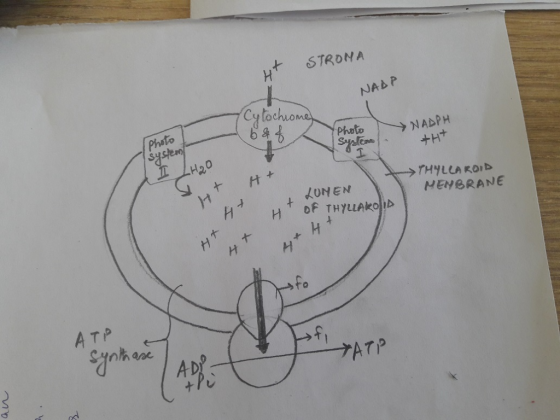
1. PHOTOLYSIS OF WATER : When light ( photons ) falls on PSII 2 electrons are dislodged and accepted by the Primary electron acceptor (PEA). To compensate this loss of electron simultaneous splitting of water occurs :

Electrons are taken up by PSII , but the protons are accumalated within the lumen of thyllakoids because splitting of H2O takes place on the inner side of the membrane
2. Proton motive force is also created due to transport of electrons during their transport from one photosystem to the other .
The PEA (which is located on the outer side of the membrane) while transporting electrons, transport it to a proton carrier rather than to an electron carrier and so when electrons are transported form PEA to Cyt b3 to Cyt f , a proton is released into the lumen of thyllakoid from the stroma .
3. Further increase in the PMF is due to reduction of protons in the stroma when NADP reductase enzyme ( Located on the outer side of the thyllakoid membrane reduces NADP to NAPDH++ H+. These protons are also removed from the stroma.
As a result inside the chloroplast, protons decrease in the stroma and increase inside the lumen of the thyllakoid. Why is this gradient essential ? Because it is breakdown of this gradient which cause movement of protons through Fo( Transmembrane channel ) of the ATPase enzyme . Enough energy is liberated during this transport which causes conformational change in the F1 particle of ATPase enzyme ( Facing the stroma) and thus catalyse formation of ATP molecules .
Add Answer to:
You have learned that proton motive force is important in
movement of ions across membranes. Both...
What is proton motive force? What is its importance in biology? It is the force with...
 What is proton motive force? What is its importance in biology? It is the force with which protons move in acid-base reactions O It is the force that results in the creation (synthesis) of a high-energy moleculc It is a form of energy that arises due to differences in pH across biological membranes O All of the above only (2) and (3)
6. Electron movement results in the establishment of a proton gradient across the inner mitochondrial membrane....
6. Electron movement results in the establishment of a proton gradient across the inner mitochondrial membrane. The proton motive force then provides the energy for ATP formation. a. How are protons shifted from the matrix to the intramembrane space? b. How is the proton gradient harnessed for ATP formation? c. How does ATP reach the cellular compartment/s where biosynthesis is occurring?
2. As you learned, membranes impermeable to hydrogen ions are required for electron transfer phosphorylation. Membranes...
 2. As you learned, membranes impermeable to hydrogen ions are required for electron transfer phosphorylation. Membranes in mitochondria serve this purpose in eukary otes. Bacteria do not have this organelle, but they do make ATP by electron transfer phosphorylation. How do you think they do it, given that they have no mitochondria?
Respiration and the light reactions of photosynthesis have several features in common. Which of the following...
 Respiration and the light reactions of photosynthesis have several features in common. Which of the following is NOT a common feature? O Both use an electron transport chain. Both couple the energy in Redox reactions to the translocation of protons across a lipid bilayer membrane. O Both have a primary function of reducing NAD+ to NADH Both can generate ATP by using the energy stored in a proton gradient to drive ATP synthase. Both require membranes for key reactions in...
1. 2,4-Dinitrophenol (DNP) is a molecule that can shuttle protons across cellular membranes and was used...
1. 2,4-Dinitrophenol (DNP) is a molecule that can shuttle protons across cellular membranes and was used in diet pills in the 1930s (but was quickly discontinued for its lethality). Explain how this molecule might induce weight loss, and why its consumption is often fatal. 2. Biosynthesis and breakdown of glucose share many common enzymes and reactions, but this is not the case in the metabolism of fatty acids. Compare and contrast fatty acid biosynthesis vs. beta-oxidation (location, acyl group carriers,...
How many membranes does the chloroplast have? 30. How many membranes doos the mitochondria have? 31....
 How many membranes does the chloroplast have? 30. How many membranes doos the mitochondria have? 31. A stack of thylakoids are known as d, 4 e, 3 a. Thylakoid dises b, c. thy lakoid lumen 32. The products produced in the light independent reaction are used to drive the light dependent reac a. True b, False 33. The ATP and NADPH produces in the light reaction are used to drive the synthesis of sugars from CO2 a. True b. False...
19. How many membranes does the chloroplast have 50. How many membranes does the mitochondria have?...
 19. How many membranes does the chloroplast have 50. How many membranes does the mitochondria have? 0.4 C3 31 A stack of this lakoids are known as: granum Thylakoid dises Grama ethylakid lumen 32. The products produced in the light independent reaction are used to drive the light dependent reaction . Stroma Trie h. False 33. The Aland NADPI pride in the light reaction are used to drive the synthesis of gars from CO2 True 34. Photosystem II in photosynthesis,...
The course is BUSINESS LAW( BUS5 ).Please select a legal principle that you have learned about...
The course is BUSINESS LAW( BUS5 ).Please select a legal principle that you have learned about in this course that you think is important for students to understand. In responding to this discussion board, please address the following questions: Identify the legal principle or rule. Please state the chapter where it was covered. Discuss a case in the textbook which helps to illustrate how this rule was applied. You may also reference a current newspaper article which demonstrates how the...
Analyze two important concepts you have learned about auscultation of the chest. Explain how you apply...
 Analyze two important concepts you have learned about auscultation of the chest. Explain how you apply these concepts into practice of patients on the unit or in the community.
Your classmate is excited to tell you about something they just learned. There’s a toxin named...
Your classmate is excited to tell you about something they just learned. There’s a toxin named ouabain that was used by East Africans to make poison arrows. “And guess what-ouabain kills people by blocking the sodium/potassium pump that we learned about in BILD 1!” But your classmate is confused about something. “The sodium/potassium pump moves sodium and potassium ions against the concentration gradients, in the opposite direction of how the ions would normally go. But in class we said that...
 What is proton motive force? What is its importance in biology? It is the force with which protons move in acid-base reactions O It is the force that results in the creation (synthesis) of a high-energy moleculc It is a form of energy that arises due to differences in pH across biological membranes O All of the above only (2) and (3)
 2. As you learned, membranes impermeable to hydrogen ions are required for electron transfer phosphorylation. Membranes in mitochondria serve this purpose in eukary otes. Bacteria do not have this organelle, but they do make ATP by electron transfer phosphorylation. How do you think they do it, given that they have no mitochondria?
 Respiration and the light reactions of photosynthesis have several features in common. Which of the following is NOT a common feature? O Both use an electron transport chain. Both couple the energy in Redox reactions to the translocation of protons across a lipid bilayer membrane. O Both have a primary function of reducing NAD+ to NADH Both can generate ATP by using the energy stored in a proton gradient to drive ATP synthase. Both require membranes for key reactions in...
 How many membranes does the chloroplast have? 30. How many membranes doos the mitochondria have? 31. A stack of thylakoids are known as d, 4 e, 3 a. Thylakoid dises b, c. thy lakoid lumen 32. The products produced in the light independent reaction are used to drive the light dependent reac a. True b, False 33. The ATP and NADPH produces in the light reaction are used to drive the synthesis of sugars from CO2 a. True b. False...
 19. How many membranes does the chloroplast have 50. How many membranes does the mitochondria have? 0.4 C3 31 A stack of this lakoids are known as: granum Thylakoid dises Grama ethylakid lumen 32. The products produced in the light independent reaction are used to drive the light dependent reaction . Stroma Trie h. False 33. The Aland NADPI pride in the light reaction are used to drive the synthesis of gars from CO2 True 34. Photosystem II in photosynthesis,...
 Analyze two important concepts you have learned about auscultation of the chest. Explain how you apply these concepts into practice of patients on the unit or in the community.
Most questions answered within 3 hours.
-
Where is the error in this code sequence?
String s1 = "Hello";
String s2 = "ello";...
asked 10 months ago -
Financial data for Joel de Paris, Inc., for last year
follow:
Joel de Paris, Inc.
Balance...
asked 10 months ago -
Consider this reaction:
Al2(SO4)3 (aq)+ BaCl3
(aq) Al2Cl6 (aq)- +
3BaSO4(s) . What is the...
asked 10 months ago -
Suppose that Savneet is considering increasing her
recent random sample from 20 car rentals to 40...
asked 10 months ago -
Trucks arrive at an unloading terminal at an average rate of 120
per hour.
Trucks arrive...
asked 10 months ago -
Why are methanol and ethanol completely soluble in water while
octanol is not very little soluble....
asked 10 months ago -
A facilities manager at a university reads in a research report
that the mean amount of...
asked 10 months ago -
When the CuSO4 is rehydrated by adding water to the anhydrous
compound, is this an endothermic...
asked 10 months ago -
A ray of sunlight is passing from diamond into crown glass; the
angle of incidence is...
asked 10 months ago -
A block of mass 0.249 kg is placed on top of a light, vertical
spring of...
asked 10 months ago -
how do the kidneys compensate in the presences of acidosis
a) trigger hyperventilate
b) reserve acid...
asked 10 months ago -
Question 501 pts
The rental rate of capital to the firm increases. Which of the
following...
asked 10 months ago