1. A crystal is composed of two elements, A and B. The basic crystal structure is...
Homework Answers

Add Answer to:
1. A crystal is composed of two elements, A and B. The basic
crystal structure is...
Consider a face-centered cubic crystal structure that has one atom at each lattice point. The atomic...
Consider a face-centered cubic crystal structure that has one atom at each lattice point. The atomic radius, ? is 0.152 nm and the atomic weight, ? is 68.4 g/mol. Assuming the atoms to be hard spheres and touch each other with their nearest neighbor, calculate the mass density.
6 1.12 (a) A material is composed of two types of atoms. Atom A has an...
 6
1.12 (a) A material is composed of two types of atoms. Atom A has an effective radius of 2.2 Å and atom B has an effective radius of 1.8 Å. The lattice is a bcc with atoms A at the corners and atom B in the center. Determine the lattice constant and the volume den- sities of A atoms and B atoms. (b) Repeat part (a) with atoms B at the corners and atom A in the center. (c)...
6
1.12 (a) A material is composed of two types of atoms. Atom A has an effective radius of 2.2 Å and atom B has an effective radius of 1.8 Å. The lattice is a bcc with atoms A at the corners and atom B in the center. Determine the lattice constant and the volume den- sities of A atoms and B atoms. (b) Repeat part (a) with atoms B at the corners and atom A in the center. (c)...
A hypothetical metal (W) has a body centered cubic crystal structure. Using a metallic radius of...
A hypothetical metal (W) has a body centered cubic crystal structure. Using a metallic radius of 139 pm for the W atom, calculate the density of W in grams per cubic centimeter. (1pm=10-12m) (Atomic weight of W is 183.84 g/mol)
A hypothetical metal (W) has a body centered cubic crystal structure. Using a metallic radius of...
 A hypothetical metal (W) has a body centered cubic crystal structure. Using a metallic radius of 139 pm for the W atom, calculate the density of W in grams per cubic centimeter. (1pm=10 m) (Atomic weight of W is 183.84 g/mol) h
Q1. (20 pts) A hypothetical metal (W) has a body centered cubic crystal structure. Using a...
 Q1. (20 pts) A hypothetical metal (W) has a body centered cubic crystal structure. Using a metallic radius of 139 pm for the W atom, calculate the density of W in grams per cubic centimeter. (1pm=10 m) (Atomic weight of W is 183.84 g/mol)
Q1. (20 pts) A hypothetical metal (W) has a body centered cubic crystal structure. Using a...
 Q1. (20 pts) A hypothetical metal (W) has a body centered cubic crystal structure. Using a metallic radius of 139 pm for the W atom, calculate the density of Win grams per cubic centimeter. (1pm=10" m) (Atomic weight of W is 183.84 g/mol)
The atom radius of copper is r = 0.1278 nm. Its crystal structure has face-centered cubic...
The atom radius of copper is r = 0.1278 nm. Its crystal structure has face-centered cubic cells. a) What is the crystal-lattice constant? b) What is the concentration of copper atoms? c) What is the atomic volume (the volume of 1 mol of copper)? answer each part with explanation and shown work
Unit Cell Calculations Name _____________________________ Unit Cells: The Simplest Repeating Unit in a Crystal The structure...
 Unit Cell Calculations Name
_____________________________
Unit Cells: The Simplest Repeating Unit in a Crystal
The structure of solids can be described as if they were
three-dimensional analogs of a piece of wallpaper. Wallpaper has a
regular repeating design that extends from one edge to the other.
Crystals have a similar repeating design, but in this case the
design extends in three dimensions from one edge of the solid to
the other. We can unambiguously describe a piece of wallpaper by...
Unit Cell Calculations Name
_____________________________
Unit Cells: The Simplest Repeating Unit in a Crystal
The structure of solids can be described as if they were
three-dimensional analogs of a piece of wallpaper. Wallpaper has a
regular repeating design that extends from one edge to the other.
Crystals have a similar repeating design, but in this case the
design extends in three dimensions from one edge of the solid to
the other. We can unambiguously describe a piece of wallpaper by...
Q. 3. Potassium fluoride adopts the rock salt (NaCl type) structure, with a density of 2.48...
Q. 3. Potassium fluoride adopts the rock salt (NaCl type) structure, with a density of 2.48 g/cm3. Using the data for the Part 4 model you constructed, calculate the expected distance between the center of the potassium ion and the center of an adjacent fluoride ion in pm. Q. 4. The diameter of a Cs+ ion is 334 pm; the diameter of a Br- ion is 392 pm. For CsBr, which crystallizes in the CsCl type structure from Part 5,...
NiAl is an intermetallic compound which has the CsCl-type crystal structure, which is shown below. The...
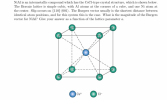 NiAl is an intermetallic compound which has the CsCl-type crystal structure, which is shown below. The Bravais lattice is simple cubic, with Al atoms at the corners of a cube, and one Ni atom at the center. Slip occurs on {110} (001). The Burgers vector usually is the shortest distance between identical atom positions, and for this system this is the case. What is the magnitude of the Burgers vector for NiAl? Give your answer as a function of the...
 6
1.12 (a) A material is composed of two types of atoms. Atom A has an effective radius of 2.2 Å and atom B has an effective radius of 1.8 Å. The lattice is a bcc with atoms A at the corners and atom B in the center. Determine the lattice constant and the volume den- sities of A atoms and B atoms. (b) Repeat part (a) with atoms B at the corners and atom A in the center. (c)...
6
1.12 (a) A material is composed of two types of atoms. Atom A has an effective radius of 2.2 Å and atom B has an effective radius of 1.8 Å. The lattice is a bcc with atoms A at the corners and atom B in the center. Determine the lattice constant and the volume den- sities of A atoms and B atoms. (b) Repeat part (a) with atoms B at the corners and atom A in the center. (c)...
 A hypothetical metal (W) has a body centered cubic crystal structure. Using a metallic radius of 139 pm for the W atom, calculate the density of W in grams per cubic centimeter. (1pm=10 m) (Atomic weight of W is 183.84 g/mol) h
 Q1. (20 pts) A hypothetical metal (W) has a body centered cubic crystal structure. Using a metallic radius of 139 pm for the W atom, calculate the density of W in grams per cubic centimeter. (1pm=10 m) (Atomic weight of W is 183.84 g/mol)
 Q1. (20 pts) A hypothetical metal (W) has a body centered cubic crystal structure. Using a metallic radius of 139 pm for the W atom, calculate the density of Win grams per cubic centimeter. (1pm=10" m) (Atomic weight of W is 183.84 g/mol)
 NiAl is an intermetallic compound which has the CsCl-type crystal structure, which is shown below. The Bravais lattice is simple cubic, with Al atoms at the corners of a cube, and one Ni atom at the center. Slip occurs on {110} (001). The Burgers vector usually is the shortest distance between identical atom positions, and for this system this is the case. What is the magnitude of the Burgers vector for NiAl? Give your answer as a function of the...
Most questions answered within 3 hours.
-
Where is the error in this code sequence?
String s1 = "Hello";
String s2 = "ello";...
asked 10 months ago -
Financial data for Joel de Paris, Inc., for last year
follow:
Joel de Paris, Inc.
Balance...
asked 10 months ago -
Consider this reaction:
Al2(SO4)3 (aq)+ BaCl3
(aq) Al2Cl6 (aq)- +
3BaSO4(s) . What is the...
asked 10 months ago -
Suppose that Savneet is considering increasing her
recent random sample from 20 car rentals to 40...
asked 10 months ago -
Trucks arrive at an unloading terminal at an average rate of 120
per hour.
Trucks arrive...
asked 10 months ago -
Why are methanol and ethanol completely soluble in water while
octanol is not very little soluble....
asked 10 months ago -
A facilities manager at a university reads in a research report
that the mean amount of...
asked 10 months ago -
When the CuSO4 is rehydrated by adding water to the anhydrous
compound, is this an endothermic...
asked 10 months ago -
A ray of sunlight is passing from diamond into crown glass; the
angle of incidence is...
asked 10 months ago -
A block of mass 0.249 kg is placed on top of a light, vertical
spring of...
asked 10 months ago -
how do the kidneys compensate in the presences of acidosis
a) trigger hyperventilate
b) reserve acid...
asked 10 months ago -
Question 501 pts
The rental rate of capital to the firm increases. Which of the
following...
asked 10 months ago