design a turing machine that accepts word1#word2 where word 2 is substring of word1. the regular...
design a turing machine that accepts word1#word2 where word 2 is substring of word1.
the regular expression for word1 and word2 is (a+b+c+d)*
Homework Answers
Initial State: A
Final State: Z
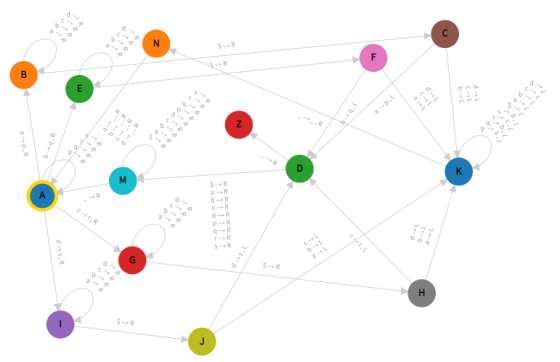
Explanation
- Trying to match the symbols.
- If there is an unmatch, going back to the starting of the string and removing first symbol in word1
Add Answer to:
design a turing machine that accepts word1#word2 where word 2 is
substring of word1.
the regular...
determine if the language is regular, context-free, Turing-decidable, or undecidable. For languages that are regular, give...
 determine if the language is regular, context-free, Turing-decidable, or undecidable. For languages that are regular, give a DFA that accepts the language, a regular expression that generates the language, and a maximal list of strings that are pairwise distinguishable with respect to the language. For languages that are context-free but not regular, prove that the language is not regular and either give a context- free grammar that generates the language or a pushdown automaton that accepts the language. You need...
determine if the language is regular, context-free, Turing-decidable, or undecidable. For languages that are regular, give...
 determine if the language is regular, context-free, Turing-decidable, or undecidable. For languages that are regular, give a DFA that accepts the language, a regular expression that generates the language, and a maximal list of strings that arc pairwise distinguishable with respect to the language. For languages that are context-free but not regular, prove that the language is not regular and either give a context- free grammar that generates the language or a pushdown automaton that accepts the language. You need...
(a) Turing Machines can easily be designed to recognize regular languages. Construct either a Turing Machine...
(a) Turing Machines can easily be designed to recognize regular languages. Construct either a Turing Machine that accepts the language denoted by the regular expression 0^*1 for the alphabet Σ = {0, 1}. Choose a random string in the language and trace through it (step by step) using your machine
Design a TM (Turing Machine) which writes the reverse of the input word on the tape...
 Design a TM (Turing Machine) which writes the reverse of the
input word on the tape after reading the first blank after the
word. The input alphabet is = { &, c, d), and assume the word
starts with &, then with a word from (c+d)*
As an example: input tape is &ccdd..., after
executing the Turing Machine, the tap would contain
&ccddddcc
We were unable to transcribe this imageWe were unable to transcribe this imageWe were unable to transcribe...
Design a TM (Turing Machine) which writes the reverse of the
input word on the tape after reading the first blank after the
word. The input alphabet is = { &, c, d), and assume the word
starts with &, then with a word from (c+d)*
As an example: input tape is &ccdd..., after
executing the Turing Machine, the tap would contain
&ccddddcc
We were unable to transcribe this imageWe were unable to transcribe this imageWe were unable to transcribe...
How do I design a Turing Machine which accepts strings that begin with 'a' and end...
How do I design a Turing Machine which accepts strings that begin with 'a' and end with two 'b's. For example, the strings abb and aaabb should be accepted. While the strings bbaa and ab should not be accepted.
Design a Turing machine that recognizes the language L := {vSw : u, w E {0,1)" and u is a substri...
 Design a Turing machine that recognizes the language L := {vSw : u, w E {0,1)" and u is a substring of u For example, 0801 E L' 10$010 E L, but i 00$10101 ¢ L. Describe the High Level algorithm informally and define the corresponding Turing Machine in details.
Design a Turing machine that recognizes the language L := {vSw : u, w E {0,1)" and u is a substring of u For example, 0801 E L' 10$010 E...
Design a Turing machine that recognizes the language L := {vSw : u, w E {0,1)" and u is a substring of u For example, 0801 E L' 10$010 E L, but i 00$10101 ¢ L. Describe the High Level algorithm informally and define the corresponding Turing Machine in details.
Design a Turing machine that recognizes the language L := {vSw : u, w E {0,1)" and u is a substring of u For example, 0801 E L' 10$010 E...
40 points) Please design a Turing machine T to recognize the union of the languages of two Turing...
 40 points) Please design a Turing machine T to recognize the union of the languages of two Turing machines Mi and M2. That is, T accepts an input string w, if and only if either Mi or M2 or both accept string w. Please describe the high-level idea (or algorithm) of your Turing machine T. You do not need to draw the low-level state transition diagram of your Turing machine. Note that the difficulty is that Mi or M2 may...
2. Let L = {hMi: M is a Turing machine that accepts at least two binary strings}. a) Define the notions of a recognisabl...
 2. Let L = {hMi: M is a Turing machine that accepts at least two
binary strings}. a) Define the notions of a recognisable language
and an undecidable language. [5 marks] b) Is L Turing-recognisable?
Justify your answer with an informal argument. [5 marks] c) Prove
that L is undecidable. (Hint: use Rice’s theorem.) [20 marks] d)
Bonus: Justify with a formal proof your answer to b). [20
marks]
2. Let L-M M): M is a Turing machine that accepts...
2. Let L = {hMi: M is a Turing machine that accepts at least two
binary strings}. a) Define the notions of a recognisable language
and an undecidable language. [5 marks] b) Is L Turing-recognisable?
Justify your answer with an informal argument. [5 marks] c) Prove
that L is undecidable. (Hint: use Rice’s theorem.) [20 marks] d)
Bonus: Justify with a formal proof your answer to b). [20
marks]
2. Let L-M M): M is a Turing machine that accepts...
For a regular language below, write an equivalent regular expression and draw an FA that accepts...
For a regular language below, write an equivalent regular expression and draw an FA that accepts the language. L = {w ∈ {a,b}*:w contains the substring aba}
I'm not sure how to answer this problem. Can someone help me with this. thanks 5. Let M be the Turing machine BIBR 9 9 ala R a) Give a regular expression for L(M. b) Using the techniques from The...
 I'm not sure how to answer this problem. Can someone help me
with this. thanks
5. Let M be the Turing machine BIBR 9 9 ala R a) Give a regular expression for L(M. b) Using the techniques from Theorem 10.1.3, give the rules of an unrestricted gram- mar G that accepts L(M. c) Trace the computation of M when run with input bab and give the corresponding derivation in G.
5. Let M be the Turing machine BIBR 9...
I'm not sure how to answer this problem. Can someone help me
with this. thanks
5. Let M be the Turing machine BIBR 9 9 ala R a) Give a regular expression for L(M. b) Using the techniques from Theorem 10.1.3, give the rules of an unrestricted gram- mar G that accepts L(M. c) Trace the computation of M when run with input bab and give the corresponding derivation in G.
5. Let M be the Turing machine BIBR 9...
 determine if the language is regular, context-free, Turing-decidable, or undecidable. For languages that are regular, give a DFA that accepts the language, a regular expression that generates the language, and a maximal list of strings that are pairwise distinguishable with respect to the language. For languages that are context-free but not regular, prove that the language is not regular and either give a context- free grammar that generates the language or a pushdown automaton that accepts the language. You need...
 determine if the language is regular, context-free, Turing-decidable, or undecidable. For languages that are regular, give a DFA that accepts the language, a regular expression that generates the language, and a maximal list of strings that arc pairwise distinguishable with respect to the language. For languages that are context-free but not regular, prove that the language is not regular and either give a context- free grammar that generates the language or a pushdown automaton that accepts the language. You need...
 Design a TM (Turing Machine) which writes the reverse of the
input word on the tape after reading the first blank after the
word. The input alphabet is = { &, c, d), and assume the word
starts with &, then with a word from (c+d)*
As an example: input tape is &ccdd..., after
executing the Turing Machine, the tap would contain
&ccddddcc
We were unable to transcribe this imageWe were unable to transcribe this imageWe were unable to transcribe...
Design a TM (Turing Machine) which writes the reverse of the
input word on the tape after reading the first blank after the
word. The input alphabet is = { &, c, d), and assume the word
starts with &, then with a word from (c+d)*
As an example: input tape is &ccdd..., after
executing the Turing Machine, the tap would contain
&ccddddcc
We were unable to transcribe this imageWe were unable to transcribe this imageWe were unable to transcribe...
 Design a Turing machine that recognizes the language L := {vSw : u, w E {0,1)" and u is a substring of u For example, 0801 E L' 10$010 E L, but i 00$10101 ¢ L. Describe the High Level algorithm informally and define the corresponding Turing Machine in details.
Design a Turing machine that recognizes the language L := {vSw : u, w E {0,1)" and u is a substring of u For example, 0801 E L' 10$010 E...
Design a Turing machine that recognizes the language L := {vSw : u, w E {0,1)" and u is a substring of u For example, 0801 E L' 10$010 E L, but i 00$10101 ¢ L. Describe the High Level algorithm informally and define the corresponding Turing Machine in details.
Design a Turing machine that recognizes the language L := {vSw : u, w E {0,1)" and u is a substring of u For example, 0801 E L' 10$010 E...
 40 points) Please design a Turing machine T to recognize the union of the languages of two Turing machines Mi and M2. That is, T accepts an input string w, if and only if either Mi or M2 or both accept string w. Please describe the high-level idea (or algorithm) of your Turing machine T. You do not need to draw the low-level state transition diagram of your Turing machine. Note that the difficulty is that Mi or M2 may...
 2. Let L = {hMi: M is a Turing machine that accepts at least two
binary strings}. a) Define the notions of a recognisable language
and an undecidable language. [5 marks] b) Is L Turing-recognisable?
Justify your answer with an informal argument. [5 marks] c) Prove
that L is undecidable. (Hint: use Rice’s theorem.) [20 marks] d)
Bonus: Justify with a formal proof your answer to b). [20
marks]
2. Let L-M M): M is a Turing machine that accepts...
2. Let L = {hMi: M is a Turing machine that accepts at least two
binary strings}. a) Define the notions of a recognisable language
and an undecidable language. [5 marks] b) Is L Turing-recognisable?
Justify your answer with an informal argument. [5 marks] c) Prove
that L is undecidable. (Hint: use Rice’s theorem.) [20 marks] d)
Bonus: Justify with a formal proof your answer to b). [20
marks]
2. Let L-M M): M is a Turing machine that accepts...
 I'm not sure how to answer this problem. Can someone help me
with this. thanks
5. Let M be the Turing machine BIBR 9 9 ala R a) Give a regular expression for L(M. b) Using the techniques from Theorem 10.1.3, give the rules of an unrestricted gram- mar G that accepts L(M. c) Trace the computation of M when run with input bab and give the corresponding derivation in G.
5. Let M be the Turing machine BIBR 9...
I'm not sure how to answer this problem. Can someone help me
with this. thanks
5. Let M be the Turing machine BIBR 9 9 ala R a) Give a regular expression for L(M. b) Using the techniques from Theorem 10.1.3, give the rules of an unrestricted gram- mar G that accepts L(M. c) Trace the computation of M when run with input bab and give the corresponding derivation in G.
5. Let M be the Turing machine BIBR 9...
Most questions answered within 3 hours.
-
Where is the error in this code sequence?
String s1 = "Hello";
String s2 = "ello";...
asked 10 months ago -
Financial data for Joel de Paris, Inc., for last year
follow:
Joel de Paris, Inc.
Balance...
asked 10 months ago -
Consider this reaction:
Al2(SO4)3 (aq)+ BaCl3
(aq) Al2Cl6 (aq)- +
3BaSO4(s) . What is the...
asked 10 months ago -
Suppose that Savneet is considering increasing her
recent random sample from 20 car rentals to 40...
asked 10 months ago -
Trucks arrive at an unloading terminal at an average rate of 120
per hour.
Trucks arrive...
asked 10 months ago -
Why are methanol and ethanol completely soluble in water while
octanol is not very little soluble....
asked 10 months ago -
A facilities manager at a university reads in a research report
that the mean amount of...
asked 10 months ago -
When the CuSO4 is rehydrated by adding water to the anhydrous
compound, is this an endothermic...
asked 10 months ago -
A ray of sunlight is passing from diamond into crown glass; the
angle of incidence is...
asked 10 months ago -
A block of mass 0.249 kg is placed on top of a light, vertical
spring of...
asked 10 months ago -
how do the kidneys compensate in the presences of acidosis
a) trigger hyperventilate
b) reserve acid...
asked 10 months ago -
Question 501 pts
The rental rate of capital to the firm increases. Which of the
following...
asked 10 months ago