Where does the U.S. government get money to pay for its deficit spending? (Macroeconomics) Thanks!
Where does the U.S. government get money to pay for its deficit spending? (Macroeconomics) Thanks!
Homework Answers
There are several ways the US government can pay for the deficit in the budget. When government spends more than what it earns, this results in deficit spending and it can be financed through borrowing from public, printing money or raising taxes.
Currently the government relies more on acquiring funds from public, both from domestic and foreign investors. This results in accumulating national / public debt. Currently, U.S. federal debt is 109 percent of America’s GDP. Federal Reserve has indirectly financed 60 percent of the deficit on quarterly basis, in addition, there is financing by foreign investors including foreign central banks. So the financing comes from domestic investors (public and banks), Federal reserve and foreign banks.
Add Answer to:
Where does the U.S. government get money to pay for its deficit
spending? (Macroeconomics) Thanks!
Why would policymakers advocate printing money to pay for government spending? What impact does printing money...
Why would policymakers advocate printing money to pay for government spending? What impact does printing money to pay for government spending have on the public?
Macroeconomics (consumption, investment and loanable funds) question. The Current U.S. government spending is $4.746 trillion. That's...
Macroeconomics (consumption, investment and loanable funds) question. The Current U.S. government spending is $4.746 trillion. That's the federal budget for fiscal year 2020 covering October 1, 2019, to September 30, 2020. It's 21% of gross domestic product. That means that Government Spending in the United States has increased under the current U.S. Administration. Additionally, last year the Congress passed a tax reform that, among other effects, cut payroll taxes: i) Can you establish the macroeconomics effects of these policies on...
When the government spends tax dollars where does the money come from? What does the government...
When the government spends tax dollars where does the money come from? What does the government obtain with the money? Are there any opportunity costs to government taxing and spending?
Suppose that the U.S. government significantly increases its budget deficit and finances the resulting debt by...
 Suppose that the U.S. government significantly increases its
budget deficit and finances the resulting debt by selling
government bonds to Canadians. What would be the impact of this
action on the bond markets
Suppose that the U.S. government significantly increases its budget deficit and finances the resulting debt by selling government bonds to Canadians. What would be the impact of this action on the bond markets.
Suppose that the U.S. government significantly increases its
budget deficit and finances the resulting debt by selling
government bonds to Canadians. What would be the impact of this
action on the bond markets
Suppose that the U.S. government significantly increases its budget deficit and finances the resulting debt by selling government bonds to Canadians. What would be the impact of this action on the bond markets.
In 2010 the U.S. government was running a large budget deficit. Some were concerned that pressure...
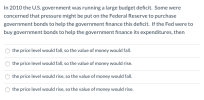 In 2010 the U.S. government was running a large budget deficit. Some were concerned that pressure might be put on the Federal Reserve to purchase government bonds to help the government finance this deficit. If the Fed were to buy government bonds to help the government finance its expenditures, then the price level would fall, so the value of money would fall. the price level would fall, so the value of money would rise. the price level would rise, so...
What means would be best to reduce the current U.S. government deficit: (a) Cuts in mandatory...
What means would be best to reduce the current U.S. government deficit: (a) Cuts in mandatory spending programs; (b) Cuts in discretionary spending; and/or (c) Increased taxation? Explain why the particular actions you recommend are the best approach for reducing the deficit.
empt=475859&cmid=1507980 es EUN-1416 PTIT OF Macroeconomics Spring ZUZU / Money and the recerar Reserve (LH 1481...
 empt=475859&cmid=1507980 es EUN-1416 PTIT OF Macroeconomics Spring ZUZU / Money and the recerar Reserve (LH 1481 When the government collects more in taxes than it pays out in government spending and transfer payments, the result is a: Select one: a. trade deficit. b. recession. c. budget deficit. d. budget surplus. The sum of past federal budget deficits is the: backs <
Figure 16-3 Interest Rate \Do Quantity of Money Figure 16-3 shows the impact of deficit spending...
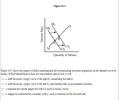 Figure 16-3 Interest Rate \Do Quantity of Money Figure 16-3 shows the impact of deficit spending and the corresponding economic expansion on the demand curve for money. If the Federal Reserve does not want interest rates to rise, it will a. shift the money supply curve to the right by monetizing the deficit b. shift the money supply curve to the left by open market sales of government securities c. maintain the current targets for both M1 and M2 money...
Question text A budget deficit occurs when government receipts are less than spending and a budget...
Question text A budget deficit occurs when government receipts are less than spending and a budget surplus occurs when government spending is less than receipts. Select one: True False Question 29 Not yet answered Marked out of 0.4 An advantage of a consumption tax over the present income tax system is that a consumption tax discourages consumption and encourages saving. Select one: True False Question 30 One of the largest categories of U.S. federal government spending is Social Security and...
5. Using money creation to pay for government spending Consider Kharkeez, a hypothetical country that produces...
 5. Using money creation to pay for government spending Consider Kharkeez, a hypothetical country that produces only burgers. In 2019, a burger is priced at $4.00. Complete the first row of the table with the quantity of burgers that can be bought with $700. Hint: In this problem, assume it is not possible to buy a fraction of a burger, and always round down to the nearest whole burger. For example, if your calculations result in 1.5 burgers, the answer...
 Suppose that the U.S. government significantly increases its
budget deficit and finances the resulting debt by selling
government bonds to Canadians. What would be the impact of this
action on the bond markets
Suppose that the U.S. government significantly increases its budget deficit and finances the resulting debt by selling government bonds to Canadians. What would be the impact of this action on the bond markets.
Suppose that the U.S. government significantly increases its
budget deficit and finances the resulting debt by selling
government bonds to Canadians. What would be the impact of this
action on the bond markets
Suppose that the U.S. government significantly increases its budget deficit and finances the resulting debt by selling government bonds to Canadians. What would be the impact of this action on the bond markets.
 In 2010 the U.S. government was running a large budget deficit. Some were concerned that pressure might be put on the Federal Reserve to purchase government bonds to help the government finance this deficit. If the Fed were to buy government bonds to help the government finance its expenditures, then the price level would fall, so the value of money would fall. the price level would fall, so the value of money would rise. the price level would rise, so...
 empt=475859&cmid=1507980 es EUN-1416 PTIT OF Macroeconomics Spring ZUZU / Money and the recerar Reserve (LH 1481 When the government collects more in taxes than it pays out in government spending and transfer payments, the result is a: Select one: a. trade deficit. b. recession. c. budget deficit. d. budget surplus. The sum of past federal budget deficits is the: backs <
 Figure 16-3 Interest Rate \Do Quantity of Money Figure 16-3 shows the impact of deficit spending and the corresponding economic expansion on the demand curve for money. If the Federal Reserve does not want interest rates to rise, it will a. shift the money supply curve to the right by monetizing the deficit b. shift the money supply curve to the left by open market sales of government securities c. maintain the current targets for both M1 and M2 money...
 5. Using money creation to pay for government spending Consider Kharkeez, a hypothetical country that produces only burgers. In 2019, a burger is priced at $4.00. Complete the first row of the table with the quantity of burgers that can be bought with $700. Hint: In this problem, assume it is not possible to buy a fraction of a burger, and always round down to the nearest whole burger. For example, if your calculations result in 1.5 burgers, the answer...
Most questions answered within 3 hours.
-
Where is the error in this code sequence?
String s1 = "Hello";
String s2 = "ello";...
asked 11 months ago -
Financial data for Joel de Paris, Inc., for last year
follow:
Joel de Paris, Inc.
Balance...
asked 11 months ago -
Consider this reaction:
Al2(SO4)3 (aq)+ BaCl3
(aq) Al2Cl6 (aq)- +
3BaSO4(s) . What is the...
asked 11 months ago -
Suppose that Savneet is considering increasing her
recent random sample from 20 car rentals to 40...
asked 11 months ago -
Trucks arrive at an unloading terminal at an average rate of 120
per hour.
Trucks arrive...
asked 11 months ago -
Why are methanol and ethanol completely soluble in water while
octanol is not very little soluble....
asked 11 months ago -
A facilities manager at a university reads in a research report
that the mean amount of...
asked 11 months ago -
When the CuSO4 is rehydrated by adding water to the anhydrous
compound, is this an endothermic...
asked 11 months ago -
A ray of sunlight is passing from diamond into crown glass; the
angle of incidence is...
asked 11 months ago -
A block of mass 0.249 kg is placed on top of a light, vertical
spring of...
asked 11 months ago -
how do the kidneys compensate in the presences of acidosis
a) trigger hyperventilate
b) reserve acid...
asked 11 months ago -
Question 501 pts
The rental rate of capital to the firm increases. Which of the
following...
asked 11 months ago