Grignard Reaction Question 3: If unreacted Mg is present why should you not add HCl in...
Grignard Reaction
Question 3:
If unreacted Mg is present why should you not add HCl in working up the reaction? Show the complete chemical reaction to explain.
Homework Answers
Request Answer!
We need at least 10 more requests to produce the answer.
0 / 10 have requested this problem solution
The more requests, the faster the answer.
Add Answer to:
Grignard Reaction
Question 3:
If unreacted Mg is present why should you not add HCl in...
Why should we add HCl to the reaction mixture at the end of the nitrile hydrolysis...
 Why should we add HCl to the reaction mixture at the end of the nitrile hydrolysis reaction. Explain!!
Why will the following reaction not occur the way that it is described? 3. C Mg...
 Why will the following reaction not occur the way that it is described? 3. C Mg The 3-iodopropyne is pointing the wrong direction a. b. An elimination reaction is favored over a substitution. The product of chlorocyclopentane and Mg° is too sterically hindered to add to the 3- iodopropyne. C. d. The 3-iodopropyne contains an acidic hydrogen and cannot be made into a Grignard reagent. Grignard reagents don't react well with alkyl halides. e.
Grignard reagent THE GRIGNARD REAGENT-PREPARATION AND REACTION In this experiment, you will prepa...
 i need help with the postlab questions please
Grignard reagent THE GRIGNARD REAGENT-PREPARATION AND REACTION In this experiment, you will prepare a Grignard reagent, phenyl magnesium bromide, from bromobenzene and magnesium metal. The Grignard reagent will then react with methyl benzoate to form triphenylmethanol. Introduction Grignard reagents, such as organomagnesium halides, were discovered in 1910 by French chemist Victor Grignard. The Grignard reaction is one of the most general methods for carbon- carbon bond formation in all of organic chemistry....
i need help with the postlab questions please
Grignard reagent THE GRIGNARD REAGENT-PREPARATION AND REACTION In this experiment, you will prepare a Grignard reagent, phenyl magnesium bromide, from bromobenzene and magnesium metal. The Grignard reagent will then react with methyl benzoate to form triphenylmethanol. Introduction Grignard reagents, such as organomagnesium halides, were discovered in 1910 by French chemist Victor Grignard. The Grignard reaction is one of the most general methods for carbon- carbon bond formation in all of organic chemistry....
Please only answer 3 P Grignard 1. During the formation of the Grignard reagent, the solution...
 Please only answer 3
P
Grignard 1. During the formation of the Grignard reagent, the solution can boil without addition of external heat. Explain 2. Explain why acetone and water should be excluded from the reaction vessel during the formation of the Grignard reagent. 3. At what stage of the procedure can water be allowed to come into contact with the reaction solution? 4. Why is the dry ice crushed before use and why should you wait to crush the...
Please only answer 3
P
Grignard 1. During the formation of the Grignard reagent, the solution can boil without addition of external heat. Explain 2. Explain why acetone and water should be excluded from the reaction vessel during the formation of the Grignard reagent. 3. At what stage of the procedure can water be allowed to come into contact with the reaction solution? 4. Why is the dry ice crushed before use and why should you wait to crush the...
Pre-lab Question 1. Briefly explain why Grignard reaction are considered a very versatile class of reactions....
Pre-lab Question 1. Briefly explain why Grignard reaction are considered a very versatile class of reactions. 1b. What solvents are often used in Grignard reactions and briefly explain why. 1c. One possible side product of this experiment is biphenyl, explain how it can form. How can you determine if this side product has formed? 1d. Why is the reaction moisture sensitive?
Write the chemical equation for the reaction that occurs when you add HCl solution to a...
Write the chemical equation for the reaction that occurs when you add HCl solution to a CH3CO2H/NaCH3CO2 buffer system. Thank you!
write the chemical equation for the reaction that occurs when you add HCl solution to a...
write the chemical equation for the reaction that occurs when you add HCl solution to a CH3CO2H/NaCH3CO2 buffer system
Grignard reagent THE GRIGNARD REAGENT-PREPARATION AND REACTION In this experiment, you will prepa...
 i need help with the prelab questions please
Grignard reagent THE GRIGNARD REAGENT-PREPARATION AND REACTION In this experiment, you will prepare a Grignard reagent, phenyl magnesium bromide, from bromobenzene and magnesium metal. The Grignard reagent will then react with methyl benzoate to form triphenylmethanol. Introduction Grignard reagents, such as organomagnesium halides, were discovered in 1910 by French chemist Victor Grignard. The Grignard reaction is one of the most general methods for carbon- carbon bond formation in all of organic chemistry....
i need help with the prelab questions please
Grignard reagent THE GRIGNARD REAGENT-PREPARATION AND REACTION In this experiment, you will prepare a Grignard reagent, phenyl magnesium bromide, from bromobenzene and magnesium metal. The Grignard reagent will then react with methyl benzoate to form triphenylmethanol. Introduction Grignard reagents, such as organomagnesium halides, were discovered in 1910 by French chemist Victor Grignard. The Grignard reaction is one of the most general methods for carbon- carbon bond formation in all of organic chemistry....
The Grignard reaction has good yields but a major limitation is that halides and carbonyls react....
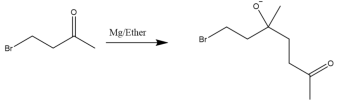 The Grignard reaction has good yields but a major limitation is
that halides and carbonyls react. In fact if a compound has more
than one of either, you end up forming oligomers. How do you
prevent oligomers forming? Propose a way to prevent them? Explain
why this works.
Mg/Ether Br Br
The Grignard reaction has good yields but a major limitation is
that halides and carbonyls react. In fact if a compound has more
than one of either, you end up forming oligomers. How do you
prevent oligomers forming? Propose a way to prevent them? Explain
why this works.
Mg/Ether Br Br
Question 1 5 pts I. Reacting Mg(s) with HCl(aq) solution 1) evidence that a chemical reaction...
 Question 1 5 pts I. Reacting Mg(s) with HCl(aq) solution 1) evidence that a chemical reaction occurred: gas evolution 2) molecular equation: 3) general reaction type: HTML Editora
 Why should we add HCl to the reaction mixture at the end of the nitrile hydrolysis reaction. Explain!!
 Why will the following reaction not occur the way that it is described? 3. C Mg The 3-iodopropyne is pointing the wrong direction a. b. An elimination reaction is favored over a substitution. The product of chlorocyclopentane and Mg° is too sterically hindered to add to the 3- iodopropyne. C. d. The 3-iodopropyne contains an acidic hydrogen and cannot be made into a Grignard reagent. Grignard reagents don't react well with alkyl halides. e.
 i need help with the postlab questions please
Grignard reagent THE GRIGNARD REAGENT-PREPARATION AND REACTION In this experiment, you will prepare a Grignard reagent, phenyl magnesium bromide, from bromobenzene and magnesium metal. The Grignard reagent will then react with methyl benzoate to form triphenylmethanol. Introduction Grignard reagents, such as organomagnesium halides, were discovered in 1910 by French chemist Victor Grignard. The Grignard reaction is one of the most general methods for carbon- carbon bond formation in all of organic chemistry....
i need help with the postlab questions please
Grignard reagent THE GRIGNARD REAGENT-PREPARATION AND REACTION In this experiment, you will prepare a Grignard reagent, phenyl magnesium bromide, from bromobenzene and magnesium metal. The Grignard reagent will then react with methyl benzoate to form triphenylmethanol. Introduction Grignard reagents, such as organomagnesium halides, were discovered in 1910 by French chemist Victor Grignard. The Grignard reaction is one of the most general methods for carbon- carbon bond formation in all of organic chemistry....
 Please only answer 3
P
Grignard 1. During the formation of the Grignard reagent, the solution can boil without addition of external heat. Explain 2. Explain why acetone and water should be excluded from the reaction vessel during the formation of the Grignard reagent. 3. At what stage of the procedure can water be allowed to come into contact with the reaction solution? 4. Why is the dry ice crushed before use and why should you wait to crush the...
Please only answer 3
P
Grignard 1. During the formation of the Grignard reagent, the solution can boil without addition of external heat. Explain 2. Explain why acetone and water should be excluded from the reaction vessel during the formation of the Grignard reagent. 3. At what stage of the procedure can water be allowed to come into contact with the reaction solution? 4. Why is the dry ice crushed before use and why should you wait to crush the...
 i need help with the prelab questions please
Grignard reagent THE GRIGNARD REAGENT-PREPARATION AND REACTION In this experiment, you will prepare a Grignard reagent, phenyl magnesium bromide, from bromobenzene and magnesium metal. The Grignard reagent will then react with methyl benzoate to form triphenylmethanol. Introduction Grignard reagents, such as organomagnesium halides, were discovered in 1910 by French chemist Victor Grignard. The Grignard reaction is one of the most general methods for carbon- carbon bond formation in all of organic chemistry....
i need help with the prelab questions please
Grignard reagent THE GRIGNARD REAGENT-PREPARATION AND REACTION In this experiment, you will prepare a Grignard reagent, phenyl magnesium bromide, from bromobenzene and magnesium metal. The Grignard reagent will then react with methyl benzoate to form triphenylmethanol. Introduction Grignard reagents, such as organomagnesium halides, were discovered in 1910 by French chemist Victor Grignard. The Grignard reaction is one of the most general methods for carbon- carbon bond formation in all of organic chemistry....
 The Grignard reaction has good yields but a major limitation is
that halides and carbonyls react. In fact if a compound has more
than one of either, you end up forming oligomers. How do you
prevent oligomers forming? Propose a way to prevent them? Explain
why this works.
Mg/Ether Br Br
The Grignard reaction has good yields but a major limitation is
that halides and carbonyls react. In fact if a compound has more
than one of either, you end up forming oligomers. How do you
prevent oligomers forming? Propose a way to prevent them? Explain
why this works.
Mg/Ether Br Br
 Question 1 5 pts I. Reacting Mg(s) with HCl(aq) solution 1) evidence that a chemical reaction occurred: gas evolution 2) molecular equation: 3) general reaction type: HTML Editora
Most questions answered within 3 hours.
-
Where is the error in this code sequence?
String s1 = "Hello";
String s2 = "ello";...
asked 10 months ago -
Financial data for Joel de Paris, Inc., for last year
follow:
Joel de Paris, Inc.
Balance...
asked 10 months ago -
Consider this reaction:
Al2(SO4)3 (aq)+ BaCl3
(aq) Al2Cl6 (aq)- +
3BaSO4(s) . What is the...
asked 10 months ago -
Suppose that Savneet is considering increasing her
recent random sample from 20 car rentals to 40...
asked 10 months ago -
Trucks arrive at an unloading terminal at an average rate of 120
per hour.
Trucks arrive...
asked 10 months ago -
Why are methanol and ethanol completely soluble in water while
octanol is not very little soluble....
asked 10 months ago -
A facilities manager at a university reads in a research report
that the mean amount of...
asked 10 months ago -
When the CuSO4 is rehydrated by adding water to the anhydrous
compound, is this an endothermic...
asked 10 months ago -
A ray of sunlight is passing from diamond into crown glass; the
angle of incidence is...
asked 10 months ago -
A block of mass 0.249 kg is placed on top of a light, vertical
spring of...
asked 10 months ago -
how do the kidneys compensate in the presences of acidosis
a) trigger hyperventilate
b) reserve acid...
asked 10 months ago -
Question 501 pts
The rental rate of capital to the firm increases. Which of the
following...
asked 10 months ago