The standard cell potential for a reaction in an electrolytic cell is always Select the correct...
The standard cell potential for a reaction in an electrolytic cell is always
Select the correct answer below:
positive
negative
zero
impossible to determine
Homework Answers

Add Answer to:
The standard cell potential for a reaction in an electrolytic
cell is always
Select the correct...
For a galvanic cell where the standard free energy change is negative and the cell potential...
 For a galvanic cell where the standard free energy change is negative and the cell potential is positive, the reaction in the cell must be: Select the correct answer below: O always spontaneous O never spontaneous O spontaneous at certain temperatures O impossible to predict
QUESTION 11 A. Electrolytic B. Electrolytic Match the voltaic and electrolytic cell concepts A. A Requires...
 QUESTION 11 A. Electrolytic B. Electrolytic Match the voltaic and electrolytic cell concepts A. A Requires energy input B. Has a negative cell potential E. is used to power tools C. A is spontaneous F. Has the positive terminal on the left side D. A Requires a salt bridge C. Voltaic D. Voltaic E. Electrolytic F. Voltaic ALL QUESTION 12
One difference between an electrolytic cell and a galvanic (voltaic) cell is the galvanic cell reaction...
One difference between an electrolytic cell and a galvanic (voltaic) cell is the galvanic cell reaction is spontaneous and the electrolytic cell reaction is not spontaneous. galvanic cells last longer than electrolytic cells.` electrolytic cells produce more power than galvanic cells. electrolytic cells always require inert electrodes .electrons flow from the anode to the cathode in a galvanic cell and in the opposite direction in a voltaic cell.
Using tabulated standard reduction potentials from your text, calculate the standard cell potential, E degree_cell (always...
 Using tabulated standard reduction potentials from your text, calculate the standard cell potential, E degree_cell (always positive for a galvanic cell), based on the following reaction: Cu^2+ (aq) + Mg(s) Mg^2+ (aq) + Cu(s) A galvanic cell based on the above reaction is constructed according to the generic sketch of a galvanic cell shown below:
13, Electron flow in an electrolytic cell is always from to A. anode to cathode B....
 13, Electron flow in an electrolytic cell is always from to A. anode to cathode B. cathode to anode C. anode to negative terminal 14. The cathode terminal in an electrolytic cell is the terminal. A. (-) B. +) C. neutral 15 Bacod on t
Question 5 (4 points) Saved Electrolytic cells must have a standard cell potential of < 0.000...
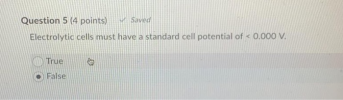 Question 5 (4 points) Saved Electrolytic cells must have a standard cell potential of < 0.000 V. True False
If a standard cell potential is E∘cell=+0.85VEcell∘=+0.85V at 25 ∘C∘C, is the redox reaction of the...
If a standard cell potential is E∘cell=+0.85VEcell∘=+0.85V at 25 ∘C∘C, is the redox reaction of the cell spontaneous? If a standard cell potential is at 25 , is the redox reaction of the cell spontaneous? Yes, a redox reaction with a positive standard cell potential is spontaneous under standard conditions. No, a redox reaction with a positive standard cell potential is not spontaneous under standard conditions. No, a redox reaction will not take place at all.
Determine the standard cell potential (in volts) at 25 degree C for the following reaction. You...
 Determine the standard cell potential (in volts) at 25 degree C for the following reaction. You will need to look up the relevant reduction potentials in your textbook. 3 Cu^2+ _(aq) + 2 Al_(s) rightarrow 2 Al^3+ _(aq) + 3 Cu_(s) TRUE or FALSE: The above reaction is non-spontaneous and would need the input of electricity to move forward as an electrolytic cell. True False
For a standard electrolytic cell, a power source forces the reaction Cu + Zn2+ -> Cu2+ + Zn to occur.
 For a standard electrolytic cell, a power source forces the reaction Cu + Zn2+ -> Cu2+ + Zn to occur. Determine the mass of copper that is plated out when a current of 10.0 A is passed for 30.0 minutes through a solution containing Cu2+.
Which of the following statements is TRUE? Select one: a. Cell potential is the difference in...
 Which of the following statements is TRUE? Select one: a. Cell potential is the difference in electromagnetic potential between two half cells of an electrochemical cell b. Cell potential is also known as electrovoltaic force c. Cell potential is the difference in electric potential between two electrodes of an electrochemical cell d. A small battery will have a smaller cell potential than a large battery made out of the same materials e. Cell potential increases as a battery is discharged...
 For a galvanic cell where the standard free energy change is negative and the cell potential is positive, the reaction in the cell must be: Select the correct answer below: O always spontaneous O never spontaneous O spontaneous at certain temperatures O impossible to predict
 QUESTION 11 A. Electrolytic B. Electrolytic Match the voltaic and electrolytic cell concepts A. A Requires energy input B. Has a negative cell potential E. is used to power tools C. A is spontaneous F. Has the positive terminal on the left side D. A Requires a salt bridge C. Voltaic D. Voltaic E. Electrolytic F. Voltaic ALL QUESTION 12
 Using tabulated standard reduction potentials from your text, calculate the standard cell potential, E degree_cell (always positive for a galvanic cell), based on the following reaction: Cu^2+ (aq) + Mg(s) Mg^2+ (aq) + Cu(s) A galvanic cell based on the above reaction is constructed according to the generic sketch of a galvanic cell shown below:
 13, Electron flow in an electrolytic cell is always from to A. anode to cathode B. cathode to anode C. anode to negative terminal 14. The cathode terminal in an electrolytic cell is the terminal. A. (-) B. +) C. neutral 15 Bacod on t
 Question 5 (4 points) Saved Electrolytic cells must have a standard cell potential of < 0.000 V. True False
 Determine the standard cell potential (in volts) at 25 degree C for the following reaction. You will need to look up the relevant reduction potentials in your textbook. 3 Cu^2+ _(aq) + 2 Al_(s) rightarrow 2 Al^3+ _(aq) + 3 Cu_(s) TRUE or FALSE: The above reaction is non-spontaneous and would need the input of electricity to move forward as an electrolytic cell. True False
 Which of the following statements is TRUE? Select one: a. Cell potential is the difference in electromagnetic potential between two half cells of an electrochemical cell b. Cell potential is also known as electrovoltaic force c. Cell potential is the difference in electric potential between two electrodes of an electrochemical cell d. A small battery will have a smaller cell potential than a large battery made out of the same materials e. Cell potential increases as a battery is discharged...
Most questions answered within 3 hours.
-
Where is the error in this code sequence?
String s1 = "Hello";
String s2 = "ello";...
asked 10 months ago -
Financial data for Joel de Paris, Inc., for last year
follow:
Joel de Paris, Inc.
Balance...
asked 10 months ago -
Consider this reaction:
Al2(SO4)3 (aq)+ BaCl3
(aq) Al2Cl6 (aq)- +
3BaSO4(s) . What is the...
asked 10 months ago -
Suppose that Savneet is considering increasing her
recent random sample from 20 car rentals to 40...
asked 10 months ago -
Trucks arrive at an unloading terminal at an average rate of 120
per hour.
Trucks arrive...
asked 10 months ago -
Why are methanol and ethanol completely soluble in water while
octanol is not very little soluble....
asked 10 months ago -
A facilities manager at a university reads in a research report
that the mean amount of...
asked 10 months ago -
When the CuSO4 is rehydrated by adding water to the anhydrous
compound, is this an endothermic...
asked 10 months ago -
A ray of sunlight is passing from diamond into crown glass; the
angle of incidence is...
asked 10 months ago -
A block of mass 0.249 kg is placed on top of a light, vertical
spring of...
asked 10 months ago -
how do the kidneys compensate in the presences of acidosis
a) trigger hyperventilate
b) reserve acid...
asked 10 months ago -
Question 501 pts
The rental rate of capital to the firm increases. Which of the
following...
asked 10 months ago