I need help for the order of growth for functions in Python 3. Q1: What is...
I need help for the order of growth for functions in Python 3.
Q1: What is the order of growth for the following functions?
Kinds of Growth
Here are some common orders of growth, ranked from no growth to fastest growth:
1. Θ(1) — constant time takes the same amount of time regardless of input size
2. Θ(log n) — logarithmic time
3. Θ(n) — linear time
4. Θ(n log n) — linearithmic time
5. Θ(n2 )
6. Θ(n3 ), etc. — polynomial time
7. Θ(2n), Θ(3n), etc. — exponential time (considered “intractable”; these are really, really horrible)
8. Something else not listed
You should create a parameter-free function called question1 and return a list with 10 numbers. You should put the corresponding growth rate (1-8) for each of the problems listed below.
For example:
Answer: 3 (that is linear time)
Explanation (you do not have write it but you will in the exam, so make sure you understand your choice):
There is a single loop that runs n−5 times. Each time the loop runs it executes 1 instruction in the loop header and 1 instruction in the body of the loop. The total number of instructions is 2 ∗ (n − 5) + 1 (for the last loop check) = 2n − 9 = Θ(n)
If you need more examples, you can look here: https://www.comp.nus.edu.sg/~cs1020/tut/15s2/tut09ans/T9_ans.pdf
Please note:
1) They use big-O notation, which is the same as big-Theta for our purposes. (Big-O is an upper bound and Big-Theta is a tight bound, but in computer science both bounds are often used interchangeably.)
2) They use Java syntax in their loops. You can read it as:
for (int i = 0; i < n; i=i+1)
a) i is initialized to a 0.
b) if i is less than n, perform one iteration of the loop
c) increment i by 1, check if i is less than n. If it is, run the loop again etc; if i is greater than n, stop.
Equivalent loop in Python is: for i in range(0, n)
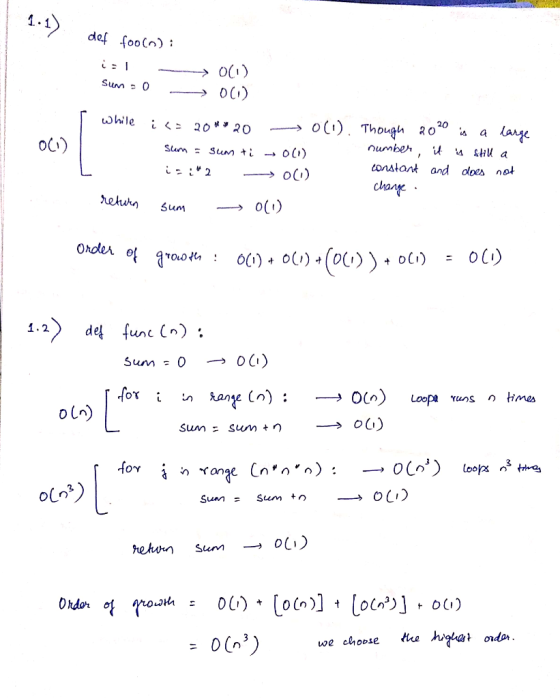
Question 1.1
def foo(n):
i = 1
sum = 0
while i <= 20**20:
sum = sum + i
i = i * 2
return sum
Question 1.2
def func(n):
sum = 0
for i in range(n):
sum =
sum + n
for j in range(n * n * n):
sum =
sum + 10
return sum
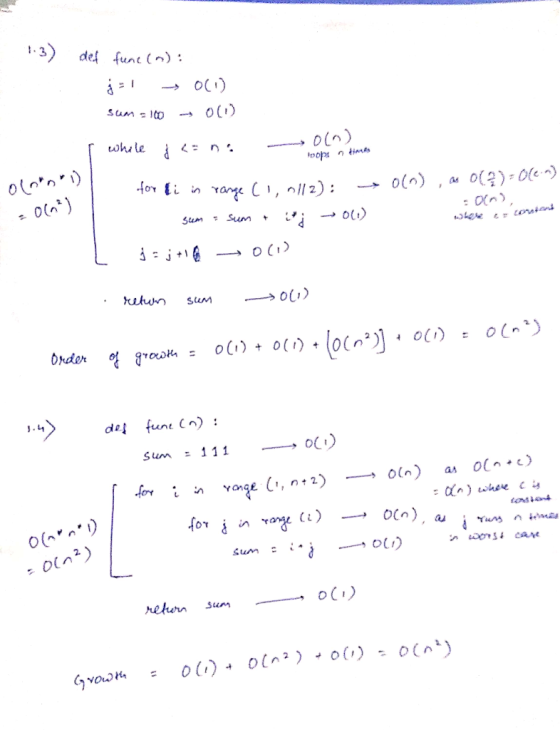
Question 1.3
def func(n):
j = 1
sum = 100
while j <= n:
for i in
range(1, n//2):
sum = sum + i*j
j = j
+ 1
return sum
Question 1.4
def func(n):
sum = 111
for i in range(1, n+2):
for j in range(i):
sum = i + j
return sum
Question 1.5
def func(n):
i = 1
sum = 0
while i <= n:
sum = sum * i
i = i * 5
return sum
Question 1.6
def mod_10(n):
if n % 10 == 0:
return 10
else:
return 1 + mod_10(n-1)
Question 1.7
Calculate the complexity for foo(bar(n)). To see pattern I'd suggest you to take different inputs for n and write down the recursion tree.
def bar(n):
if n%2 == 1:
return n + 1
return n
def foo(n):
if n < 1:
return 2
if n % 2 == 0:
return foo(n-1)
+ foo(n-2)
else:
return 1 +
foo(n-2)
Question 1.8
def func(alist):
for num in
range(len(alist)-1,0,-1):
for i in range(num):
if
alist[i] > alist[i+1]:
alist[i], alist[i+1] = alist[i+1], alist[i]
Question 1.9
def func(n):
for i in range(0,n):
for j
in range (i+1, i, -1):
for k in range(n, j, -1):
print("print")
Question 1.10
Calculate the complexity for second(n).
def first(n):
for i in range(0, n):
print("one")
def second(n):
for i in range(0, n):
first(n)
Homework Answers
Note : O(c*n) = O(n + k) = O(n) where c, k are constants.
O(c1*n) * O(c2*n^2) *O(1) = O(n^3).
Add Answer to:
I need help for the order of growth for functions in Python
3.
Q1: What is...
Python Merge Sort Adjust the following code so that you can create random lists of numbers of lengths 10, 15, and 20. You will run the merge sort 10 times for each length. Record the run time for the...
 Python Merge Sort
Adjust the following code so that you can create
random lists of numbers of lengths 10, 15,
and 20.
You will run the merge sort 10 times for each
length. Record the run time for the length and then calculate the
average time to sort.
Finally, compare the average run time for each length to the
average time for the Merge Sort.
--------------------------------------------
Initial python code:
import random
import time
def mergeSort(alist):
print("Splitting ",alist)
if len(alist)>1:
mid...
Python Merge Sort
Adjust the following code so that you can create
random lists of numbers of lengths 10, 15,
and 20.
You will run the merge sort 10 times for each
length. Record the run time for the length and then calculate the
average time to sort.
Finally, compare the average run time for each length to the
average time for the Merge Sort.
--------------------------------------------
Initial python code:
import random
import time
def mergeSort(alist):
print("Splitting ",alist)
if len(alist)>1:
mid...
8. R-4.8 Order the following functions by asymptotic growth rate. 4nlogn + 2n 2^10 2^logn 3n...
8. R-4.8 Order the following functions by asymptotic growth rate. 4nlogn + 2n 2^10 2^logn 3n + 100logn 4n 2^n n^2 + 10n n^3 nlogn 9. R-4.9 Give a big-Oh characterization, in terms of n, of the running time of the example 1 method shown in Code Fragment 4.12. 10. R-4.10 Give a big-Oh characterization, in terms of n, of the running time of the example 2 method shown in Code Fragment 4.12. 11. R-4.11 Give a big-Oh characterization, in...
Python 3 5. (16 points) Determine the big-O running time of each of the following functions:...
 Python 3
5. (16 points) Determine the big-O running time of each of the following functions: def pi (a) for i in range(len (a)): print (a[i]) for i in range(len(a)): print (ali]) def p2(a): for i in rangeClen(a)): for j in a: print (ati].j) def p3(a): for i in a: for j in a: print (i,j) def p4(a): for i in range(len(a)): pi(a) def p5(a): for i in range(len(a)): p3 (a) def p6(a): for i in range(len(a)): p5(a) def p7...
Python 3
5. (16 points) Determine the big-O running time of each of the following functions: def pi (a) for i in range(len (a)): print (a[i]) for i in range(len(a)): print (ali]) def p2(a): for i in rangeClen(a)): for j in a: print (ati].j) def p3(a): for i in a: for j in a: print (i,j) def p4(a): for i in range(len(a)): pi(a) def p5(a): for i in range(len(a)): p3 (a) def p6(a): for i in range(len(a)): p5(a) def p7...
I need to write a program based on two finished programs (listm.py and setunion.py) to implement...
I need to write a program based on two finished programs (listm.py and setunion.py) to implement the intersection operation between two sets of list. The program should not use the Python built-in list and set related functions and operations. I'm sorry about the program format is wrong(no "TAB" space), here is the same question I posted 2 days ago, but the question title is incorrect, there have complete images of my 3 Python program. The link is: https://www.chegg.com/homework-help/questions-and-answers/need-write-program-based-two-finished-programs-listmpy-setunionpy-implement-intersection-o-q44800953?trackid=uNY0ilRc Thank you!...
in my c++ class i need help with these question please Question 1. Indicate whether the...
in my c++ class i need help with these question please Question 1. Indicate whether the first function of each of the following pairs has a smaller, same, or larger order of growth (to within a constant multiple) than the second function. Use the correct notation to indicate the order of growth (f(n) ∈O(g(n)), Ω(g(n)), or Θ(g(n)) as applicable). Prove your statement using limits. (a) (lnn)2 and lnn2 (b) 42n+1 and 42n Question 2. Use the formal definitions of O,...
Python 3 Question: All I need is for someone to edit the program with comments that...
Python 3 Question: All I need is for someone to edit the program with comments that explains what the program is doing (for the entire program) def main(): developerInfo() #i left this part out retail = Retail_Item() test = Cash_Register() test.data(retail.get_item_number(), retail.get_description(), retail.get_unit_in_inventory(), retail.get_price()) answer = 'n' while answer == 'n' or answer == 'N': test.Menu() print() print() Number = int(input("Enter the menu number of the item " "you would like to purchase: ")) if Number == 8: test.show_items() else:...
What are the outputs for each question PYTHON Question 6 bools = [True, 0>-1, not not...
What are the outputs for each question PYTHON Question 6 bools = [True, 0>-1, not not True, 2%2 == 0, True and False] index = 0 while bools[index]: index += 1 print(index) a) 0 b) 1 c) 2 d) 3 e) none of the above Question 7 for i in range(2): for j in range(1): print(i, j, end = " ") a) no output b) 0 0 1 0 2 0 c) 0 0 0 1 1 0 1 1...
1 question) Arrange the following in the order of their growth rates, from least to greatest:...
1 question) Arrange the following in the order of their growth rates, from least to greatest: (5 pts) n3 n2 nn lg n n! n lg n 2n n 2 question)Show that 3n3 + n2 is big-Oh of n3. You can use either the definition of big-Oh (formal) or the limit approach. Show your work! (5 pts.) 3 question)Show that 6n2 + 20n is big-Oh of n3, but not big-Omega of n3. You can use either the definition of big-Omega...
Consider the following python code that will sort the list of numbers using the Bubble Sort...
 Consider the following python code that will sort the list of numbers using the Bubble Sort algorithm def bubbleSort(alist): print(alist) for j in range (len(alist) - 1, 8, -1): for i in range(): if alist[i] > alist[i + 1]: temp = alist[i] alist[i] = alist[i+1] alist[i+1] = temp print(alist) alist = [52, 25, 94, 17, 25, 52] bubbleSort (alist) print(alist) Sort the following series of values into ascending order using the Bubble Sort algorithm. Write out the complete row of...
 Python Merge Sort
Adjust the following code so that you can create
random lists of numbers of lengths 10, 15,
and 20.
You will run the merge sort 10 times for each
length. Record the run time for the length and then calculate the
average time to sort.
Finally, compare the average run time for each length to the
average time for the Merge Sort.
--------------------------------------------
Initial python code:
import random
import time
def mergeSort(alist):
print("Splitting ",alist)
if len(alist)>1:
mid...
Python Merge Sort
Adjust the following code so that you can create
random lists of numbers of lengths 10, 15,
and 20.
You will run the merge sort 10 times for each
length. Record the run time for the length and then calculate the
average time to sort.
Finally, compare the average run time for each length to the
average time for the Merge Sort.
--------------------------------------------
Initial python code:
import random
import time
def mergeSort(alist):
print("Splitting ",alist)
if len(alist)>1:
mid...
 Python 3
5. (16 points) Determine the big-O running time of each of the following functions: def pi (a) for i in range(len (a)): print (a[i]) for i in range(len(a)): print (ali]) def p2(a): for i in rangeClen(a)): for j in a: print (ati].j) def p3(a): for i in a: for j in a: print (i,j) def p4(a): for i in range(len(a)): pi(a) def p5(a): for i in range(len(a)): p3 (a) def p6(a): for i in range(len(a)): p5(a) def p7...
Python 3
5. (16 points) Determine the big-O running time of each of the following functions: def pi (a) for i in range(len (a)): print (a[i]) for i in range(len(a)): print (ali]) def p2(a): for i in rangeClen(a)): for j in a: print (ati].j) def p3(a): for i in a: for j in a: print (i,j) def p4(a): for i in range(len(a)): pi(a) def p5(a): for i in range(len(a)): p3 (a) def p6(a): for i in range(len(a)): p5(a) def p7...
 Consider the following python code that will sort the list of numbers using the Bubble Sort algorithm def bubbleSort(alist): print(alist) for j in range (len(alist) - 1, 8, -1): for i in range(): if alist[i] > alist[i + 1]: temp = alist[i] alist[i] = alist[i+1] alist[i+1] = temp print(alist) alist = [52, 25, 94, 17, 25, 52] bubbleSort (alist) print(alist) Sort the following series of values into ascending order using the Bubble Sort algorithm. Write out the complete row of...
Most questions answered within 3 hours.
-
Where is the error in this code sequence?
String s1 = "Hello";
String s2 = "ello";...
asked 11 months ago -
Financial data for Joel de Paris, Inc., for last year
follow:
Joel de Paris, Inc.
Balance...
asked 11 months ago -
Consider this reaction:
Al2(SO4)3 (aq)+ BaCl3
(aq) Al2Cl6 (aq)- +
3BaSO4(s) . What is the...
asked 11 months ago -
Suppose that Savneet is considering increasing her
recent random sample from 20 car rentals to 40...
asked 11 months ago -
Trucks arrive at an unloading terminal at an average rate of 120
per hour.
Trucks arrive...
asked 11 months ago -
Why are methanol and ethanol completely soluble in water while
octanol is not very little soluble....
asked 11 months ago -
A facilities manager at a university reads in a research report
that the mean amount of...
asked 11 months ago -
When the CuSO4 is rehydrated by adding water to the anhydrous
compound, is this an endothermic...
asked 11 months ago -
A ray of sunlight is passing from diamond into crown glass; the
angle of incidence is...
asked 11 months ago -
A block of mass 0.249 kg is placed on top of a light, vertical
spring of...
asked 11 months ago -
how do the kidneys compensate in the presences of acidosis
a) trigger hyperventilate
b) reserve acid...
asked 11 months ago -
Question 501 pts
The rental rate of capital to the firm increases. Which of the
following...
asked 11 months ago