write no. of control variables and dependent and independent variables in tabular from for following tests...
write no. of control variables and dependent and independent variables in tabular from for following tests
chi square
t-test
anova
ancova
manova
mancova
correlation
path analysis
Homework Answers

Add Answer to:
write no. of control variables and dependent and
independent variables in tabular from for following tests...
22. Questions that address structure usually distinguish between independent and dependent variables O 2017 Taylor &...
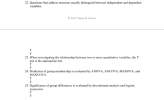 22. Questions that address structure usually distinguish between independent and dependent variables O 2017 Taylor & Francis 23. When investigating the relationship between two or more quantitative variables, the T test is the appropriate test. 24. Prediction of group membership is evaluated by ANOVA, ANCOVA, MANOVA, and MANCOVA 25. Significance of group differences is evaluated by discriminant analysis and logistic regression.
Which of the following tests does not use at least one quantitative variable? independent t-test dependent...
 Which of the following tests does not use at least one quantitative variable? independent t-test dependent t-test ANOVA Chi-square test
One-way analysis of covariance (ANCOVA) is similar to ANOVA but additionally controls for a variable that...
One-way analysis of covariance (ANCOVA) is similar to ANOVA but additionally controls for a variable that may influence the DV. T F Factorial analysis of variance (factorial ANOVA) extends ANOVA to research scenarios with two or more IVs that are categorical. T F Factorial analysis of variance (factorial ANCOVA) examines group differences in a single quantitative dependent variable based upon two or more categorical independent variables, while controlling for a covariate that may influence the DV. T F One-way multivariate...
Which of the following tests does not use at least one quantitative variable Independent T Test...
Which of the following tests does not use at least one quantitative variable Independent T Test Dependent T Test ANOVA Chi-Square test
The primary factor that determines the statistical test students should use is the number of independent...
The primary factor that determines the statistical test students should use is the number of independent and dependent variables. True or False When investigating the relationship between two or more quantitative variables, chi-square is the appropriate test.True or False The Pearson correlation coefficient measures the association between two quantitative variables, distinguishing between the independent and dependent variables.True or False Multiple regression is used when there are several dependent variables and one independent quantitative variable.True or False When testing for the...
Classical experimental designs involve: Control and experimental groups Independent and dependent variables Pre-tests and post-tests All...
Classical experimental designs involve: Control and experimental groups Independent and dependent variables Pre-tests and post-tests All the above
Discriminant analysis seeks to identify which combination of quantitative IVs best predicts group membership by a...
Discriminant analysis seeks to identify which combination of quantitative IVs best predicts group membership by a single DV that has two or more categories. T F In binary logistic regression, the DV is a dichotomous variable. T F Factor analysis and principal components analysis are different techniques, but they are very similar. T F Factor analysis allows the researcher to explore the underlying structures of an instrument or data set and is often used to develop and test a theory....
Factorial analysis of variance (factorial ANOVA) extends ANOVA to research scenarios with two or more IVs...
Factorial analysis of variance (factorial ANOVA) extends ANOVA to research scenarios with two or more IVs that are categorical. True or False Factorial analysis of variance (factorial ANCOVA) examines group differences in a single quantitative dependent variable based upon two or more categorical independent variables, while controlling for a covariate that may influence the DV. True or False One-way multivariate analysis of variance (MANOVA) is utilized to simultaneously study two or more related IVs, while controlling for the correlations among...
Factorial analysis of variance (factorial ANOVA) extends ANOVA to research scenarios with two or more IVs...
Factorial analysis of variance (factorial ANOVA) extends ANOVA to research scenarios with two or more IVs that are categorical. True or False Factorial analysis of variance (factorial ANCOVA) examines group differences in a single quantitative dependent variable based upon two or more categorical independent variables, while controlling for a covariate that may influence the DV. True or False One-way multivariate analysis of variance (MANOVA) is utilized to simultaneously study two or more related IVs, while controlling for the correlations among...
1. Factorial analysis of variance (factorial ANOVA) extends ANOVA to research scenarios with two or more...
1. Factorial analysis of variance (factorial ANOVA) extends ANOVA to research scenarios with two or more IVs that are categorical. True or False 2. Factorial analysis of variance (factorial ANCOVA) examines group differences in a single quantitative dependent variable based upon two or more categorical independent variables, while controlling for a covariate that may influence the DV. True or False 3. One-way multivariate analysis of variance (MANOVA) is utilized to simultaneously study two or more related IVs, while controlling for...
 22. Questions that address structure usually distinguish between independent and dependent variables O 2017 Taylor & Francis 23. When investigating the relationship between two or more quantitative variables, the T test is the appropriate test. 24. Prediction of group membership is evaluated by ANOVA, ANCOVA, MANOVA, and MANCOVA 25. Significance of group differences is evaluated by discriminant analysis and logistic regression.
 Which of the following tests does not use at least one quantitative variable? independent t-test dependent t-test ANOVA Chi-square test
Most questions answered within 3 hours.
-
Where is the error in this code sequence?
String s1 = "Hello";
String s2 = "ello";...
asked 10 months ago -
Financial data for Joel de Paris, Inc., for last year
follow:
Joel de Paris, Inc.
Balance...
asked 10 months ago -
Consider this reaction:
Al2(SO4)3 (aq)+ BaCl3
(aq) Al2Cl6 (aq)- +
3BaSO4(s) . What is the...
asked 10 months ago -
Suppose that Savneet is considering increasing her
recent random sample from 20 car rentals to 40...
asked 10 months ago -
Trucks arrive at an unloading terminal at an average rate of 120
per hour.
Trucks arrive...
asked 10 months ago -
Why are methanol and ethanol completely soluble in water while
octanol is not very little soluble....
asked 10 months ago -
A facilities manager at a university reads in a research report
that the mean amount of...
asked 10 months ago -
When the CuSO4 is rehydrated by adding water to the anhydrous
compound, is this an endothermic...
asked 10 months ago -
A ray of sunlight is passing from diamond into crown glass; the
angle of incidence is...
asked 10 months ago -
A block of mass 0.249 kg is placed on top of a light, vertical
spring of...
asked 10 months ago -
how do the kidneys compensate in the presences of acidosis
a) trigger hyperventilate
b) reserve acid...
asked 10 months ago -
Question 501 pts
The rental rate of capital to the firm increases. Which of the
following...
asked 10 months ago