Discuss how the government deficit might impact the interest rate, investing, and saving in the market.
Discuss how the government deficit might impact the interest rate, investing, and saving in the market.
Homework Answers
A government deficit will take the money out of the market and give it to the government to fund their programs in the market, this reinvestment will increase the income in hand of people and decrease the saving, both will lead to a higher interest rate in the market.
At a higher interest rate the investment in the market will fall and the saving or the supply of the loanable fund will shift to the left. that is decreasing the saving quantity
Add Answer to:
Discuss how the government deficit might impact the interest
rate, investing, and saving in the market.
Discuss the impact of income tax on investing, saving, and economic growth.
Discuss the impact of income tax on investing, saving, and economic growth.
Suppose that the government reduces its fiscal deficit. The impact in the capital (loanable funds) market...
 Suppose that the government reduces its fiscal deficit. The impact in the capital (loanable funds) market is to shift demand to the left reducing the interest rate; demand to the right reducing the interest rate demand to the left increasing the interest rate O demand to the right increasing the interest rate O none of the above
Question 10 (1 point) If the government runs a deficit too big, the interest rate might...
 Question 10 (1 point) If the government runs a deficit too big, the interest rate might increase. Investment is negatively related to the interest rate. However, Keynesian economists believe that I isn't very sensitive to the interest while Classical ones believe it is. Why does it explain (partially) why classical economists are more against the government spending money to stimulate the economy? (Note: difficult question as well] The less sensitive the investment is (to the interest rate), the more the...
6. Suppose there is a surplus in the market for loanable funds. Is the interest rate...
6. Suppose there is a surplus in the market for loanable funds. Is the interest rate above or below its equilibrium level? How do saving and investment at this interest rate be compared? Which one is greater? 7. If at some interest rate desired investment is $400 billion, desired private saving is $600 billion, and the budget deficit is $300 billion, is there a surplus or a shortage in the market for loanable funds? What does this imply would happen...
7. If at some interest rate desired investment is $400 billion, desired private saving is $600...
7. If at some interest rate desired investment is $400 billion, desired private saving is $600 billion, and the budget deficit is $300 billion, is there a surplus or a shortage in the market for loanable funds? What does this imply would happen to interest rates? 8. In a closed economy, GDP is $1000, government purchases are $200, and consumption is $700. If the government has a budget surplus of $25, what are investment, taxes, private saving, public saving and...
Write the government deficit as a function of the nominal interest rate.
Write the government deficit as a function of the nominal interest rate.
Figure 16-3 Interest Rate \Do Quantity of Money Figure 16-3 shows the impact of deficit spending...
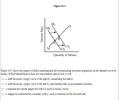 Figure 16-3 Interest Rate \Do Quantity of Money Figure 16-3 shows the impact of deficit spending and the corresponding economic expansion on the demand curve for money. If the Federal Reserve does not want interest rates to rise, it will a. shift the money supply curve to the right by monetizing the deficit b. shift the money supply curve to the left by open market sales of government securities c. maintain the current targets for both M1 and M2 money...
3. E ffects of a government budget deficit Consider a hypothetical open economy. The following table presents data on the relationship between various real interest rates and national saving, domesti...
 3. Effects of a government budget deficit Consider a hypothetical open economy. The following table presents data on the relationship between various real interest rates and national saving, domestic investment, and net capital outflow in this economy, where the currency is the U.S. dollar. Assume that the economy is currently experiencing a balanced government budget. Given the information in the preceding table, use the blue points (circle symbol) to plot the demand for loanable funds. Next, use the orange points (square symbol)...
(1) Consider the situation below how it might affect the US market interest rate. (2) Draw...
(1) Consider the situation below how it might affect the US market interest rate. (2) Draw a demand and supply for money as part of your answer (3) Explain briefly on your graph and reasoning. Government expenditures are supported by tax income or borrowing. The government has increased the debt ceiling over time and this year the government decided to increase individual income tax instead. How might this decision affect the US market interest rate from the household perspective only.
Other things equal, an increase in the government budget deficit increases business prospects. might not have...
Other things equal, an increase in the government budget deficit increases business prospects. might not have any effect on interest rates. drives the interest rate up. drives the interest rate down.
 Suppose that the government reduces its fiscal deficit. The impact in the capital (loanable funds) market is to shift demand to the left reducing the interest rate; demand to the right reducing the interest rate demand to the left increasing the interest rate O demand to the right increasing the interest rate O none of the above
 Question 10 (1 point) If the government runs a deficit too big, the interest rate might increase. Investment is negatively related to the interest rate. However, Keynesian economists believe that I isn't very sensitive to the interest while Classical ones believe it is. Why does it explain (partially) why classical economists are more against the government spending money to stimulate the economy? (Note: difficult question as well] The less sensitive the investment is (to the interest rate), the more the...
 Figure 16-3 Interest Rate \Do Quantity of Money Figure 16-3 shows the impact of deficit spending and the corresponding economic expansion on the demand curve for money. If the Federal Reserve does not want interest rates to rise, it will a. shift the money supply curve to the right by monetizing the deficit b. shift the money supply curve to the left by open market sales of government securities c. maintain the current targets for both M1 and M2 money...
Most questions answered within 3 hours.
-
Where is the error in this code sequence?
String s1 = "Hello";
String s2 = "ello";...
asked 10 months ago -
Financial data for Joel de Paris, Inc., for last year
follow:
Joel de Paris, Inc.
Balance...
asked 10 months ago -
Consider this reaction:
Al2(SO4)3 (aq)+ BaCl3
(aq) Al2Cl6 (aq)- +
3BaSO4(s) . What is the...
asked 10 months ago -
Suppose that Savneet is considering increasing her
recent random sample from 20 car rentals to 40...
asked 10 months ago -
Trucks arrive at an unloading terminal at an average rate of 120
per hour.
Trucks arrive...
asked 10 months ago -
Why are methanol and ethanol completely soluble in water while
octanol is not very little soluble....
asked 10 months ago -
A facilities manager at a university reads in a research report
that the mean amount of...
asked 10 months ago -
When the CuSO4 is rehydrated by adding water to the anhydrous
compound, is this an endothermic...
asked 10 months ago -
A ray of sunlight is passing from diamond into crown glass; the
angle of incidence is...
asked 10 months ago -
A block of mass 0.249 kg is placed on top of a light, vertical
spring of...
asked 10 months ago -
how do the kidneys compensate in the presences of acidosis
a) trigger hyperventilate
b) reserve acid...
asked 10 months ago -
Question 501 pts
The rental rate of capital to the firm increases. Which of the
following...
asked 10 months ago