1. The first human cell line to be established in culture was derived from what type...
1. The first human cell line to be established in culture was derived from what type of cancer?
|
A. |
liver cancer |
|
|
B. |
breast cancer |
|
|
C. |
lung cancer |
|
|
D. |
cervical cancer |
2. Which of the following can induce cellular senescence?
|
A. |
Oncogene Expression |
|
|
B. |
All of these |
|
|
C. |
Super-Mitogenic Signals |
|
|
D. |
DNA Damage |
|
|
E. |
Replicative stresses |
3. Match the following with closest relation:
|
|
|
A. |
replicative senescence |
|
B. |
telomere length control |
|
C. |
hTERT |
|
D. |
BFB cycle |
|
end-to-end fusion |
|
telomerase |
|
TRF1 |
|
4. The expression of telomerase prevents cellular senescence.
True
False
5. Fill in the blanks: The consequences of telomeric shortening and cell crisis are __________ and __________.
6. All the following statements regarding telomerase are true, EXCEPT:
|
A. |
telomerase is expressed in 80% of tumor cells |
|
|
B. |
somatic cells have telomerase activity throughout their lives because of their high activity levels |
|
|
C. |
germline cells have telomerase activity because of the importance of retaining all their genetic information |
|
|
D. |
telomerase overcomes telomere shortening |
|
|
E. |
telomerase is expressed in some stem cells but it is highly regulated |
7.The synthesis of all DNA strands during DNA replication must be initiated at the 5’-hydroxyl end of an existing DNA strand.
True
False
8. TRF1 complex and TRF2 complex are for telomere protection and telomere length control respectively.
True
False
9. Telomerase function contributes to the following except?
|
A. |
protects ends of chromosome |
|
|
B. |
extends DNA |
|
|
C. |
function as reverse transcriptase |
|
|
D. |
promotes transcription of mRNA |
10. Mice with cells that do not senesce die young of cancer because _______?
|
A. |
tumor cells continue to divide and cause death of the host organism |
|
|
B. |
tumor cells may be considered immortal |
|
|
C. |
Cellular senescence represents an important tumor suppression mechanism |
|
|
D. |
the two most important tumor suppressor pathways (p53 & pRB) are missing |
|
|
E. |
all of these |
11. What kind of enzyme is the telomerase protein?
|
A. |
terminal transferase |
|
|
B. |
DNA polymerase |
|
|
C. |
RNA polymerase |
|
|
D. |
reverse transcriptase |
12. Match the following terms with close connection with their definition/function:
|
A. |
non-growing state of cells in which they exhibit distinctive cell phenotypes and remain viable for extended periods of time but are unable to proliferate |
|
B. |
lasso-like structure at the end of a telomere that serves to protect the terminal of a chromosomal DNA molecule from end to end fusion and degradation by exonucleases |
|
C. |
protective nucleoprotein structure at the end of a eukaryotic chromosome that protects the end from degradation and fusion with other chromosomes |
|
D. |
region of a chromosome that holds the two chromatids together and binds with mitotic spindle fibers |
|
telomeres |
|
senescence |
|
centromeres |
|
T-loop |
13. Embryonic stem (ES) cells show unlimited replicative potential in culture and are thus immortal.
True
False
14. Telomeres are essential for chromosome stability.
True
False
15. All of the following statements are true except _______?
|
A. |
it is a reverse transcriptase |
|
|
B. |
overexpression of hTERT can induce cell immortalization |
|
|
C. |
overexpression of the dominant negative (dn) hTERT leads to crisis |
|
|
D. |
hTERT behaves like a tumor suppressor |
16. The nucleotide sequence of Telomeric DNA is:
|
A. |
TTAGGG |
|
|
B. |
TTACCC |
|
|
C. |
TAACCC |
|
|
D. |
TTTAGG |
Thanks!
Homework Answers


Add Answer to:
1. The first human cell line to be established in culture was
derived from what type...
Cancer Biology 8. Re-expression of telomerase can confer immortality to emerging clones of tumor cells, and...
 Cancer Biology
8. Re-expression of telomerase can confer immortality to emerging clones of tumor cells, and was originally viewed as an attractive target for drug discovery. However, which of the following best explains the lack of therapeutic efficacy for telomerase inhibitors? a. Telomerase alone is sufficient for transformation in human cells. b. Telomerase is required for the maintenance of somatic cell populations. c. Too many post-inhibition cell doublings would be required to see anti-tumor efficacy. d. Telomerase has sequence and...
Cancer Biology
8. Re-expression of telomerase can confer immortality to emerging clones of tumor cells, and was originally viewed as an attractive target for drug discovery. However, which of the following best explains the lack of therapeutic efficacy for telomerase inhibitors? a. Telomerase alone is sufficient for transformation in human cells. b. Telomerase is required for the maintenance of somatic cell populations. c. Too many post-inhibition cell doublings would be required to see anti-tumor efficacy. d. Telomerase has sequence and...
Write the letter of the correct answer on the first page. Control of entry into the...
 Write the letter of the correct answer on the first page. Control of entry into the cell cycle is essential. Unicellular eukaryotes that enter into it too soonyw have the necessary energy to complete it, leading to their demise, whereas in multicellular eukaryotes usually leads to cycle are controlled by proteins, problems with the genes that code for these proteins are a commorn source of error. These genes fall into two broad groups: 33 uncontrolled cellular division 32 Since the...
help me with that please this question is cery important i have a final , 7. Loss-of-function mutations in p53 typify the ajority of human cancers Discovery of the roles for p53 in the DNA damage...
 help me with that please this question is cery important i
have a final ,
7. Loss-of-function mutations in p53 typify the ajority of human cancers Discovery of the roles for p53 in the DNA damage checkpoint and in apoptosis helps to explain its potency as a tumor suppressor protein. Recent studies suggest that p53 may possess an additional anti-tumor function: preventing telomerase activity. In one such study by Ogawa and colleagues, a human pancreatic cell line called MIA PaCa-2,...
help me with that please this question is cery important i
have a final ,
7. Loss-of-function mutations in p53 typify the ajority of human cancers Discovery of the roles for p53 in the DNA damage checkpoint and in apoptosis helps to explain its potency as a tumor suppressor protein. Recent studies suggest that p53 may possess an additional anti-tumor function: preventing telomerase activity. In one such study by Ogawa and colleagues, a human pancreatic cell line called MIA PaCa-2,...
only one answer per question QUESTION 6 In a DNA molecule, what type of bond helds...
only one answer per question QUESTION 6 In a DNA molecule, what type of bond helds together the two antiparallel strands of nucleotide chains? a peptide bonds. b polar covalent bonds. c ionic bonds. d hydrogen bonds. e complementary base pairing bonds. QUESTION 7 Who proposed the double helix model? a Watson and Crick. b Griffith. c Avery. d Franklin. e Beadle and Tatum. QUESTION 8 Which of the following enzymes removes the primers used for DNA replication? a...
2. Explain why the replication of one of the DNA strands is continuous while the other...
2. Explain why the replication of one of the DNA strands is continuous while the other strand is discontinuous. What causes this difference? 3. A) What are telomeres? B) Are telomeres present in both Prokaryotes and Eukaryotes? Explain why some cells have telomeres and others don't. 4. A) Draw a cell with 2 pairs chromosomes as it goes through the cell cycle and indicate the main things that happen to its chromosomes at each stage (label: sister chromatids, homologous chromosomes,...
What would be the likely result of activation of telomerase in somatic cells? A) immediate cell...
What would be the likely result of activation of telomerase in somatic cells? A) immediate cell death B) Nothing, as somatic cells already have active telomeres C) Cells capable of continuous division D) premature aging of the cell E) Cells displaying extensive DNA rearrangement and mutation
21. Which of the following techniques is most likely to lead to heteroplasmy? Select one: a....
21. Which of the following techniques is most likely to lead to heteroplasmy? Select one: a. cytoplasmic (ooplasmic) donation b. embryo adoption c. in vitro fertilization d. preimplantation genetic diagnosis 22. Identifying combinations of _______ alleles is useful in tissue typing, establishing identity, and estimating disease risk. Select one: a. HIV b. CCR5 c. HLA d. antibody 23. A gene expression microarray has: Select one: a. an entire genome of DNA, cut into hundreds of pieces, attached to a small...
A 47-year old woman is diagnosed with a lipoma on her left thigh. What is true...
A 47-year old woman is diagnosed with a lipoma on her left thigh. What is true of this growth? Choose all that apply. Question options: A) It is benign. B) It is malignant. C) The patient should receive chemotherapy to shrink the growth. D) The lipoma cells are dividing rapidly. E) It has begun to spread to the surrounding muscle. F) The lipoma cells contain a mutation. G) It is surrounded by a capsule. A 65 year old man is...
cancer biology 15. The carly pioneers of oncogene research were using a 3T3 cell transformation assay,...
 cancer biology
15. The carly pioneers of oncogene research were using a 3T3 cell transformation assay, an immortalized mouse cell line that "stacks the deck" in favor of transformation- and enables it via transfection with a single oncogene. Which of the following is NOT TRUE regarding 3T3 cells? 1. They were immortalized spontaneously. b. They evolve within the first 25 cell-transfers from a diploid to a tetrapl C. They are 100% disome (normal karyotype). d. They show chromosomal imbalances typical...
cancer biology
15. The carly pioneers of oncogene research were using a 3T3 cell transformation assay, an immortalized mouse cell line that "stacks the deck" in favor of transformation- and enables it via transfection with a single oncogene. Which of the following is NOT TRUE regarding 3T3 cells? 1. They were immortalized spontaneously. b. They evolve within the first 25 cell-transfers from a diploid to a tetrapl C. They are 100% disome (normal karyotype). d. They show chromosomal imbalances typical...
Question 1: Everyone who has chronic myeloid leukemia (CML), a cell that makes blood cells, has...
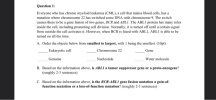 Question 1: Everyone who has chronic myeloid leukemia (CML), a cell that makes blood cells, has a mutation where chromosome 22 has switched some DNA with chromosome 9. The switch causes there to be a gene fusion of two genes, BCR and ABLI. The ABL1 protein has many roles inside the cell, including promoting cell division. Normally, it is turned off until a certain signal from outside the cell activates it. However, when BCR is fused with ABLI, ABLI is...
 Cancer Biology
8. Re-expression of telomerase can confer immortality to emerging clones of tumor cells, and was originally viewed as an attractive target for drug discovery. However, which of the following best explains the lack of therapeutic efficacy for telomerase inhibitors? a. Telomerase alone is sufficient for transformation in human cells. b. Telomerase is required for the maintenance of somatic cell populations. c. Too many post-inhibition cell doublings would be required to see anti-tumor efficacy. d. Telomerase has sequence and...
Cancer Biology
8. Re-expression of telomerase can confer immortality to emerging clones of tumor cells, and was originally viewed as an attractive target for drug discovery. However, which of the following best explains the lack of therapeutic efficacy for telomerase inhibitors? a. Telomerase alone is sufficient for transformation in human cells. b. Telomerase is required for the maintenance of somatic cell populations. c. Too many post-inhibition cell doublings would be required to see anti-tumor efficacy. d. Telomerase has sequence and...
 Write the letter of the correct answer on the first page. Control of entry into the cell cycle is essential. Unicellular eukaryotes that enter into it too soonyw have the necessary energy to complete it, leading to their demise, whereas in multicellular eukaryotes usually leads to cycle are controlled by proteins, problems with the genes that code for these proteins are a commorn source of error. These genes fall into two broad groups: 33 uncontrolled cellular division 32 Since the...
 help me with that please this question is cery important i
have a final ,
7. Loss-of-function mutations in p53 typify the ajority of human cancers Discovery of the roles for p53 in the DNA damage checkpoint and in apoptosis helps to explain its potency as a tumor suppressor protein. Recent studies suggest that p53 may possess an additional anti-tumor function: preventing telomerase activity. In one such study by Ogawa and colleagues, a human pancreatic cell line called MIA PaCa-2,...
help me with that please this question is cery important i
have a final ,
7. Loss-of-function mutations in p53 typify the ajority of human cancers Discovery of the roles for p53 in the DNA damage checkpoint and in apoptosis helps to explain its potency as a tumor suppressor protein. Recent studies suggest that p53 may possess an additional anti-tumor function: preventing telomerase activity. In one such study by Ogawa and colleagues, a human pancreatic cell line called MIA PaCa-2,...
 cancer biology
15. The carly pioneers of oncogene research were using a 3T3 cell transformation assay, an immortalized mouse cell line that "stacks the deck" in favor of transformation- and enables it via transfection with a single oncogene. Which of the following is NOT TRUE regarding 3T3 cells? 1. They were immortalized spontaneously. b. They evolve within the first 25 cell-transfers from a diploid to a tetrapl C. They are 100% disome (normal karyotype). d. They show chromosomal imbalances typical...
cancer biology
15. The carly pioneers of oncogene research were using a 3T3 cell transformation assay, an immortalized mouse cell line that "stacks the deck" in favor of transformation- and enables it via transfection with a single oncogene. Which of the following is NOT TRUE regarding 3T3 cells? 1. They were immortalized spontaneously. b. They evolve within the first 25 cell-transfers from a diploid to a tetrapl C. They are 100% disome (normal karyotype). d. They show chromosomal imbalances typical...
 Question 1: Everyone who has chronic myeloid leukemia (CML), a cell that makes blood cells, has a mutation where chromosome 22 has switched some DNA with chromosome 9. The switch causes there to be a gene fusion of two genes, BCR and ABLI. The ABL1 protein has many roles inside the cell, including promoting cell division. Normally, it is turned off until a certain signal from outside the cell activates it. However, when BCR is fused with ABLI, ABLI is...
Most questions answered within 3 hours.
-
Where is the error in this code sequence?
String s1 = "Hello";
String s2 = "ello";...
asked 10 months ago -
Financial data for Joel de Paris, Inc., for last year
follow:
Joel de Paris, Inc.
Balance...
asked 10 months ago -
Consider this reaction:
Al2(SO4)3 (aq)+ BaCl3
(aq) Al2Cl6 (aq)- +
3BaSO4(s) . What is the...
asked 10 months ago -
Suppose that Savneet is considering increasing her
recent random sample from 20 car rentals to 40...
asked 10 months ago -
Trucks arrive at an unloading terminal at an average rate of 120
per hour.
Trucks arrive...
asked 10 months ago -
Why are methanol and ethanol completely soluble in water while
octanol is not very little soluble....
asked 10 months ago -
A facilities manager at a university reads in a research report
that the mean amount of...
asked 10 months ago -
When the CuSO4 is rehydrated by adding water to the anhydrous
compound, is this an endothermic...
asked 10 months ago -
A ray of sunlight is passing from diamond into crown glass; the
angle of incidence is...
asked 10 months ago -
A block of mass 0.249 kg is placed on top of a light, vertical
spring of...
asked 10 months ago -
how do the kidneys compensate in the presences of acidosis
a) trigger hyperventilate
b) reserve acid...
asked 10 months ago -
Question 501 pts
The rental rate of capital to the firm increases. Which of the
following...
asked 10 months ago