Centripetal force (university physics 1): At what altitude should a geosynchronous satellite be placed? A geosynchronous...
Centripetal force (university physics 1):
At what altitude should a geosynchronous satellite be placed? A geosynchronous orbit means the satellite stays above the same point on earth...so what is its orbital period
Homework Answers
Let the satellite is at a distance r from the center of the earth.
At each point in the orbit, the gravitational force is equal to the centripetal acceleration.
Let M be the mass of earth and m be that of the satellite moving with angular velocity ω
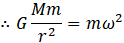
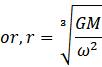
For, Geosynchronous orbits the time period of the satellite is equal to that of the rotation of earth.

Hence,

However, this distance is from the center of earth.
To calculate its altitude, we must subtract this from the radius of earth.

Orbital period as stated above is 24 hr and angular velocity is

Add Answer to:
Centripetal force (university physics 1):
At what altitude should a geosynchronous satellite be placed? A
geosynchronous...
A satellite of mass 42.5 kg in geosynchronous orbit at an altitude of 3.58 ✕ 104...
A satellite of mass 42.5 kg in geosynchronous orbit at an altitude of 3.58 ✕ 104 km above the Earth's surface remains above the same spot on the Earth. Assume its orbit is circular. Find the magnitude of the gravitational force exerted by the Earth on the satellite. Hint: The answer is not 417 N
For communications purposes, satellites are typically placed in a circular geosynchronous orbit. If the orbit is...
For communications purposes, satellites are typically placed in a circular geosynchronous orbit. If the orbit is in the equatorial plane of the Earth, it is called geostationary. A satellite’s orbital speed in a geostationary orbit is set to match the angular velocity Ωe of the rotating Earth (with mass M), so that as seen from the Earth the satellite is stationary above a fixed point on the Equator. For a satellite of mass m in a geostationary circular orbit then...
Problem 1 a. The apogee and perigee altitude (distance from the surface of Earth) of the...
Problem 1 a. The apogee and perigee altitude (distance from the surface of Earth) of the Chandra X-rays Observatory are 139,200 km and 9,620 km (final orbit after 4th burn, Aug 7, 1999). Estimate its orbital period (in hours). Hint: the mass of Chandra is much smaller than the mass of Earth. b. Communications and weather satellites are often placed in geosynchronous “parking” orbits above Earth. These are the orbits where satellites can remain fixed above a specific point on...
a satellite in a geosynchronous orbit remains above the same point on Earth 2. A satellite...
 a satellite in a geosynchronous orbit remains above the same
point on Earth
2. A satellite in a geosynchronous orbit remains above the same point on Earth provided it orbits in the equatorial plane in the same direction as Earth's rotation. (a) Calculate the speed of a satellite in such an orbit. (b) Calculate the total energy of a satellite in such an orbit.
a satellite in a geosynchronous orbit remains above the same
point on Earth
2. A satellite in a geosynchronous orbit remains above the same point on Earth provided it orbits in the equatorial plane in the same direction as Earth's rotation. (a) Calculate the speed of a satellite in such an orbit. (b) Calculate the total energy of a satellite in such an orbit.
6.43- Satellites and Kepler's Laws: An Argument for Simplicity A geosynchronous Earth satellite is one that has an...
 6.43- Satellites and Kepler's Laws: An Argument for Simplicity A geosynchronous Earth satellite is one that has an orbital period of precisely 1 day. Such orbits are useful for communication and weather observation because the satellite remains above the same point on Earth (provided it orbits in the equatorial plane in the same direction as Earth's rotation). Calculate the radius of such an orbit based on the data for the moon using the following data: Distance from Earth to Moon...
A satellite is said to be in a geosynchronous orbit. a) what is the period of...
A satellite is said to be in a geosynchronous orbit. a) what is the period of this orbit? b) at what distance from the center of Earth must such a satellite be placed into orbit? (Hint: Use Newton's form of Kepler's third law)
1. A geosynchronous orbit is one that if a satellite is placed equatorially in it will...
 1. A geosynchronous orbit is one that if a satellite is placed equatorially in it will appear stationary above the same geographical spot. Starting from Newton's law of universal gravitation for circular orbits calculate the radius of this orbit. (You must show all steps). (8 points)
Previous Question: A satellite is said to be in a “geosynchronous” orbit if it appears always...
Previous Question: A satellite is said to be in a “geosynchronous” orbit if it appears always to remain over the exact same spot on the rotating Earth. What is the period of this orbit? [enter your answer in hours.] (a) At what distance (in km) from the center of the Earth must such a satellite be placed into orbit? [Enter your answer in regular decimal notation instead of scientific notation, i.e. not 3.97 x 10^5, but 397000 .] (b) Why...
Telecommunication satellites travel in geosynchronous orbits. these satellites move in sync with the Earth surface and...
Telecommunication satellites travel in geosynchronous orbits. these satellites move in sync with the Earth surface and always stay above the same point on the surface of the earth. all satellites in geosynchronous orbit must be located in the equatorial plane. Please, explain why it has to stay in the equatorial plane. Please EXPLAIN why it has to stay in the equatorial plane. DRAW a simple diagram showing forces acting on such a satellite. Hint: For any stable orbit the centripetal...
Major Tom orbits the planet Earth aboard a geosynchronous space station. In a geosynchronous orbit, the...
Major Tom orbits the planet Earth aboard a geosynchronous space station. In a geosynchronous orbit, the station stays above the same spot on the surface of the planet and orbits in time with Earth’s rotation. A) What is the space station’s orbital speed? Assume the radius is perfectly circular. B) What is the only possible radius for such an orbit? (You may calculate the radius from the center of the Earth) C) Major Tom’s weight on the surface of Earth...
 a satellite in a geosynchronous orbit remains above the same
point on Earth
2. A satellite in a geosynchronous orbit remains above the same point on Earth provided it orbits in the equatorial plane in the same direction as Earth's rotation. (a) Calculate the speed of a satellite in such an orbit. (b) Calculate the total energy of a satellite in such an orbit.
a satellite in a geosynchronous orbit remains above the same
point on Earth
2. A satellite in a geosynchronous orbit remains above the same point on Earth provided it orbits in the equatorial plane in the same direction as Earth's rotation. (a) Calculate the speed of a satellite in such an orbit. (b) Calculate the total energy of a satellite in such an orbit.
 6.43- Satellites and Kepler's Laws: An Argument for Simplicity A geosynchronous Earth satellite is one that has an orbital period of precisely 1 day. Such orbits are useful for communication and weather observation because the satellite remains above the same point on Earth (provided it orbits in the equatorial plane in the same direction as Earth's rotation). Calculate the radius of such an orbit based on the data for the moon using the following data: Distance from Earth to Moon...
 1. A geosynchronous orbit is one that if a satellite is placed equatorially in it will appear stationary above the same geographical spot. Starting from Newton's law of universal gravitation for circular orbits calculate the radius of this orbit. (You must show all steps). (8 points)
Most questions answered within 3 hours.
-
Where is the error in this code sequence?
String s1 = "Hello";
String s2 = "ello";...
asked 10 months ago -
Financial data for Joel de Paris, Inc., for last year
follow:
Joel de Paris, Inc.
Balance...
asked 10 months ago -
Consider this reaction:
Al2(SO4)3 (aq)+ BaCl3
(aq) Al2Cl6 (aq)- +
3BaSO4(s) . What is the...
asked 10 months ago -
Suppose that Savneet is considering increasing her
recent random sample from 20 car rentals to 40...
asked 10 months ago -
Trucks arrive at an unloading terminal at an average rate of 120
per hour.
Trucks arrive...
asked 10 months ago -
Why are methanol and ethanol completely soluble in water while
octanol is not very little soluble....
asked 10 months ago -
A facilities manager at a university reads in a research report
that the mean amount of...
asked 10 months ago -
When the CuSO4 is rehydrated by adding water to the anhydrous
compound, is this an endothermic...
asked 10 months ago -
A ray of sunlight is passing from diamond into crown glass; the
angle of incidence is...
asked 10 months ago -
A block of mass 0.249 kg is placed on top of a light, vertical
spring of...
asked 10 months ago -
how do the kidneys compensate in the presences of acidosis
a) trigger hyperventilate
b) reserve acid...
asked 10 months ago -
Question 501 pts
The rental rate of capital to the firm increases. Which of the
following...
asked 10 months ago