Prove that for any regular expressions R, S, and T, we have (R+S)∗T = (R∗S∗)∗T. Please...
Prove that for any regular expressions R, S, and T, we have (R+S)∗T = (R∗S∗)∗T.
Please give a detailed proof.
Homework Answers

Add Answer to:
Prove that for any regular expressions R, S, and T, we have
(R+S)∗T = (R∗S∗)∗T.
Please...
Problem 1 [20 pts Prove that for any regular expressions R, S, and T, we have...
 Problem 1 [20 pts Prove that for any regular expressions R, S, and T, we have (R+S)"T (RS)T
Prove/disprove for any regular expressions R and S: (a) (R + S)∗S = (R∗S)∗ (b) (R...
Prove/disprove for any regular expressions R and S: (a) (R + S)∗S = (R∗S)∗ (b) (R + S)∗ = (R∗S)∗ Note: when disproving a statement, you must give a concrete example of R and S, meaning a definition of R and S over some chosen alphabet.
Question on algebra of regular expressions. Use regular algebra to prove that (a+ab)*a=a(a+ba)*.
 Question on algebra of regular expressions.
Use regular algebra to prove that (a+ab)*a=a(a+ba)*.
Question on algebra of regular expressions.
Use regular algebra to prove that (a+ab)*a=a(a+ba)*.
4 Consider the FA below. 92 931 Compute: Regular expressions for all R . Regular expressions for ...
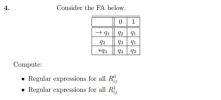 4 Consider the FA below. 92 931 Compute: Regular expressions for all R . Regular expressions for all Ri
4 Consider the FA below. 92 931 Compute: Regular expressions for all R . Regular expressions for all Ri
4 Consider the FA below. 92 931 Compute: Regular expressions for all R . Regular expressions for all Ri
Theoretical Computer Science | Regular Expressions Let R be the regular expression (bba∗a + b) *...
Theoretical Computer Science | Regular Expressions Let R be the regular expression (bba∗a + b) * (a + abb). Give anE-NFA that is equivalent to R. Show all steps and do not simplify.
7. 15 Points For a regular expression r, we use L(r) to denote the language it represents. For each of the following regular expressions r, find an NFA that accepts L(r). (b). L((a +b+A) b(a bb)) し(...
 7. 15 Points For a regular expression r, we use L(r) to denote the language it represents. For each of the following regular expressions r, find an NFA that accepts L(r). (b). L((a +b+A) b(a bb)) し(((aa
7. 15 Points For a regular expression r, we use L(r) to denote the language it represents. For each of the following regular expressions r, find an NFA that accepts L(r). (b). L((a +b+A) b(a bb)) し(((aa
7. 15 Points For a regular expression r, we use L(r) to denote the language it represents. For each of the following regular expressions r, find an NFA that accepts L(r). (b). L((a +b+A) b(a bb)) し(((aa
Prove that the following are not regular languages. Just B and F please Prove that the...
 Prove that the following are not regular languages. Just B and F
please
Prove that the following are not regular languages. {0^n1^n | n Greaterthanorequalto 1}. This language, consisting of a string of 0's followed by an equal-length string of l's, is the language L_01 we considered informally at the beginning of the section. Here, you should apply the pumping lemma in the proof. The set of strings of balanced parentheses. These are the strings of characters "(" and ")"...
Prove that the following are not regular languages. Just B and F
please
Prove that the following are not regular languages. {0^n1^n | n Greaterthanorequalto 1}. This language, consisting of a string of 0's followed by an equal-length string of l's, is the language L_01 we considered informally at the beginning of the section. Here, you should apply the pumping lemma in the proof. The set of strings of balanced parentheses. These are the strings of characters "(" and ")"...
3.1.7 Remark. Trivially, for any R:A → B, we have dom(R) C A and ran(R) CB...
 3.1.7 Remark. Trivially, for any R:A → B, we have dom(R) C A and ran(R) CB (give a quick proof of each of these inclusions).
3. Let X be a random variable and denote by Mx(t) its MGF. Prove that, for any t > 0, we have 3. Let X be a random variable and denote by Mx(t) its MGF. Prove that, for any t > 0, we have
 3. Let X be a random variable and denote by Mx(t) its MGF. Prove that, for any t > 0, we have
3. Let X be a random variable and denote by Mx(t) its MGF. Prove that, for any t > 0, we have
3. Let X be a random variable and denote by Mx(t) its MGF. Prove that, for any t > 0, we have
1. Prove that for any set S S R, S is closed if and only if...
 1. Prove that for any set S S R, S is closed if and only if Se is open. Notice the book has a proof of this, but it uses a different notation for set complements and a different definition of neighborhood. You may consult it, but you must write your proof using the definition for interior point I presented in class (also in the notes on blackboard). If you copy the proof from the book you will not receive...
 Problem 1 [20 pts Prove that for any regular expressions R, S, and T, we have (R+S)"T (RS)T
 Question on algebra of regular expressions.
Use regular algebra to prove that (a+ab)*a=a(a+ba)*.
Question on algebra of regular expressions.
Use regular algebra to prove that (a+ab)*a=a(a+ba)*.
 4 Consider the FA below. 92 931 Compute: Regular expressions for all R . Regular expressions for all Ri
4 Consider the FA below. 92 931 Compute: Regular expressions for all R . Regular expressions for all Ri
4 Consider the FA below. 92 931 Compute: Regular expressions for all R . Regular expressions for all Ri
 7. 15 Points For a regular expression r, we use L(r) to denote the language it represents. For each of the following regular expressions r, find an NFA that accepts L(r). (b). L((a +b+A) b(a bb)) し(((aa
7. 15 Points For a regular expression r, we use L(r) to denote the language it represents. For each of the following regular expressions r, find an NFA that accepts L(r). (b). L((a +b+A) b(a bb)) し(((aa
7. 15 Points For a regular expression r, we use L(r) to denote the language it represents. For each of the following regular expressions r, find an NFA that accepts L(r). (b). L((a +b+A) b(a bb)) し(((aa
 Prove that the following are not regular languages. Just B and F
please
Prove that the following are not regular languages. {0^n1^n | n Greaterthanorequalto 1}. This language, consisting of a string of 0's followed by an equal-length string of l's, is the language L_01 we considered informally at the beginning of the section. Here, you should apply the pumping lemma in the proof. The set of strings of balanced parentheses. These are the strings of characters "(" and ")"...
Prove that the following are not regular languages. Just B and F
please
Prove that the following are not regular languages. {0^n1^n | n Greaterthanorequalto 1}. This language, consisting of a string of 0's followed by an equal-length string of l's, is the language L_01 we considered informally at the beginning of the section. Here, you should apply the pumping lemma in the proof. The set of strings of balanced parentheses. These are the strings of characters "(" and ")"...
 3.1.7 Remark. Trivially, for any R:A → B, we have dom(R) C A and ran(R) CB (give a quick proof of each of these inclusions).
 3. Let X be a random variable and denote by Mx(t) its MGF. Prove that, for any t > 0, we have
3. Let X be a random variable and denote by Mx(t) its MGF. Prove that, for any t > 0, we have
3. Let X be a random variable and denote by Mx(t) its MGF. Prove that, for any t > 0, we have
 1. Prove that for any set S S R, S is closed if and only if Se is open. Notice the book has a proof of this, but it uses a different notation for set complements and a different definition of neighborhood. You may consult it, but you must write your proof using the definition for interior point I presented in class (also in the notes on blackboard). If you copy the proof from the book you will not receive...
Most questions answered within 3 hours.
-
Where is the error in this code sequence?
String s1 = "Hello";
String s2 = "ello";...
asked 10 months ago -
Financial data for Joel de Paris, Inc., for last year
follow:
Joel de Paris, Inc.
Balance...
asked 10 months ago -
Consider this reaction:
Al2(SO4)3 (aq)+ BaCl3
(aq) Al2Cl6 (aq)- +
3BaSO4(s) . What is the...
asked 10 months ago -
Suppose that Savneet is considering increasing her
recent random sample from 20 car rentals to 40...
asked 10 months ago -
Trucks arrive at an unloading terminal at an average rate of 120
per hour.
Trucks arrive...
asked 10 months ago -
Why are methanol and ethanol completely soluble in water while
octanol is not very little soluble....
asked 10 months ago -
A facilities manager at a university reads in a research report
that the mean amount of...
asked 10 months ago -
When the CuSO4 is rehydrated by adding water to the anhydrous
compound, is this an endothermic...
asked 10 months ago -
A ray of sunlight is passing from diamond into crown glass; the
angle of incidence is...
asked 10 months ago -
A block of mass 0.249 kg is placed on top of a light, vertical
spring of...
asked 10 months ago -
how do the kidneys compensate in the presences of acidosis
a) trigger hyperventilate
b) reserve acid...
asked 10 months ago -
Question 501 pts
The rental rate of capital to the firm increases. Which of the
following...
asked 10 months ago