2a. What is meant by allosteric regulation of enzymes? Include key/relevant terms (Enzyme, active site, effector,...
2a. What is meant by allosteric regulation of enzymes? Include key/relevant terms (Enzyme, active site, effector, secondary site, conformational change, affinity and other terms you feel are relevant).
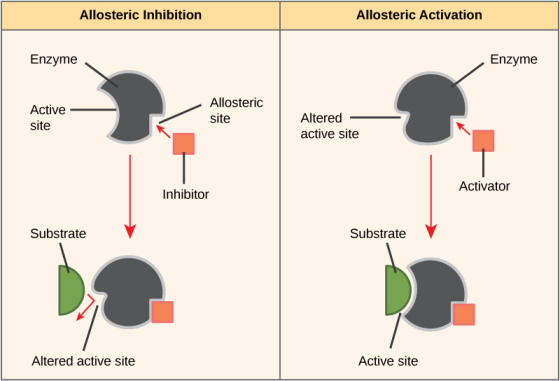
b. Describe/draw, in detail, two mechanisms of inhibitory allosteric regulation (aka allosteric inhibition)
c. Describe/draw, in detail, two mechanisms of excitatory allosteric regulation (aka allosteric activation)
Homework Answers
a. The allosteric enzyme is an enzyme that has an active site which is the primary site along with the allosteric site a secondary site where an enzyme regulator can bind. There are two types of regulators- activators that increases the activity of the enzyme and inhibitors that decrease the activity of the enzymes. The regulator that increases or decreases the activity of the enzyme is called its effector. These are able to produce a conformational change which either increases the affinity of the substrate towards the active site of the enzyme or decreases its affinity towards the active site of the enzyme.
b,c
Add Answer to:
2a. What is meant by allosteric regulation of enzymes? Include
key/relevant terms (Enzyme, active site, effector,...
Enzyme 6. Where do substrates bind on an enzyme? A. allosteric site B. active site C....
 Enzyme 6. Where do substrates bind on an enzyme? A. allosteric site B. active site C. receptor D. ion channel 7. Enzymes are capable of increasing the rate of a chemical reaction through which of the following means? A. changing AG from positive to negative B. reducing the activation energy C. changing the equilibrium point of the reaction D. increasing kinetic energy 8. When a molecule can occupy the same active site as the substrate, a situation called can result...
1. What are the different sources of energy available to living organisms? 2. How do the...
 1. What are the different sources of energy available to living organisms? 2. How do the acquisition and the use of energy by living organisms work according to the laws of thermodynamics? 3. Explain the energy use in the following reactions: endergonic/exergonic. 4. What is metabolism? How are chemical reactions related to metabolism? Why is energy needed to run a metabolism? What are coupled reactions? 5. Draw a picture of ATP. Why is this molecule so important for cells? How...
1. According to the paper, what does lactate dehydrogenase (LDH) do and what does it allow...
 1. According to the paper, what does lactate dehydrogenase
(LDH) do and what does it allow to happen within the myofiber? (5
points)
2. According to the paper, what is the major disadvantage of
relying on glycolysis during high-intensity exercise? (5
points)
3. Using Figure 1 in the paper, briefly describe the different
sources of ATP production at 50% versus 90% AND explain whether you
believe this depiction of ATP production applies to a Type IIX
myofiber in a human....
1. According to the paper, what does lactate dehydrogenase
(LDH) do and what does it allow to happen within the myofiber? (5
points)
2. According to the paper, what is the major disadvantage of
relying on glycolysis during high-intensity exercise? (5
points)
3. Using Figure 1 in the paper, briefly describe the different
sources of ATP production at 50% versus 90% AND explain whether you
believe this depiction of ATP production applies to a Type IIX
myofiber in a human....
 Enzyme 6. Where do substrates bind on an enzyme? A. allosteric site B. active site C. receptor D. ion channel 7. Enzymes are capable of increasing the rate of a chemical reaction through which of the following means? A. changing AG from positive to negative B. reducing the activation energy C. changing the equilibrium point of the reaction D. increasing kinetic energy 8. When a molecule can occupy the same active site as the substrate, a situation called can result...
 1. What are the different sources of energy available to living organisms? 2. How do the acquisition and the use of energy by living organisms work according to the laws of thermodynamics? 3. Explain the energy use in the following reactions: endergonic/exergonic. 4. What is metabolism? How are chemical reactions related to metabolism? Why is energy needed to run a metabolism? What are coupled reactions? 5. Draw a picture of ATP. Why is this molecule so important for cells? How...
 1. According to the paper, what does lactate dehydrogenase
(LDH) do and what does it allow to happen within the myofiber? (5
points)
2. According to the paper, what is the major disadvantage of
relying on glycolysis during high-intensity exercise? (5
points)
3. Using Figure 1 in the paper, briefly describe the different
sources of ATP production at 50% versus 90% AND explain whether you
believe this depiction of ATP production applies to a Type IIX
myofiber in a human....
1. According to the paper, what does lactate dehydrogenase
(LDH) do and what does it allow to happen within the myofiber? (5
points)
2. According to the paper, what is the major disadvantage of
relying on glycolysis during high-intensity exercise? (5
points)
3. Using Figure 1 in the paper, briefly describe the different
sources of ATP production at 50% versus 90% AND explain whether you
believe this depiction of ATP production applies to a Type IIX
myofiber in a human....
Most questions answered within 3 hours.
-
Where is the error in this code sequence?
String s1 = "Hello";
String s2 = "ello";...
asked 10 months ago -
Financial data for Joel de Paris, Inc., for last year
follow:
Joel de Paris, Inc.
Balance...
asked 10 months ago -
Consider this reaction:
Al2(SO4)3 (aq)+ BaCl3
(aq) Al2Cl6 (aq)- +
3BaSO4(s) . What is the...
asked 10 months ago -
Suppose that Savneet is considering increasing her
recent random sample from 20 car rentals to 40...
asked 10 months ago -
Trucks arrive at an unloading terminal at an average rate of 120
per hour.
Trucks arrive...
asked 10 months ago -
Why are methanol and ethanol completely soluble in water while
octanol is not very little soluble....
asked 10 months ago -
A facilities manager at a university reads in a research report
that the mean amount of...
asked 10 months ago -
When the CuSO4 is rehydrated by adding water to the anhydrous
compound, is this an endothermic...
asked 10 months ago -
A ray of sunlight is passing from diamond into crown glass; the
angle of incidence is...
asked 10 months ago -
A block of mass 0.249 kg is placed on top of a light, vertical
spring of...
asked 10 months ago -
how do the kidneys compensate in the presences of acidosis
a) trigger hyperventilate
b) reserve acid...
asked 10 months ago -
Question 501 pts
The rental rate of capital to the firm increases. Which of the
following...
asked 10 months ago