In what way is hooke’s law useful when calibrating a spring for measuring forces?
In what way is hooke’s law useful when calibrating a spring for measuring forces?
Homework Answers
It says that force is directly proportional to the distance that the spring is either compressed or stretched. X is a distance from the rest position of the spring. K is the spring constant. So F=kx means that you only have to take a couple of measurements of distance and force to know k, and after that, you can accurately gauge the amount of force for any distance stretched or compressed
Add Answer to:
In what way is hooke’s law useful when calibrating a spring for
measuring forces?
For Hooke’s Law, F = kx, the spring constant, k, describes the force required to deform...
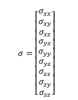 For Hooke’s Law, F = kx, the spring constant, k, describes the
force required to deform a spring. For a three-dimensional object,
we can generalize Hooke’s Law to describe the stress required to
strain a material: where stress can be written as a [9x1] tensor,
strain can also be written as a [9x1] tensor, and E is an
“elasticity” tensor, which is analogous to our spring constant. How
many elements, n, in the elasticity tensor are required to satisfy
the...
For Hooke’s Law, F = kx, the spring constant, k, describes the
force required to deform a spring. For a three-dimensional object,
we can generalize Hooke’s Law to describe the stress required to
strain a material: where stress can be written as a [9x1] tensor,
strain can also be written as a [9x1] tensor, and E is an
“elasticity” tensor, which is analogous to our spring constant. How
many elements, n, in the elasticity tensor are required to satisfy
the...
A block of mass m = 2.0 kg is attached to a Hooke’s-law spring with force...
A block of mass m = 2.0 kg is attached to a Hooke’s-law spring with force constant k = 8 . 0 N / m and is on a frictionless horizontal surface, as shown in the figure below. The block is released from rest at position x i . As the block passes through the equilibrium point at x = 0, it moves with a speed of 8.0 m/s. What is the value, in m, of the initial position, x...
Hooke’s Law states that the force required to maintain a spring stretched x units beyond its...
Hooke’s Law states that the force required to maintain a spring stretched x units beyond its natural length is proportional to x, i.e. f(x) = kx where k is a positive constant. Suppose that 4 J of work is needed to stretch a spring from its natural length 10 cm to a length of 36 cm. Find the exact value of work needed to stretch the spring from 15 cm to 28 cm.
A light spring has unstressed length of 16.5 cm. It is described by Hooke’s law with...
A light spring has unstressed length of 16.5 cm. It is described by Hooke’s law with spring constant 5.30 N/m. The spring is placed horizontally on a table. One end of the horizontal spring is held on a fixed vertical axle, and the other end is attached to a puck of mass m that can move without friction over the horizontal surface. The puck is set into motion in a circle with a period of 1.80 s. a. Find and...
1. When you are calibrating data in lab with a microscope and when magnification increases, what...
1. When you are calibrating data in lab with a microscope and when magnification increases, what happens to the field of view? At what magnification is the working distance the largest? 2. You are measuring the diameter of your cheek cells. What do values of mean and standard deviation, respectively, tell you about your data? 3. What is the major difference between the prokaryotic cell and the eukaryotic cell that leads to their classification as such?
If you cut a spring of stiffness constant k to two equal lengths, what is the...
If you cut a spring of stiffness constant k to two equal lengths, what is the spring constant for each of the two pieces. Hint: Use Newton’s Third Law and Hooke’s law in justifying your answer.
When calibrating a spectrophotometer, what absorbance should the blank have? Show transcribed image text
 When calibrating a spectrophotometer, what absorbance should the blank have?
A chemist is calibrating a spectrophotometer by measuring samples of known concentrations. The results are given...
 A chemist is calibrating a spectrophotometer by measuring samples of known concentrations. The results are given in the table below. 1. True (ppm) Meas (ppm) 0 10 20 30 40 50 60 70 80 90 100 1 11 21 28 37 48 56 68 75 86 96 Because of random errors repeated measurements on the same sample will vary. You can assume that the errors are independent and approximately normal. The machine is in calibration if the average measurement equals...
3/What is a balanced scorecard approach and why might it be useful for measuring overall IS...
3/What is a balanced scorecard approach and why might it be useful for measuring overall IS performance?
A scientist has suspended a spring from a door frame. When an object is attached to...
 A scientist has suspended a spring from a door frame. When an object is attached to the spring's bottom end, the spring extends downward by an additional distance, d, measuring 4.30 cm. (That downward distance is relative to the unstretched position that the spring had previously held whern in equilibrium, as shown by the horizontal dashed line in the figure below Calculate the mass of the hanging object (in kg) if the spring constant k has the value 59.5 N/m...
 For Hooke’s Law, F = kx, the spring constant, k, describes the
force required to deform a spring. For a three-dimensional object,
we can generalize Hooke’s Law to describe the stress required to
strain a material: where stress can be written as a [9x1] tensor,
strain can also be written as a [9x1] tensor, and E is an
“elasticity” tensor, which is analogous to our spring constant. How
many elements, n, in the elasticity tensor are required to satisfy
the...
For Hooke’s Law, F = kx, the spring constant, k, describes the
force required to deform a spring. For a three-dimensional object,
we can generalize Hooke’s Law to describe the stress required to
strain a material: where stress can be written as a [9x1] tensor,
strain can also be written as a [9x1] tensor, and E is an
“elasticity” tensor, which is analogous to our spring constant. How
many elements, n, in the elasticity tensor are required to satisfy
the...
 When calibrating a spectrophotometer, what absorbance should the blank have?
 A chemist is calibrating a spectrophotometer by measuring samples of known concentrations. The results are given in the table below. 1. True (ppm) Meas (ppm) 0 10 20 30 40 50 60 70 80 90 100 1 11 21 28 37 48 56 68 75 86 96 Because of random errors repeated measurements on the same sample will vary. You can assume that the errors are independent and approximately normal. The machine is in calibration if the average measurement equals...
 A scientist has suspended a spring from a door frame. When an object is attached to the spring's bottom end, the spring extends downward by an additional distance, d, measuring 4.30 cm. (That downward distance is relative to the unstretched position that the spring had previously held whern in equilibrium, as shown by the horizontal dashed line in the figure below Calculate the mass of the hanging object (in kg) if the spring constant k has the value 59.5 N/m...
Most questions answered within 3 hours.
-
Where is the error in this code sequence?
String s1 = "Hello";
String s2 = "ello";...
asked 10 months ago -
Financial data for Joel de Paris, Inc., for last year
follow:
Joel de Paris, Inc.
Balance...
asked 10 months ago -
Consider this reaction:
Al2(SO4)3 (aq)+ BaCl3
(aq) Al2Cl6 (aq)- +
3BaSO4(s) . What is the...
asked 10 months ago -
Suppose that Savneet is considering increasing her
recent random sample from 20 car rentals to 40...
asked 10 months ago -
Trucks arrive at an unloading terminal at an average rate of 120
per hour.
Trucks arrive...
asked 10 months ago -
Why are methanol and ethanol completely soluble in water while
octanol is not very little soluble....
asked 10 months ago -
A facilities manager at a university reads in a research report
that the mean amount of...
asked 10 months ago -
When the CuSO4 is rehydrated by adding water to the anhydrous
compound, is this an endothermic...
asked 10 months ago -
A ray of sunlight is passing from diamond into crown glass; the
angle of incidence is...
asked 10 months ago -
A block of mass 0.249 kg is placed on top of a light, vertical
spring of...
asked 10 months ago -
how do the kidneys compensate in the presences of acidosis
a) trigger hyperventilate
b) reserve acid...
asked 10 months ago -
Question 501 pts
The rental rate of capital to the firm increases. Which of the
following...
asked 10 months ago