A weighed amount of sodium chloride is completely dissolved in a measured volume of 4.00 M...
A weighed amount of sodium chloride is completely dissolved in a measured volume of 4.00 M ammonia solution at ice temperature, and carbon dioxide is bubbled in. Assume that sodium bicarbonate is formed until the limiting reagent is entirely used up. The solubility of sodium bicarbonate in water at ice temperature is 0.75 mol per liter. Also assume that all the sodium bicarbonate precipitated is collected and converted quantitatively to sodium carbonate The mass of sodium chloride in (g) is 17.29 The volume of ammonia solution in (mL) is 35.16. Calculate the following: How many grams of the sodium bicarbonate formed will precipitate from the above volume of solution?
Homework Answers


Add Answer to:
A weighed amount of sodium chloride is completely dissolved in a
measured volume of 4.00 M...
A weighed amount of sodium chloride is completely dissolved in a measured volume of 4.00 M...
A weighed amount of sodium chloride is completely dissolved in a measured volume of 4.00 M ammonia solution at ice temperature, and carbon dioxide is bubbled in. Assume that sodium bicarbonate is formed until the limiting reagent is entirely used up. The solubility of sodium bicarbonate in water at ice temperature is 0.75 mol per liter. Also assume that all the sodium bicarbonate precipitated is collected and converted quantitatively to sodium carbonate The mass of sodium chloride in (g) is...
Ity Help Page Student Help A weighed amount of sodium chloride is completely dissolved in a...
 Ity Help Page Student Help A weighed amount of sodium chloride is completely dissolved in a measured volume of 4.00 M ammonia solution at ice temperature, and carbon dioxide is bubbled in. Assume that sodium bicarbonate is formed until the limiting reagent is entirely used up. The solubility of sodium bicarbonate in water at ice temperature is 0.75 mol per liter. Also assume that all the sodium bicarbonate precipitated is collected and converted quantitatively to sodium carbonate The mass of...
Suppose 6.91 g of sodium chloride is dissolved in 100. mL of a 0.50 M aqueous...
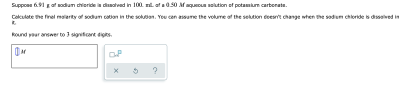 Suppose 6.91 g of sodium chloride is dissolved in 100. mL of a 0.50 M aqueous solution of potassium carbonate. Calculate the final molarity of sodium cation in the solution. You can assume the volume of the solution doesn't change when the sodium chloride is dissolved in it. Round your answer to 3 significant digits. x 6 ?
25.67 mL of 4.786 M iron (III) chloride solution reacted with 26.57 mL of 5.376 M...
 25.67 mL of 4.786 M iron (III) chloride solution reacted with
26.57 mL of 5.376 M ammonium carbonate producing iron (III)
carbonate as precipitate at 89.58%
write proper annotated balanced chemical reactions. need help
understanding each step using the ICE method.
To facilitate calculations here molar masses of involved elements to be used: 26.982 74.922 137.327 79.904 Aluminum g/mol Arsenic g/mol Barium g/mol Bromine g/mol 40.078 12.011 35.453 1.008 Calcium g/mol Carbon g/mol Chlorine g/mol Hydrogen g/mol 55.845 207.2 Iron...
25.67 mL of 4.786 M iron (III) chloride solution reacted with
26.57 mL of 5.376 M ammonium carbonate producing iron (III)
carbonate as precipitate at 89.58%
write proper annotated balanced chemical reactions. need help
understanding each step using the ICE method.
To facilitate calculations here molar masses of involved elements to be used: 26.982 74.922 137.327 79.904 Aluminum g/mol Arsenic g/mol Barium g/mol Bromine g/mol 40.078 12.011 35.453 1.008 Calcium g/mol Carbon g/mol Chlorine g/mol Hydrogen g/mol 55.845 207.2 Iron...
Sodium carbonate, Na2CO3, reacts with hydrochloric acid, HCl, to produce sodium chloride, carbon dioxide and water....
 Sodium carbonate, Na2CO3, reacts with hydrochloric acid, HCl, to produce sodium chloride, carbon dioxide and water. Refer to slide 7.18 for a summary of formulae relevant to the calculations below. 2HCl(aq) + Na.CO3(aq) + NaCl(aq) + H2O(l) + CO2(g) 1. Use this reaction to explain what is meant by the terms "acid", "conjugate base" and "salt" 2. Balance the equation for this reaction. 3. A solution was prepared by dissolving 5.00 g of Na2CO3 in water and adding water to...
5. A basic buffer solution can be prepared by using a A) solution of sodium hydroxide....
5. A basic buffer solution can be prepared by using a A) solution of sodium hydroxide. B) solution of ammonia and ammonium chloride C) a mixtureof of sodium hydroxide and hydrochloric acid D) a mixture of acetic acid and sodium acetate. 6. Which is a diprotic acid? A) Hydrochloric acid, HCl B) Sulfuric acid, H2SO4 C ) Phosphoric acid, H3PO4 D) Acetic acid, 7. What is the formula of the compound formed between calcium ion and bicarbonate ion? A) CaSO4...
Prepare 250 mL of-0.02 M K2Cr2O7 by transferring an accurately weighed amount of the dried dichromate into a 250 mL volumetric flask and diluting to the mark. Since this is a volumetric preparat...
 Prepare 250 mL of-0.02 M K2Cr2O7 by transferring an accurately weighed amount of the dried dichromate into a 250 mL volumetric flask and diluting to the mark. Since this is a volumetric preparation, the exact concentration of the titrant will be based on the analytical weight of the potassium dichromate used to prepare the solution. . Analysis of the Unknown FeO Sample Accurately weigh four (4)-0.3 g samples of the dried unknown into four 400 or 600 mL beakers. Add...
5. Let a square represent an ammonium ion and a circle represent a sulfate ion. Which...
 5. Let a square represent an ammonium ion and a circle represent a sulfate ion. Which of the following depicts a small representative volume of a 0.10 M aqueous solution of ammonium sulfate? Water molecules have not been included. For each incorrect answer, state why it is incorrect; be as specific as possible. A в C о ‑ G F None of B these O ODO epresents an ato At 25°C in a 50 mL Erlenmeyer flask were combined 1.050...
MSISTRY 203-204 Grganic Chemistry Lab Manual 3 4 EXPERIMENT #9 The Preparation of t Butyl Chloride A tertiary carbonium ion is more rapidly formed than a secondary or primary carbonium ion. Onc...
 MSISTRY 203-204 Grganic Chemistry Lab Manual 3 4 EXPERIMENT #9 The Preparation of t Butyl Chloride A tertiary carbonium ion is more rapidly formed than a secondary or primary carbonium ion. Once formed, a tertiary carbonium ion is stabilized by charge dispersal to a greater extent than a secondary or primary carbonium ion. It therefore has a longer life expectancy. Primary carbonium ions, protons, may exist in solution only in solvated form have any free existence, they dehydration reaction and...
CHM 1210 Final practice Name: Know electrolyte table, 5 solubility rules; 26 polyatomics (name/formula) Write 7...
 CHM 1210 Final practice Name: Know electrolyte table, 5 solubility rules; 26 polyatomics (name/formula) Write 7 naturally occurring diatomic molecules (name; formula, phase , charge) Write rite out strong acids and weak acids by name; formula, phase ,charge Write out the molecular, complete, and net-ionic equations for the following reactions The mixing of Cobalt(IlI) chloride and silver nitrate The mixing of acetic acid and sodium hydroxide The mixing of hydrochloric acid and cakcium hydroxide The mixing of barium chloride and...
 Ity Help Page Student Help A weighed amount of sodium chloride is completely dissolved in a measured volume of 4.00 M ammonia solution at ice temperature, and carbon dioxide is bubbled in. Assume that sodium bicarbonate is formed until the limiting reagent is entirely used up. The solubility of sodium bicarbonate in water at ice temperature is 0.75 mol per liter. Also assume that all the sodium bicarbonate precipitated is collected and converted quantitatively to sodium carbonate The mass of...
 Suppose 6.91 g of sodium chloride is dissolved in 100. mL of a 0.50 M aqueous solution of potassium carbonate. Calculate the final molarity of sodium cation in the solution. You can assume the volume of the solution doesn't change when the sodium chloride is dissolved in it. Round your answer to 3 significant digits. x 6 ?
 25.67 mL of 4.786 M iron (III) chloride solution reacted with
26.57 mL of 5.376 M ammonium carbonate producing iron (III)
carbonate as precipitate at 89.58%
write proper annotated balanced chemical reactions. need help
understanding each step using the ICE method.
To facilitate calculations here molar masses of involved elements to be used: 26.982 74.922 137.327 79.904 Aluminum g/mol Arsenic g/mol Barium g/mol Bromine g/mol 40.078 12.011 35.453 1.008 Calcium g/mol Carbon g/mol Chlorine g/mol Hydrogen g/mol 55.845 207.2 Iron...
25.67 mL of 4.786 M iron (III) chloride solution reacted with
26.57 mL of 5.376 M ammonium carbonate producing iron (III)
carbonate as precipitate at 89.58%
write proper annotated balanced chemical reactions. need help
understanding each step using the ICE method.
To facilitate calculations here molar masses of involved elements to be used: 26.982 74.922 137.327 79.904 Aluminum g/mol Arsenic g/mol Barium g/mol Bromine g/mol 40.078 12.011 35.453 1.008 Calcium g/mol Carbon g/mol Chlorine g/mol Hydrogen g/mol 55.845 207.2 Iron...
 Sodium carbonate, Na2CO3, reacts with hydrochloric acid, HCl, to produce sodium chloride, carbon dioxide and water. Refer to slide 7.18 for a summary of formulae relevant to the calculations below. 2HCl(aq) + Na.CO3(aq) + NaCl(aq) + H2O(l) + CO2(g) 1. Use this reaction to explain what is meant by the terms "acid", "conjugate base" and "salt" 2. Balance the equation for this reaction. 3. A solution was prepared by dissolving 5.00 g of Na2CO3 in water and adding water to...
 Prepare 250 mL of-0.02 M K2Cr2O7 by transferring an accurately weighed amount of the dried dichromate into a 250 mL volumetric flask and diluting to the mark. Since this is a volumetric preparation, the exact concentration of the titrant will be based on the analytical weight of the potassium dichromate used to prepare the solution. . Analysis of the Unknown FeO Sample Accurately weigh four (4)-0.3 g samples of the dried unknown into four 400 or 600 mL beakers. Add...
 5. Let a square represent an ammonium ion and a circle represent a sulfate ion. Which of the following depicts a small representative volume of a 0.10 M aqueous solution of ammonium sulfate? Water molecules have not been included. For each incorrect answer, state why it is incorrect; be as specific as possible. A в C о ‑ G F None of B these O ODO epresents an ato At 25°C in a 50 mL Erlenmeyer flask were combined 1.050...
 MSISTRY 203-204 Grganic Chemistry Lab Manual 3 4 EXPERIMENT #9 The Preparation of t Butyl Chloride A tertiary carbonium ion is more rapidly formed than a secondary or primary carbonium ion. Once formed, a tertiary carbonium ion is stabilized by charge dispersal to a greater extent than a secondary or primary carbonium ion. It therefore has a longer life expectancy. Primary carbonium ions, protons, may exist in solution only in solvated form have any free existence, they dehydration reaction and...
 CHM 1210 Final practice Name: Know electrolyte table, 5 solubility rules; 26 polyatomics (name/formula) Write 7 naturally occurring diatomic molecules (name; formula, phase , charge) Write rite out strong acids and weak acids by name; formula, phase ,charge Write out the molecular, complete, and net-ionic equations for the following reactions The mixing of Cobalt(IlI) chloride and silver nitrate The mixing of acetic acid and sodium hydroxide The mixing of hydrochloric acid and cakcium hydroxide The mixing of barium chloride and...
Most questions answered within 3 hours.
-
Where is the error in this code sequence?
String s1 = "Hello";
String s2 = "ello";...
asked 10 months ago -
Financial data for Joel de Paris, Inc., for last year
follow:
Joel de Paris, Inc.
Balance...
asked 10 months ago -
Consider this reaction:
Al2(SO4)3 (aq)+ BaCl3
(aq) Al2Cl6 (aq)- +
3BaSO4(s) . What is the...
asked 10 months ago -
Suppose that Savneet is considering increasing her
recent random sample from 20 car rentals to 40...
asked 10 months ago -
Trucks arrive at an unloading terminal at an average rate of 120
per hour.
Trucks arrive...
asked 10 months ago -
Why are methanol and ethanol completely soluble in water while
octanol is not very little soluble....
asked 10 months ago -
A facilities manager at a university reads in a research report
that the mean amount of...
asked 10 months ago -
When the CuSO4 is rehydrated by adding water to the anhydrous
compound, is this an endothermic...
asked 10 months ago -
A ray of sunlight is passing from diamond into crown glass; the
angle of incidence is...
asked 10 months ago -
A block of mass 0.249 kg is placed on top of a light, vertical
spring of...
asked 10 months ago -
how do the kidneys compensate in the presences of acidosis
a) trigger hyperventilate
b) reserve acid...
asked 10 months ago -
Question 501 pts
The rental rate of capital to the firm increases. Which of the
following...
asked 10 months ago