A) Design a MOSFET class B output stage to deliver an average power of 100W into...
A) Design a MOSFET class B output stage to deliver an average power of 100W into a 16Ω load. Use a power supply voltage at least 3V greater than the peak sine wave output desired and rounded to the nearest appropriate volt.
B) Calculate the peak current from each supply, the total supply power, and the power conversion efficiency.
C) Calculate the maximum possible power dissipation in each transistor for a sine wave input.
Homework Answers


Add Answer to:
A) Design a MOSFET class B output stage to deliver an average
power of 100W into...
It is required to design a class B output stage to deliver an average power of 20 W to an 8-Ω loa...
 It is required to design a class B output stage to deliver an average power of 20 W to an 8-Ω load. The power supply is to be selected such that Vcc is about 5 V greater than the peak output voltage. This avoids transistor saturation and the associated nonlinear distortion, and allows for including short-circuit protection circuitry. (The latter will be discussed in Section 12.6.) Determine the supply voltage required the peak current drawn from each supply, the total...
2. Design an idealized class B output stage, as shown in Figure 2, to deliver an...
 2. Design an idealized class B output stage, as shown in Figure 2, to deliver an average of 25 W to an 82 speaker. The peak output voltage must be no larger than 80 percent of supply voltages Vcc. Determine: a) The required value of Voc b) The peak current in each transistor c) The power conversion efficiency V+ On Vo ap RL Figure 2
a) What is "power-conversion efficiency' of an output stage? Comparo the class-A and class-B amplifier output...
 a) What is "power-conversion efficiency' of an output stage? Comparo the class-A and class-B amplifier output stages with rospect to their power-conversion officiencies. b) Assume that an emitter follower 9, is used as a class-A output stago, with the constant current supplied by another transistor 2. (as in Figure Q.4.a). Let Vcc=16V, 1 =100mA, and R=10002. If the output voltage is an 4-V-peak sinusoid, find the power conversion efficiency. VC Figure Q.4.a c) Explain the crossover distortion in a class-B...
Design a boost converter power stage to the following specification: Input voltage Output voltage: Output voltage...
 Design a boost converter power stage to the following specification: Input voltage Output voltage: Output voltage ripple:max 20mV Load power: Switching frequency: 15kHz 110-125V 300V 1.5kW Calculate: (i) Maximum duty cycle (ii) Minimum duty cycle (iii) Average diode current (iv) Assuming the Rds(on) of the MOSFET is 0.01 Ω, and the diode forward voltage is 0.8V, calculate the approximate efficiency of the circuit. 2. A switching power supply shown in the circuit below has its switch driven by a signal...
2. Consider a class B BJT output stage with a square wave output voltage of amplitude Vo across a...
 2. Consider a class B BJT output stage with a square wave output voltage of amplitude Vo across a load Ri. and employing power supplies Vss. Neglecting the effects of finite VBE and VCEs (i.e., assume both VBE and VcEsat are negligible small) determine the load power, the supply power, the power conversion efficiency, the maximum attainable power conversion efficiency and the corresponding value of Vo.
2. Consider a class B BJT output stage with a square wave output voltage...
2. Consider a class B BJT output stage with a square wave output voltage of amplitude Vo across a load Ri. and employing power supplies Vss. Neglecting the effects of finite VBE and VCEs (i.e., assume both VBE and VcEsat are negligible small) determine the load power, the supply power, the power conversion efficiency, the maximum attainable power conversion efficiency and the corresponding value of Vo.
2. Consider a class B BJT output stage with a square wave output voltage...
12.12 Consider the complementary-BJT class B output stage and neglect the effects of finite Vgf and...
 12.12 Consider the complementary-BJT class B output stage and neglect the effects of finite Vgf and VCEstFor t10-V power supplies and an 8-S2 load resistance, what is the maximum sine-wave output power available? What supply power corresponds? What is the power-conversion efficiency? For output signals of half this amplitude, find the output power, the supply power, and the power-conversion efficiency
7, (15 pts) Draw the circuit for the complementary BJT class B output stage. For ±10...
 7, (15 pts) Draw the circuit for the complementary BJT class B output stage. For ±10 V power supplies and a 10-Ω load resistance, what is the maximum sine-wave output power available? What supply power corresponds? What is the power-conversion efficiency in this case? (Neglect the effects of VbE and VcEsat.)
1. A class B output stage operates from 310V supplies. Assuming relatively ideal transistors, what is...
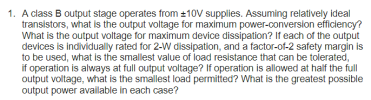 1. A class B output stage operates from 310V supplies. Assuming relatively ideal transistors, what is the output voltage for maximum power-conversion efficiency? What is the output voltage for maximum device dissipation? If each of the output devices is individually rated for 2-W dissipation, and a factor-of-2 safety margin is to be used, what is the smallest value of load resistance that can be tolerated, if operation is always at full output voltage? If operation is allowed at half the...
Design a DC-DC boost converter, shown below, that converts an unregulated supply of 12.0 Vak into a load voltage of...
 Design a DC-DC boost converter, shown below, that converts an unregulated supply of 12.0 Vak into a load voltage of 30.0 Ve and load current of 0.25 A. The switching frequency of the transistor is 100 kHz. The transistor has an on-resistance of 0.15 Ω and the diode drops 0.7 V when it is conducting. The voltage ripple (Av) is taken as 20 mVpp The circuit has 80% conversion efficiency. Find the DC input-current (Iden), duty-cycle (D), inductance (L), power-dissipation...
The last stage of operational Amplifier is a power amplifier. Class B is a good choice...
The last stage of operational Amplifier is a power amplifier. Class B is a good choice for the power amplifier. However, class B suffer from crossover distortion. Several methods are used to correct this non linearity as was discussed in the lecture (class AB). One of this method is the use of VBE multiplier. Design the output of an operational amplifier using class AB that employ VBE multiplier. For temperature stability RE can be used for the NPN and PNP...
 It is required to design a class B output stage to deliver an average power of 20 W to an 8-Ω load. The power supply is to be selected such that Vcc is about 5 V greater than the peak output voltage. This avoids transistor saturation and the associated nonlinear distortion, and allows for including short-circuit protection circuitry. (The latter will be discussed in Section 12.6.) Determine the supply voltage required the peak current drawn from each supply, the total...
 2. Design an idealized class B output stage, as shown in Figure 2, to deliver an average of 25 W to an 82 speaker. The peak output voltage must be no larger than 80 percent of supply voltages Vcc. Determine: a) The required value of Voc b) The peak current in each transistor c) The power conversion efficiency V+ On Vo ap RL Figure 2
 a) What is "power-conversion efficiency' of an output stage? Comparo the class-A and class-B amplifier output stages with rospect to their power-conversion officiencies. b) Assume that an emitter follower 9, is used as a class-A output stago, with the constant current supplied by another transistor 2. (as in Figure Q.4.a). Let Vcc=16V, 1 =100mA, and R=10002. If the output voltage is an 4-V-peak sinusoid, find the power conversion efficiency. VC Figure Q.4.a c) Explain the crossover distortion in a class-B...
 Design a boost converter power stage to the following specification: Input voltage Output voltage: Output voltage ripple:max 20mV Load power: Switching frequency: 15kHz 110-125V 300V 1.5kW Calculate: (i) Maximum duty cycle (ii) Minimum duty cycle (iii) Average diode current (iv) Assuming the Rds(on) of the MOSFET is 0.01 Ω, and the diode forward voltage is 0.8V, calculate the approximate efficiency of the circuit. 2. A switching power supply shown in the circuit below has its switch driven by a signal...
 2. Consider a class B BJT output stage with a square wave output voltage of amplitude Vo across a load Ri. and employing power supplies Vss. Neglecting the effects of finite VBE and VCEs (i.e., assume both VBE and VcEsat are negligible small) determine the load power, the supply power, the power conversion efficiency, the maximum attainable power conversion efficiency and the corresponding value of Vo.
2. Consider a class B BJT output stage with a square wave output voltage...
2. Consider a class B BJT output stage with a square wave output voltage of amplitude Vo across a load Ri. and employing power supplies Vss. Neglecting the effects of finite VBE and VCEs (i.e., assume both VBE and VcEsat are negligible small) determine the load power, the supply power, the power conversion efficiency, the maximum attainable power conversion efficiency and the corresponding value of Vo.
2. Consider a class B BJT output stage with a square wave output voltage...
 12.12 Consider the complementary-BJT class B output stage and neglect the effects of finite Vgf and VCEstFor t10-V power supplies and an 8-S2 load resistance, what is the maximum sine-wave output power available? What supply power corresponds? What is the power-conversion efficiency? For output signals of half this amplitude, find the output power, the supply power, and the power-conversion efficiency
 7, (15 pts) Draw the circuit for the complementary BJT class B output stage. For ±10 V power supplies and a 10-Ω load resistance, what is the maximum sine-wave output power available? What supply power corresponds? What is the power-conversion efficiency in this case? (Neglect the effects of VbE and VcEsat.)
 1. A class B output stage operates from 310V supplies. Assuming relatively ideal transistors, what is the output voltage for maximum power-conversion efficiency? What is the output voltage for maximum device dissipation? If each of the output devices is individually rated for 2-W dissipation, and a factor-of-2 safety margin is to be used, what is the smallest value of load resistance that can be tolerated, if operation is always at full output voltage? If operation is allowed at half the...
 Design a DC-DC boost converter, shown below, that converts an unregulated supply of 12.0 Vak into a load voltage of 30.0 Ve and load current of 0.25 A. The switching frequency of the transistor is 100 kHz. The transistor has an on-resistance of 0.15 Ω and the diode drops 0.7 V when it is conducting. The voltage ripple (Av) is taken as 20 mVpp The circuit has 80% conversion efficiency. Find the DC input-current (Iden), duty-cycle (D), inductance (L), power-dissipation...
Most questions answered within 3 hours.
-
Where is the error in this code sequence?
String s1 = "Hello";
String s2 = "ello";...
asked 10 months ago -
Financial data for Joel de Paris, Inc., for last year
follow:
Joel de Paris, Inc.
Balance...
asked 10 months ago -
Consider this reaction:
Al2(SO4)3 (aq)+ BaCl3
(aq) Al2Cl6 (aq)- +
3BaSO4(s) . What is the...
asked 10 months ago -
Suppose that Savneet is considering increasing her
recent random sample from 20 car rentals to 40...
asked 10 months ago -
Trucks arrive at an unloading terminal at an average rate of 120
per hour.
Trucks arrive...
asked 10 months ago -
Why are methanol and ethanol completely soluble in water while
octanol is not very little soluble....
asked 10 months ago -
A facilities manager at a university reads in a research report
that the mean amount of...
asked 10 months ago -
When the CuSO4 is rehydrated by adding water to the anhydrous
compound, is this an endothermic...
asked 10 months ago -
A ray of sunlight is passing from diamond into crown glass; the
angle of incidence is...
asked 10 months ago -
A block of mass 0.249 kg is placed on top of a light, vertical
spring of...
asked 10 months ago -
how do the kidneys compensate in the presences of acidosis
a) trigger hyperventilate
b) reserve acid...
asked 10 months ago -
Question 501 pts
The rental rate of capital to the firm increases. Which of the
following...
asked 10 months ago