What is the main purpose for conducting a risk assessment? Is it for the business side...
What is the main purpose for conducting a risk assessment? Is it for the business side or is it for the technical side of the organization? What risk assessment method do you think is most effective (quantitative or qualitative)? Are there any other methods at there? If so, what are the name of those methods and can you explain the differences in that method from other methods?
Homework Answers
What is a risk assessment:
- A risk assessment is a systematic examination of a task, job or process that you carry out at work for the purpose of identifying the significant hazards, the risk of someone being harmed and deciding what further control measures you must take to reduce the risk to an acceptable level.
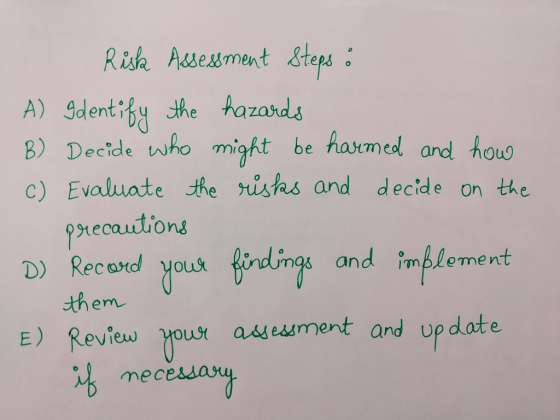
We have detailed these further below:
- Identifying the significant hazards that are present (a hazard is something that has the potential to cause someone harm or ill health).
- Deciding if what you have already done reduces the risk of someone being harmed to an acceptable level, and if not.
- Deciding what further control measures you must take to reduce the risk to an acceptable level.
- Risk Assessments should also be carried out to satisfy the requirements of legislation but above all to ensure the Health & Safety of employees.
Who should do risk assessments:
- Risk assessments should always be carried out by a person who is experienced and competent to do so, competence can be expressed as a combination of Knowledge, Awareness, training, and experience.
- If necessary consult a more experienced member of staff or external professional help to assist with the risk assessment template.
- Remember competence does not mean you have to know everything about everything, competence also means knowing when you know enough or when you should call in further expert help.
When should risk assesment be done:
- A separate risk assessment should be carried out for all tasks or processes undertaken by your organisation, they should be carried out before the task starts, or in the case of existing or long running tasks, as soon as is reasonably practicable.
- Risk Assessments should also be reviewed on a regular basis; monthly, annually, bi-annually, depending on risk, or if something changes i.e. a new worker, a change of process or substance etc.
What they are, why they're important and how to complete them:
- Risk assessment is a primary management tool in ensuring the health and safety of workers (and others). What many people perhaps are not aware of, however, is that they are actually a legal requirement for employers and certain self-employed people.
- Whether you're wondering how to complete a risk assessment or are unsure of their relevance within your industry, read on to discover everything you need to know.
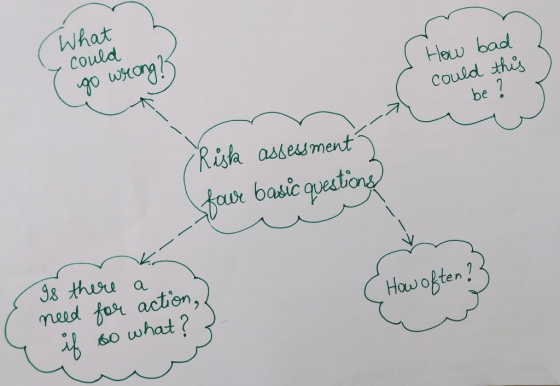
When completing a risk assessment, it is important to clearly define some keywords:
- An accident is ‘an unplanned event that results in loss’
- A hazard is ‘something that has the potential to cause harm’
- A risk is ‘the likelihood and the severity of a negative occurrence (injury, ill-health, damage, loss) resulting from a hazard.’
Different types of risk assessments:
- The types of risk assessment required within any workplace should be proportionate and relevant to the operational activities being undertaken.
- In many industries, there are specific legislative requirements that apply. For example, in environments where hazardous substances are used a Control of Substances Hazardous to Health Assessment (COSHH) should be completed.
Some common types of risk assesment include the following:
- Fire risk assessments: fire safety management procedures are required to be established in all workplaces including a suitable and sufficient fire risk assessment.
- Manual handling risk assessments: should be conducted in any workplace where an employee may be at risk from injury and/or ill-health through the need to lift, carry, move loads.
- Display screen equipment (DSE) risk assessments: are required to be completed in workplaces where employees (and others) are using computers, laptops, etc.
- COSHH risk assessments: are required within workplaces where hazardous substances are stored, used or manufactured.
Why are risk assesment important:
- As previously stated, carrying out suitable and sufficient risk assessments is the primary management tool in effective risk management.
- It is a legal requirement for any employer and must be documented wherever five or more people are employed.
- Risk assessment is a straightforward and structured method of ensuring the risks to the health, safety and wellbeing of employees (and others) are suitably eliminated, reduced or controlled.
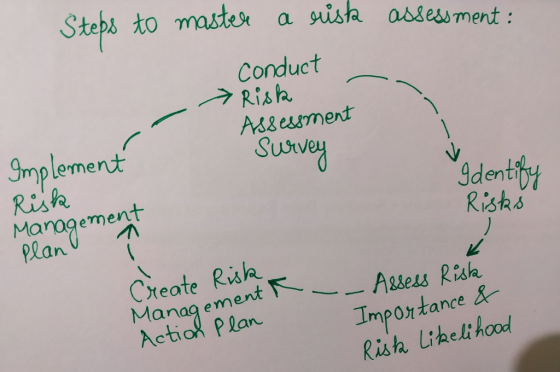
The main purpose of risk assesment are:
- To identify health and safety hazards and evaluate the risks presented within the workplace
- To evaluate the effectiveness and suitability of existing control measures
- To ensure additional controls (including procedural) are implemented wherever the remaining risk is considered to be anything other than low.
- To prioritise further resources if needed to ensure the above.
Differences between qualitative risk asessment and quantitative risk assesment:
| Qualitative | Quantitative |
|---|---|
| Risk-level | Project-level |
| Subjective evaluation of probability and impact | Probabilistic estimates of time and cost |
| Quick and easy to perform | Time consuming |
| No special software or tools required | May require specialized tools |
| It considers all the risks identified in the identify risk process. | It only considers the risks which we mark for further analysis in the Perform Qualitative Risk Analysis Process. These are the risks that have a high impact on the project objectives. |
| It does not analyses the risks mathematically to identify the probability and likelihood. Instead, it uses stakeholders inputs (expert judgment) to judge the likelihood and impact | Perform Quantitative Risk Analysis uses the probability distributions to characterize the risk’s probability and impact. It also uses the project model (e.g., Schedule, cost estimate), mathematical and simulation tools to calculate the probability and impact. |
| In this, we assess individual risks by assigning a numeric ranking of probability and impact; usually; the rank of 0 to 1 is used where 1 demonstrates high. | It predicts likely project outcomes in terms of money or time based on combined effects of risks. It also estimates the likelihood of meeting targets. And communicates contingency needed to achieve the desired level of comfort. |
| We apply to Perform Qualitative Risk Analysis process in almost all the projects. | We don’t use this process is simple and moderately complex projects. We may not find its use in software projects |
Overview of risk assesment methods:
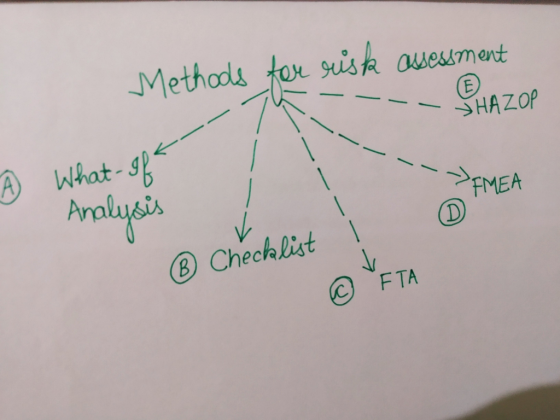
The following methods can be used for risk assessments:
- Use a what-if analysis to
identify threats and hazards.
What-if questions are asked about what could go wrong
and about what would happen if things do go wrong. This
type of analysis is a brainstorming activity and is carried
out by people who have knowledge about the areas,
operations, and processes that may be exposed to
hazardous events and conditions. -
Use a checklist of known threats and hazards to identify
your threats and hazards. The value of this type of analysis
depends upon the quality of the checklist and the
experience of the user. -
Use a combination of checklists and what-if analysis to
identify your threats and hazards. Checklists are used to
ensure that all relevant what-if questions are asked and
discussed, and to encourage a creative approach to
risk assessment. -
Use a hazard and operability study (HAZOP) to identify your
threats and hazards. If you need to do a thorough analysis,
this method is for you. However, it requires strong leadership
and is costly and time consuming. It also assumes that you
have a very knowledgeable interdisciplinary team available to
you, one with detailed knowledge about the areas, operations,
and processes that may be exposed to hazardous events and
conditions. -
Use a failure mode and effect analysis (FMEA) to identify
potential failures and to figure out what effect failures would
have. This method begins by selecting a system for analysis
and then looks at each element within the system. It then tries
to predict what would happen to the system as a whole when
each element fails. This method is often used to predict
hardware failures and is best suited for this purpose. -
Use a fault tree analysis (FTA) to identify all the things that
could potentially cause a hazardous event. It starts with a
particular type of hazardous event and then tries to identify
every possible cause.
Overview of other methods used for risk assesment:
- For both quantitative and qualitative approaches, a wide range of techniques exist.
- Each technique has its own:
- Characteristics
- Advantages
- Disadvantages
- The field of application
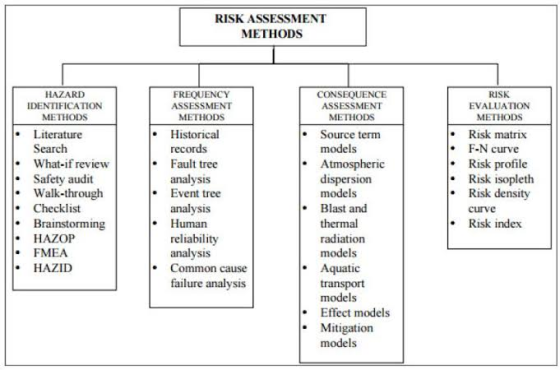
- HAZID standards for hazard identification
- HAZOP is hazard and operability
- FMEA is failure mode and effect analysis
- F-N cure is frequency-number
Qualitative or semi-quantitative techniques, such as:
- Hazard matrices
- Risk graphs
- Risk matrices
- Monographs
are often used for risk screening.
- This is in contrast to complex risks that are assessed through more expensive and sophisticated quantitative techniques, such as actuarial and hybrid risk assessment models
How to choose the techniques you’ll need:
The specific techniques used to identify and analyse risks, such as hazard and operational risks, depend on a range of relevant factors, particularly the:
- nature (including business model)
- size
- complexity, and
- the risk profile of the enterprise
Add Answer to:
What is the main purpose for conducting a risk assessment? Is it
for the business side...
53. After a risk assessment study, a bank with global operations decided to continue doing business...
53. After a risk assessment study, a bank with global operations decided to continue doing business in certain regions of the world where identity theft is widespread. To MOST effectively deal with the risk, the business should: A. Implement monitoring techniques to detect and react to potential fraud. B. Make the customer liable for losses if the customer fails to follow the bank’s advice. C. Increase its customer awareness efforts in those regions. D. Outsource credit card processing to a...
When conducting a risk assessment, what types of assets should be considered and what different types...
When conducting a risk assessment, what types of assets should be considered and what different types of impacts could an organization have to deal with?
What are the main differences between epidemiology and risk assessment in terms of goals and approaches?
What are the main differences between epidemiology and risk assessment in terms of goals and approaches?
1. Discuss the various risk assessment methodologies that may be in use today. Is there one...
1. Discuss the various risk assessment methodologies that may be in use today. Is there one that stands out to you being more productive than others? If so, please discuss why. 2. Drawing from your professional and/or academic experience, what role does non-technical reviews play during a risk assessment? What would have to be reviewed? Why the importance? 3. Discuss why you believe a threat assessment is needed prior to a risk assessment. What role does the threat assessment play?...
Explain briefly the purpose of conducting a laboratory point load test? What is the main parameter...
Explain briefly the purpose of conducting a laboratory point load test? What is the main parameter obtained from this test? What are the advantages of doing a point load test?
1. What is the main purpose of a presentation? Answer: 2. What is the main advantage...
1. What is the main purpose of a presentation? Answer: 2. What is the main advantage of speaking over writing? Answer: 3. If you want to persuade your readers, what should you consider doing? Answer: 4. While a persuasive speech might include an appeal to emotion, an informative speech should focus on _________. Answer: 5. As an aid to memory, it’s a good idea to have repetition in your presentation. Think of your presentation as having: an _________that previews, a...
(Implement falls prevention strategies) 1) When conducting an assessment on the risk of falls, why is...
(Implement falls prevention strategies) 1) When conducting an assessment on the risk of falls, why is it important to maximize the participation or unnecessary discomfort of older people? 2) If falls minimization are not having the desired result what would you do? 3) Describe how stroke and one other condition contribute to the risk of falls, and how carers or workers should respond? 4) Describe three ways the ageing process might affect the risk of falls.
What do you think the similarities and differences might be in managing the failure and risk...
What do you think the similarities and differences might be in managing the failure and risk associated with innovation in a large versus a small organization? What do you personally believe are the most important aspects of innovation; risk-taking, failure or learning? Explain. As a manager in an innovative company what would you focus on to ensure quality in the innovation process and why?
What are the six main functions that a physician organization must complete so that the business...
What are the six main functions that a physician organization must complete so that the business can achieve its purpose? How do the organization’s mission, vision, and core values play a role with achieving success?
What are the definitions of a (security) risk assessment in the textbook and in Appendix B...
What are the definitions of a (security) risk assessment in the textbook and in Appendix B of NIST SP 800-53a? Which definition do you prefer? Why? What is a security control? Give two examples of a security control. List the primary benefits of a security risk assessment. Which one do you think is the most important? Why? If security spending is not based on a security risk assessment, how are spending priorities typically determined? Why are security controls assessed? How...
Most questions answered within 3 hours.
-
Where is the error in this code sequence?
String s1 = "Hello";
String s2 = "ello";...
asked 10 months ago -
Financial data for Joel de Paris, Inc., for last year
follow:
Joel de Paris, Inc.
Balance...
asked 10 months ago -
Consider this reaction:
Al2(SO4)3 (aq)+ BaCl3
(aq) Al2Cl6 (aq)- +
3BaSO4(s) . What is the...
asked 10 months ago -
Suppose that Savneet is considering increasing her
recent random sample from 20 car rentals to 40...
asked 10 months ago -
Trucks arrive at an unloading terminal at an average rate of 120
per hour.
Trucks arrive...
asked 10 months ago -
Why are methanol and ethanol completely soluble in water while
octanol is not very little soluble....
asked 10 months ago -
A facilities manager at a university reads in a research report
that the mean amount of...
asked 10 months ago -
When the CuSO4 is rehydrated by adding water to the anhydrous
compound, is this an endothermic...
asked 10 months ago -
A ray of sunlight is passing from diamond into crown glass; the
angle of incidence is...
asked 10 months ago -
A block of mass 0.249 kg is placed on top of a light, vertical
spring of...
asked 10 months ago -
how do the kidneys compensate in the presences of acidosis
a) trigger hyperventilate
b) reserve acid...
asked 10 months ago -
Question 501 pts
The rental rate of capital to the firm increases. Which of the
following...
asked 10 months ago