Please answer all parts to question and provide explanation if needed. a) If you only have...
Please answer all parts to question and provide explanation if needed.
a) If you only have random error what's the percentage that the true value will lie between L + standdevation of L, and L - standarddeviation of L
b) How can you get the velocity from the distance curve?
c) How can you get the Distance from the velocity curve?
d)Potential Energy is the energy of position
Kinetic Energy is the energy of movement
So is Force * distance equal to which of the two?
e) Energy cannot be created or destroyed only transformed. With that in mind, the bulk of energy is lost to the system in this form. What is this form?
Homework Answers
If v(t) is the velocity at time t, the distance traveled from time t1 to time t2 is the area under the graph of v(t) from t=t1 to t=t2. This may have to be done by evaluating the integral of v(t) dt from t1 to t2.
Some areas may be a shape whose area is easy to compute from a simple formula.
For example, suppose v(t) = 3t + 5 and you want to find the distance traveled from t=2 to t=7. The area under the graph is going to be a trapezoid with vertical parallel bases. The bases of the trapezoid are v(2) = 11 and v(7) = 26. The height of the trapezoid is 7 - 2 = 5. The area of the trapezoid is 1/2 (11+ 26) (5) = 92.5 which is the distance traveled. Remember to attach the proper units of measurement. If velocity is meters per second and time is seconds, the distance is meters.
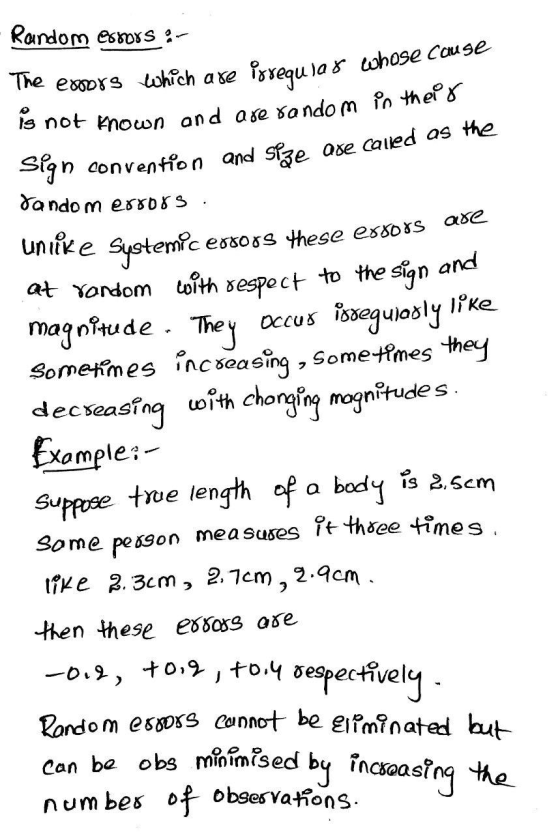
Answer a:
It depends on the L value. No classification of the value of L. For random error if L is large then the percentage will be more than 95%.
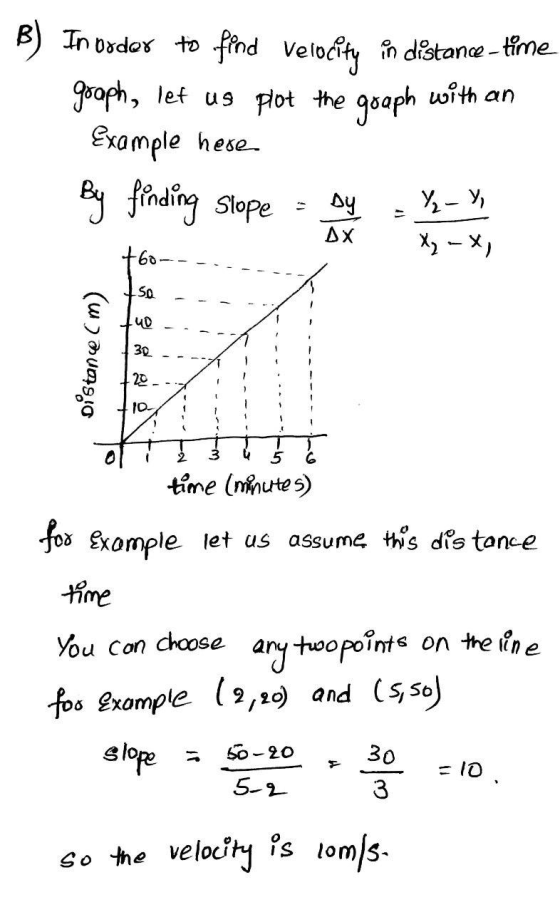
Answer b:
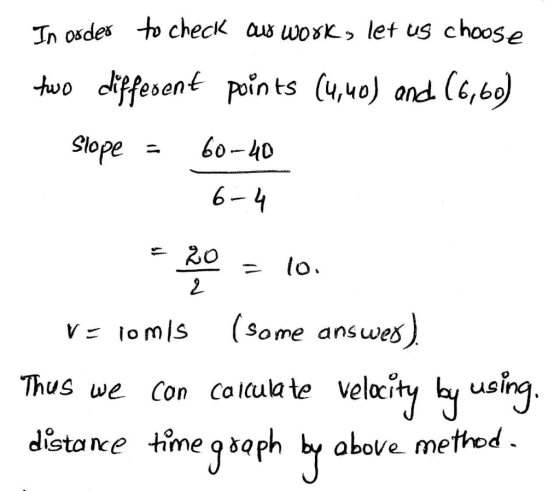
On a graph, the line which rises in equal proportion with vertical and horizontal scale is called a gradient of the graph.
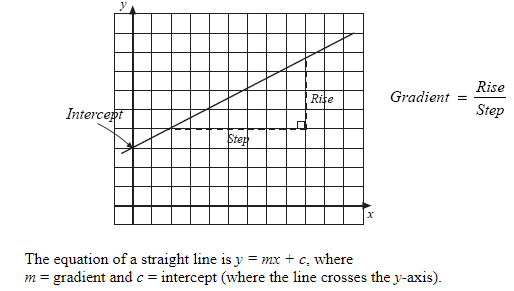
When the distance-time graph is plotted. The gradient obtained is speed but not velocity because the distance is the scalar quantity.
When a graph is plotted as displacement versus time then the gradient obtained is velocity since displacement and velocity are both vector quantities.
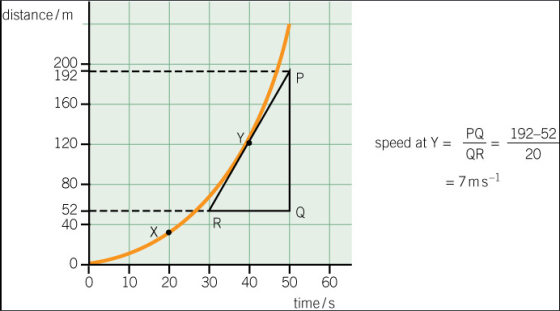
Hence, on obtaining the gradient. The speed value can be obtained.
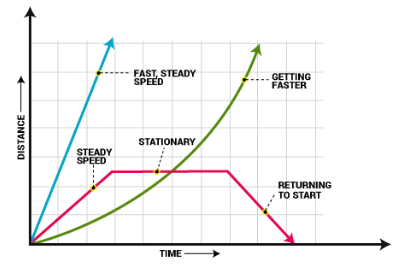
In order to find the velocity, instead of plotting distance-time graph, plot displacement time graph. Below are the figures describing the motion of the distance-time graph.
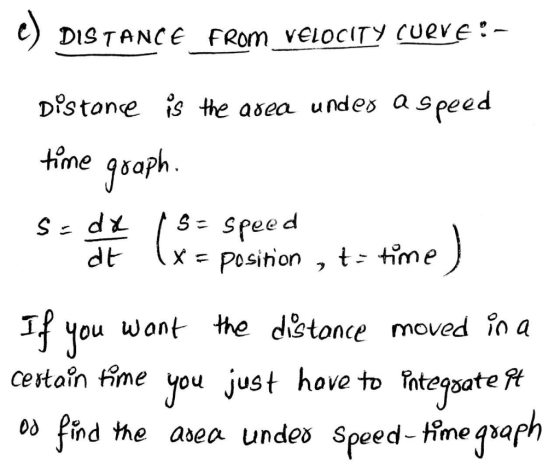
Answer c:
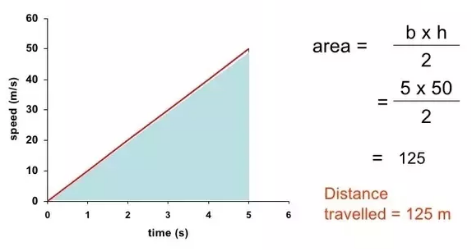
On a speed-time graph, the area under the line is numerically equal to the distance travelled.
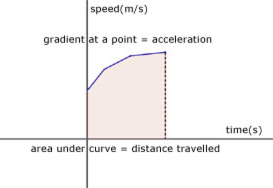
One of the examples is given below:
Answer d:
The total energy is the addition of potential energy and kinetic energy. Thus the,
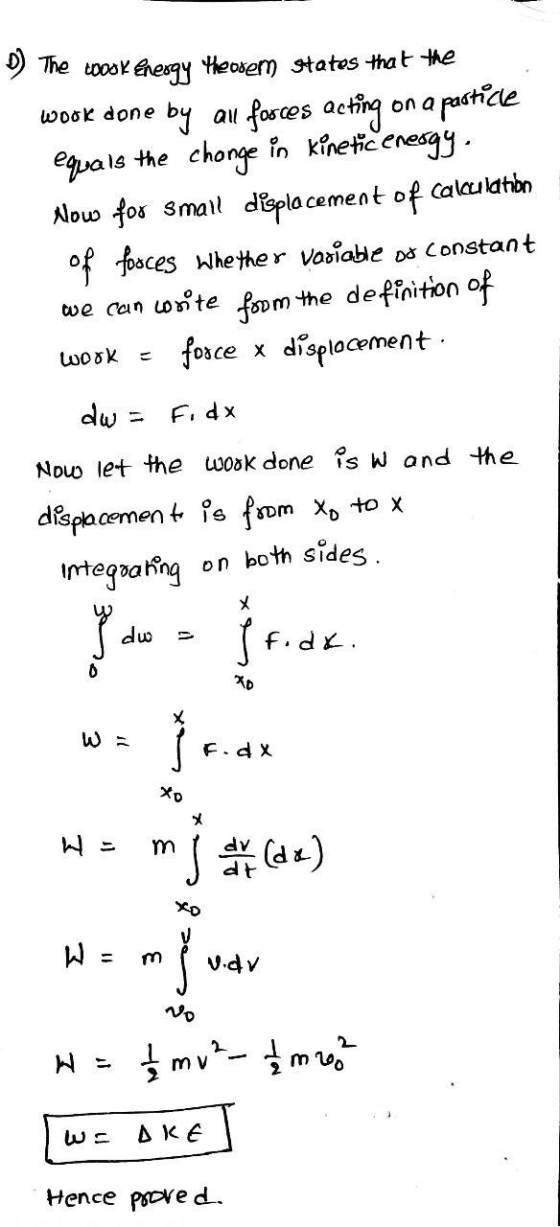
work done = energy transformed
Hence, the Force*distance moved is equal to the transformation energy taking place from potential to kinetic energy.
For example, if the potential energy(50 J) is converted to kinetic energy(50 J) then the value remains the same.
Hence, energy = force*distance moved
Answer e:
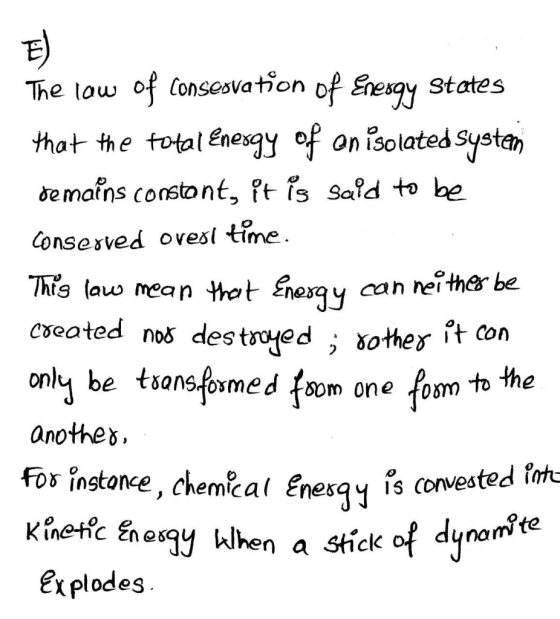
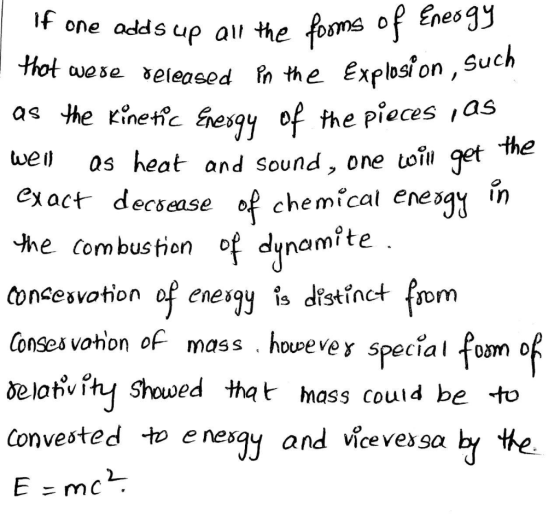
According to the law of conservation of energy, energy cannot be created nor be destroyed. It changes from one form to another. Hence, the energy lost to surrounding is mainly thermal energy.
Add Answer to:
Please answer all parts to question and provide explanation if
needed.
a) If you only have...
2. The law of conservation of energy states: energy cannot be created or destroyed, only transformed...
 2. The law of conservation of
energy states: energy cannot be created or destroyed, only
transformed and transferred. Explain how the energy bars visually
show this.
3. What forms of energy does the skydiver have at position
#3?
IN: Exploring Gravitational Potential Energy, Eg: ok 1 Tracking Energy of a Skydiver Landing on a Trampoline Thermal Energy of #2 Elastic Energy Kinetic Energy Gravitational Energy ox #3 Postion 1 Postoon 2 Position 3 Position 3 Position 4 Position 4 Position...
2. The law of conservation of
energy states: energy cannot be created or destroyed, only
transformed and transferred. Explain how the energy bars visually
show this.
3. What forms of energy does the skydiver have at position
#3?
IN: Exploring Gravitational Potential Energy, Eg: ok 1 Tracking Energy of a Skydiver Landing on a Trampoline Thermal Energy of #2 Elastic Energy Kinetic Energy Gravitational Energy ox #3 Postion 1 Postoon 2 Position 3 Position 3 Position 4 Position 4 Position...
Please answer all parts to this question! parts a through c with the explanation shown on...
 Please answer all parts to this question! parts a through c with
the explanation shown on question b! This is all one question so I
could not post them separately, please also check your answers
because the last person got it wrong! Thank you! Will give thumbs
up.
Reaction 1 below occurs very slowly, while reaction 2 below occurs much more rapidly: 1. O2(g) +20(9) 2. Ar(g) + O2(g) → Ar(9) +20(9) Q9.1 2 Points a. Ar(g) can be viewd...
Please answer all parts to this question! parts a through c with
the explanation shown on question b! This is all one question so I
could not post them separately, please also check your answers
because the last person got it wrong! Thank you! Will give thumbs
up.
Reaction 1 below occurs very slowly, while reaction 2 below occurs much more rapidly: 1. O2(g) +20(9) 2. Ar(g) + O2(g) → Ar(9) +20(9) Q9.1 2 Points a. Ar(g) can be viewd...
Can you please help me to answer this question? Please provide detailed explanation on how you...
 Can you please help me to answer this question? Please provide
detailed explanation on how you get to the answer. Please do not
omit any steps and please explain in detail specially part b. Thank
you very much in advance!
Suppose you have a perfectly insulated container holding 2.00 kg of liquid water at a temperature of 20.0 °C. You also have a large supply of ice cubes which are stored at a temperature of -20.0 °C. a. What is...
Can you please help me to answer this question? Please provide
detailed explanation on how you get to the answer. Please do not
omit any steps and please explain in detail specially part b. Thank
you very much in advance!
Suppose you have a perfectly insulated container holding 2.00 kg of liquid water at a temperature of 20.0 °C. You also have a large supply of ice cubes which are stored at a temperature of -20.0 °C. a. What is...
Please answer ALL parts in SIMPLEST FORM! NO explanations are needed, THANK YOU!!! Problem 1 (50...
 Please answer ALL parts in SIMPLEST FORM! NO explanations are
needed, THANK YOU!!!
Problem 1 (50 points) masses mA 2 kg and mg -1 kg are connected by a small pulley. Mass ma is on an inclined plane at angle θ π/4 radians, and ms is allowed to hang freely (a) Suppose the string has length potential energy of the system as a function of the height of mass ma? (b) Find the acceleration of mass ma (either which way...
Please answer ALL parts in SIMPLEST FORM! NO explanations are
needed, THANK YOU!!!
Problem 1 (50 points) masses mA 2 kg and mg -1 kg are connected by a small pulley. Mass ma is on an inclined plane at angle θ π/4 radians, and ms is allowed to hang freely (a) Suppose the string has length potential energy of the system as a function of the height of mass ma? (b) Find the acceleration of mass ma (either which way...
Please answer ALL parts in SIMPLEST FORM! NO explanations are needed, THANK YOU!!! Problem 1 (50...
 Please answer ALL parts in SIMPLEST FORM! NO explanations are
needed, THANK YOU!!!
Problem 1 (50 points) masses mA -2 kg and mg 1 kg are connected by a small pulley. Mass ma is on an inclined plane at angle 8-/4 radians, and ma is allowed to hang freely (a) Suppose the string has length potential energy of the system as a function of the height of mass mg? (b) Find the acceleration of mass ma (either which way the...
Please answer ALL parts in SIMPLEST FORM! NO explanations are
needed, THANK YOU!!!
Problem 1 (50 points) masses mA -2 kg and mg 1 kg are connected by a small pulley. Mass ma is on an inclined plane at angle 8-/4 radians, and ma is allowed to hang freely (a) Suppose the string has length potential energy of the system as a function of the height of mass mg? (b) Find the acceleration of mass ma (either which way the...
Please fully answer ALL parts! :-) Thank you so much in advance!! 1) This week, we...
 Please fully answer ALL parts!
:-) Thank you so much in advance!!
1) This week, we introduced a new model, the rigid rotor, that can be used to describe rotating molecules. Before we get into problems that describe the quantum properties of a rigid rotor, let's quickly review the classical behavior of a rotating molecule. Consider a single atom with mass m rotating about the origin in a circular orbit with radius r. If the particle's linear momentum is p...
Please fully answer ALL parts!
:-) Thank you so much in advance!!
1) This week, we introduced a new model, the rigid rotor, that can be used to describe rotating molecules. Before we get into problems that describe the quantum properties of a rigid rotor, let's quickly review the classical behavior of a rotating molecule. Consider a single atom with mass m rotating about the origin in a circular orbit with radius r. If the particle's linear momentum is p...
Please answer all parts of the Question: a,b,c,d Kinetic Theory of Gas: Explanation of Pressure and...
 Please answer all parts of the
Question: a,b,c,d
Kinetic Theory of Gas: Explanation of Pressure and Temprature Internal Energy of a gas, Ideal Gas Law 1. The average kinetic energy of a molecule, is called thermal energy, it is directly related to absolute temperature. KE (average per molecule) = 5m +(average) = 1 kg(kp = 1.38x10⁻²³ /K) KT 2. The average speed of molecules in a gas: vrms=1 where vrms stands for root-mean-square (rms) speed. 3. The INTERNAL ENERGY of...
Please answer all parts of the
Question: a,b,c,d
Kinetic Theory of Gas: Explanation of Pressure and Temprature Internal Energy of a gas, Ideal Gas Law 1. The average kinetic energy of a molecule, is called thermal energy, it is directly related to absolute temperature. KE (average per molecule) = 5m +(average) = 1 kg(kp = 1.38x10⁻²³ /K) KT 2. The average speed of molecules in a gas: vrms=1 where vrms stands for root-mean-square (rms) speed. 3. The INTERNAL ENERGY of...
Please help answer ALL the following questions in the attachment. Please answer only if you’re certain....
 Please help answer ALL the following questions in the
attachment. Please answer only if you’re certain. Thank you so much
for your help.
1 Find the mismatched pai a) Entropy (AS-measurement of disorder in a thermodynamic system b) AG<0-Energetically favorable (spontaneous) reaction c) First Law of Thermodynamics-Energy in a system is not created nor destroyed, only transformed d) Second Law of Thermodynamics-The entropy of a perfect crystal at 0 K is exactly equal to zero. e) Standard free energy (G-The...
Please help answer ALL the following questions in the
attachment. Please answer only if you’re certain. Thank you so much
for your help.
1 Find the mismatched pai a) Entropy (AS-measurement of disorder in a thermodynamic system b) AG<0-Energetically favorable (spontaneous) reaction c) First Law of Thermodynamics-Energy in a system is not created nor destroyed, only transformed d) Second Law of Thermodynamics-The entropy of a perfect crystal at 0 K is exactly equal to zero. e) Standard free energy (G-The...
can you please answer all three parts of question 3 with an explanation on how you...
 can you please answer all three parts of question 3 with an
explanation on how you figured it out?
3. (6 points) Draw the product of the following transformations in the box provided. Na CN mos o 4 . Br Na SH 4. (4 points) Draw an arrow-pushing mechanism for the reaction below. Draw in all lone pairs and charges that may be present, and the structure of the intermediate generated after the first step. oto # photo + H2O
can you please answer all three parts of question 3 with an
explanation on how you figured it out?
3. (6 points) Draw the product of the following transformations in the box provided. Na CN mos o 4 . Br Na SH 4. (4 points) Draw an arrow-pushing mechanism for the reaction below. Draw in all lone pairs and charges that may be present, and the structure of the intermediate generated after the first step. oto # photo + H2O
Please answer ALL parts in simplest form, NO explanation needed, THANK YOU! Part A 1. Which...
 Please answer ALL parts in simplest form, NO explanation needed,
THANK YOU!
Part A 1. Which is the strongest acid? a) CH3CH2CH2CH2CH2OH b) CH,CH2CH2CH2COOH C) CH2FCH2CH2CH2COOH d) CH3FCH2CH2CH2CH2OH 2. What is the name of the following alkane? CH3 H₃ C° CH H₂C a) 5,5-dimethylheptane b) 4,4-dimethylheptane c) 2,2-dimethylheptane 1) 3,3-dimethylheptane 3. The name of this alkane is: нс HC ) 3-ethyl-2-methyl-5-propyloctane 6-ethyl-2-methyl-4-propyloctane 3,3-di-methyl-5-ethylactan
Please answer ALL parts in simplest form, NO explanation needed,
THANK YOU!
Part A 1. Which is the strongest acid? a) CH3CH2CH2CH2CH2OH b) CH,CH2CH2CH2COOH C) CH2FCH2CH2CH2COOH d) CH3FCH2CH2CH2CH2OH 2. What is the name of the following alkane? CH3 H₃ C° CH H₂C a) 5,5-dimethylheptane b) 4,4-dimethylheptane c) 2,2-dimethylheptane 1) 3,3-dimethylheptane 3. The name of this alkane is: нс HC ) 3-ethyl-2-methyl-5-propyloctane 6-ethyl-2-methyl-4-propyloctane 3,3-di-methyl-5-ethylactan
 2. The law of conservation of
energy states: energy cannot be created or destroyed, only
transformed and transferred. Explain how the energy bars visually
show this.
3. What forms of energy does the skydiver have at position
#3?
IN: Exploring Gravitational Potential Energy, Eg: ok 1 Tracking Energy of a Skydiver Landing on a Trampoline Thermal Energy of #2 Elastic Energy Kinetic Energy Gravitational Energy ox #3 Postion 1 Postoon 2 Position 3 Position 3 Position 4 Position 4 Position...
2. The law of conservation of
energy states: energy cannot be created or destroyed, only
transformed and transferred. Explain how the energy bars visually
show this.
3. What forms of energy does the skydiver have at position
#3?
IN: Exploring Gravitational Potential Energy, Eg: ok 1 Tracking Energy of a Skydiver Landing on a Trampoline Thermal Energy of #2 Elastic Energy Kinetic Energy Gravitational Energy ox #3 Postion 1 Postoon 2 Position 3 Position 3 Position 4 Position 4 Position...
 Please answer all parts to this question! parts a through c with
the explanation shown on question b! This is all one question so I
could not post them separately, please also check your answers
because the last person got it wrong! Thank you! Will give thumbs
up.
Reaction 1 below occurs very slowly, while reaction 2 below occurs much more rapidly: 1. O2(g) +20(9) 2. Ar(g) + O2(g) → Ar(9) +20(9) Q9.1 2 Points a. Ar(g) can be viewd...
Please answer all parts to this question! parts a through c with
the explanation shown on question b! This is all one question so I
could not post them separately, please also check your answers
because the last person got it wrong! Thank you! Will give thumbs
up.
Reaction 1 below occurs very slowly, while reaction 2 below occurs much more rapidly: 1. O2(g) +20(9) 2. Ar(g) + O2(g) → Ar(9) +20(9) Q9.1 2 Points a. Ar(g) can be viewd...
 Can you please help me to answer this question? Please provide
detailed explanation on how you get to the answer. Please do not
omit any steps and please explain in detail specially part b. Thank
you very much in advance!
Suppose you have a perfectly insulated container holding 2.00 kg of liquid water at a temperature of 20.0 °C. You also have a large supply of ice cubes which are stored at a temperature of -20.0 °C. a. What is...
Can you please help me to answer this question? Please provide
detailed explanation on how you get to the answer. Please do not
omit any steps and please explain in detail specially part b. Thank
you very much in advance!
Suppose you have a perfectly insulated container holding 2.00 kg of liquid water at a temperature of 20.0 °C. You also have a large supply of ice cubes which are stored at a temperature of -20.0 °C. a. What is...
 Please answer ALL parts in SIMPLEST FORM! NO explanations are
needed, THANK YOU!!!
Problem 1 (50 points) masses mA 2 kg and mg -1 kg are connected by a small pulley. Mass ma is on an inclined plane at angle θ π/4 radians, and ms is allowed to hang freely (a) Suppose the string has length potential energy of the system as a function of the height of mass ma? (b) Find the acceleration of mass ma (either which way...
Please answer ALL parts in SIMPLEST FORM! NO explanations are
needed, THANK YOU!!!
Problem 1 (50 points) masses mA 2 kg and mg -1 kg are connected by a small pulley. Mass ma is on an inclined plane at angle θ π/4 radians, and ms is allowed to hang freely (a) Suppose the string has length potential energy of the system as a function of the height of mass ma? (b) Find the acceleration of mass ma (either which way...
 Please answer ALL parts in SIMPLEST FORM! NO explanations are
needed, THANK YOU!!!
Problem 1 (50 points) masses mA -2 kg and mg 1 kg are connected by a small pulley. Mass ma is on an inclined plane at angle 8-/4 radians, and ma is allowed to hang freely (a) Suppose the string has length potential energy of the system as a function of the height of mass mg? (b) Find the acceleration of mass ma (either which way the...
Please answer ALL parts in SIMPLEST FORM! NO explanations are
needed, THANK YOU!!!
Problem 1 (50 points) masses mA -2 kg and mg 1 kg are connected by a small pulley. Mass ma is on an inclined plane at angle 8-/4 radians, and ma is allowed to hang freely (a) Suppose the string has length potential energy of the system as a function of the height of mass mg? (b) Find the acceleration of mass ma (either which way the...
 Please fully answer ALL parts!
:-) Thank you so much in advance!!
1) This week, we introduced a new model, the rigid rotor, that can be used to describe rotating molecules. Before we get into problems that describe the quantum properties of a rigid rotor, let's quickly review the classical behavior of a rotating molecule. Consider a single atom with mass m rotating about the origin in a circular orbit with radius r. If the particle's linear momentum is p...
Please fully answer ALL parts!
:-) Thank you so much in advance!!
1) This week, we introduced a new model, the rigid rotor, that can be used to describe rotating molecules. Before we get into problems that describe the quantum properties of a rigid rotor, let's quickly review the classical behavior of a rotating molecule. Consider a single atom with mass m rotating about the origin in a circular orbit with radius r. If the particle's linear momentum is p...
 Please answer all parts of the
Question: a,b,c,d
Kinetic Theory of Gas: Explanation of Pressure and Temprature Internal Energy of a gas, Ideal Gas Law 1. The average kinetic energy of a molecule, is called thermal energy, it is directly related to absolute temperature. KE (average per molecule) = 5m +(average) = 1 kg(kp = 1.38x10⁻²³ /K) KT 2. The average speed of molecules in a gas: vrms=1 where vrms stands for root-mean-square (rms) speed. 3. The INTERNAL ENERGY of...
Please answer all parts of the
Question: a,b,c,d
Kinetic Theory of Gas: Explanation of Pressure and Temprature Internal Energy of a gas, Ideal Gas Law 1. The average kinetic energy of a molecule, is called thermal energy, it is directly related to absolute temperature. KE (average per molecule) = 5m +(average) = 1 kg(kp = 1.38x10⁻²³ /K) KT 2. The average speed of molecules in a gas: vrms=1 where vrms stands for root-mean-square (rms) speed. 3. The INTERNAL ENERGY of...
 Please help answer ALL the following questions in the
attachment. Please answer only if you’re certain. Thank you so much
for your help.
1 Find the mismatched pai a) Entropy (AS-measurement of disorder in a thermodynamic system b) AG<0-Energetically favorable (spontaneous) reaction c) First Law of Thermodynamics-Energy in a system is not created nor destroyed, only transformed d) Second Law of Thermodynamics-The entropy of a perfect crystal at 0 K is exactly equal to zero. e) Standard free energy (G-The...
Please help answer ALL the following questions in the
attachment. Please answer only if you’re certain. Thank you so much
for your help.
1 Find the mismatched pai a) Entropy (AS-measurement of disorder in a thermodynamic system b) AG<0-Energetically favorable (spontaneous) reaction c) First Law of Thermodynamics-Energy in a system is not created nor destroyed, only transformed d) Second Law of Thermodynamics-The entropy of a perfect crystal at 0 K is exactly equal to zero. e) Standard free energy (G-The...
 can you please answer all three parts of question 3 with an
explanation on how you figured it out?
3. (6 points) Draw the product of the following transformations in the box provided. Na CN mos o 4 . Br Na SH 4. (4 points) Draw an arrow-pushing mechanism for the reaction below. Draw in all lone pairs and charges that may be present, and the structure of the intermediate generated after the first step. oto # photo + H2O
can you please answer all three parts of question 3 with an
explanation on how you figured it out?
3. (6 points) Draw the product of the following transformations in the box provided. Na CN mos o 4 . Br Na SH 4. (4 points) Draw an arrow-pushing mechanism for the reaction below. Draw in all lone pairs and charges that may be present, and the structure of the intermediate generated after the first step. oto # photo + H2O
 Please answer ALL parts in simplest form, NO explanation needed,
THANK YOU!
Part A 1. Which is the strongest acid? a) CH3CH2CH2CH2CH2OH b) CH,CH2CH2CH2COOH C) CH2FCH2CH2CH2COOH d) CH3FCH2CH2CH2CH2OH 2. What is the name of the following alkane? CH3 H₃ C° CH H₂C a) 5,5-dimethylheptane b) 4,4-dimethylheptane c) 2,2-dimethylheptane 1) 3,3-dimethylheptane 3. The name of this alkane is: нс HC ) 3-ethyl-2-methyl-5-propyloctane 6-ethyl-2-methyl-4-propyloctane 3,3-di-methyl-5-ethylactan
Please answer ALL parts in simplest form, NO explanation needed,
THANK YOU!
Part A 1. Which is the strongest acid? a) CH3CH2CH2CH2CH2OH b) CH,CH2CH2CH2COOH C) CH2FCH2CH2CH2COOH d) CH3FCH2CH2CH2CH2OH 2. What is the name of the following alkane? CH3 H₃ C° CH H₂C a) 5,5-dimethylheptane b) 4,4-dimethylheptane c) 2,2-dimethylheptane 1) 3,3-dimethylheptane 3. The name of this alkane is: нс HC ) 3-ethyl-2-methyl-5-propyloctane 6-ethyl-2-methyl-4-propyloctane 3,3-di-methyl-5-ethylactan
Most questions answered within 3 hours.
-
Where is the error in this code sequence?
String s1 = "Hello";
String s2 = "ello";...
asked 10 months ago -
Financial data for Joel de Paris, Inc., for last year
follow:
Joel de Paris, Inc.
Balance...
asked 10 months ago -
Consider this reaction:
Al2(SO4)3 (aq)+ BaCl3
(aq) Al2Cl6 (aq)- +
3BaSO4(s) . What is the...
asked 10 months ago -
Suppose that Savneet is considering increasing her
recent random sample from 20 car rentals to 40...
asked 10 months ago -
Trucks arrive at an unloading terminal at an average rate of 120
per hour.
Trucks arrive...
asked 10 months ago -
Why are methanol and ethanol completely soluble in water while
octanol is not very little soluble....
asked 10 months ago -
A facilities manager at a university reads in a research report
that the mean amount of...
asked 10 months ago -
When the CuSO4 is rehydrated by adding water to the anhydrous
compound, is this an endothermic...
asked 10 months ago -
A ray of sunlight is passing from diamond into crown glass; the
angle of incidence is...
asked 10 months ago -
A block of mass 0.249 kg is placed on top of a light, vertical
spring of...
asked 10 months ago -
how do the kidneys compensate in the presences of acidosis
a) trigger hyperventilate
b) reserve acid...
asked 10 months ago -
Question 501 pts
The rental rate of capital to the firm increases. Which of the
following...
asked 10 months ago