What would happen to the precession of a gyroscope if it were spinning in the opposite...
What would happen to the precession of a gyroscope if it were spinning in the opposite direction?
Select one:
a. It would precess in the same direction.
b. It would precess in the opposite direction.
c. It would not precess.
d. It would precess faster.
Homework Answers
The Precession will be around a vertical axis, since the torque is always horizontal and perpendicular to the axis of rotation,
therefore, correct option should be
It would precess in the opposite direction
Add Answer to:
What would happen to the precession of a gyroscope if it were
spinning in the opposite...
In the demonstration of Bicycle wheel gyroscope procession. Tthe slow, horizontal rotation of a spinning bicycle...
In the demonstration of Bicycle wheel gyroscope procession. Tthe slow, horizontal rotation of a spinning bicycle wheel with its axis oriented horizontally is called "precession," and we can talk about "rate of precession," in terms of how quickly the bicycle wheel rotates horizontally .Make a prediction and explain your prediction: if you spun up the bicycle wheel to spin faster before you let go of one end, will the bicycle wheel precess faster or slower? (Or, another way to answer...
Angular Momentum Vector and Precession
 A disk with mass m = 6.1 kg and radius R = 0.39 m hangs from a rope attached to the ceiling. The disk spins on its axis at a distance r = 1.51 m from the rope and at a frequency f = 19.8 rev/s (with a direction shown by the arrow).1)What is the magnitude of the angular momentum of the spinning disk?2)What is the torque due to gravity on the disk? if found this to be --> 90.2678...
A gyroscope is processing about a vertical axis. Describe what happens to the precession angular speed if the followi...
A gyroscope is processing about a vertical axis. Describe what happens to the precession angular speed if the following changes in the variables are made, with all other variables remaining the same (i.e halved, doubled, unchanged): (a) The angular speed of the spinning flywheels doubled; Halved (b) The total weight is doubled; Doubled (c) The moment of inertia about the axis of the spinning flywheel is doubled; Halved (d) The distance from the pivot to the center of gravity is...
1. A gyroscope consists of a rotating disk with a 25 cm radius suitably mounted at...
1. A gyroscope consists of a rotating disk with a 25 cm radius suitably mounted at the midpoint of a 20 cm long axle so that it can spin and precess freely. One end is supported by a stand. The disk spins at 2000 rpm. The mass of the disk is 2 kg, and the axle can be taken as massless. a. Draw the gyroscope, indicating the direction of the initial angular speed and the initial angular momentum. Choose a...
If there was no axial precession of the Earth, what would happen? this is not axial...
If there was no axial precession of the Earth, what would happen? this is not axial tilt, this is axial precession 1.Seasonal change would get delayed slightly 2.Seasons would become milder or harsher depending on where you are 3.The seasons would get harsher
In the 19th century, measurements of the precession of the orbits of the planets in the...
In the 19th century, measurements of the precession of the orbits of the planets in the solar system were measured, and measured accurately. Newtonian theory was sufficient to predict the precession in most of the planets, but Mercury’s precession was anomalous: the long axis of its elliptical orbit changes direction by 43”/century (arcseconds per tropical century) faster than the expected speed. One theory that was created to explain this effect was that there was an “anti-Earth” called Vulcan that orbited...
4 pts Question 16 Examine the gyroscope diagram here. What are the correct directions (designated as...
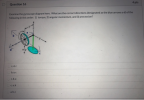 4 pts Question 16 Examine the gyroscope diagram here. What are the correct directions (designated as the blue arrows a-d) of the following in this order: 1) torque, 2) angular momentum, and 3) precession? mg cd, c b,a,c Ccb, a cab a, b, c
What would happen to DNA if the gel tray within an electrophoresis chamber were placed incorrectly,...
What would happen to DNA if the gel tray within an electrophoresis chamber were placed incorrectly, with the wells closest to the positive electrode? Choose one: A. DNA would remain in the gel. B. DNA bands would appear smeared. C. DNA would be pulled through the gel in the wrong direction. D. DNA would not fluoresce under UV light.
1a. 1b. A certain gyroscope consists of a uniform disk with a 33.0 cm radius mounted...
 1a.
1b. A certain gyroscope consists of a uniform disk with a 33.0
cm radius mounted at the center of an axle that is 11.0 cm long and
of negligible mass. The axle is horizontal and supported at one
end. If the disk is spinning around the axle at 1500 rev/min, what
is the precession rate?
In the figure, a small 0.372 kg block slides down a frictionless surface through height h = 0.918 m and then sticks to a...
1a.
1b. A certain gyroscope consists of a uniform disk with a 33.0
cm radius mounted at the center of an axle that is 11.0 cm long and
of negligible mass. The axle is horizontal and supported at one
end. If the disk is spinning around the axle at 1500 rev/min, what
is the precession rate?
In the figure, a small 0.372 kg block slides down a frictionless surface through height h = 0.918 m and then sticks to a...
If the spin of the earth suddenly changed to spin in the opposite direction, what effect...
If the spin of the earth suddenly changed to spin in the opposite direction, what effect would that have on hurricanes in the Northern hemisphere? Select one: a. They would travel East and South. b. It’s impossible to predict because hurricanes are chaotic systems. c. The Coriolis force would remain the same, so no change would occur. d. They would never reach land and instead dissipate over oceans.
 4 pts Question 16 Examine the gyroscope diagram here. What are the correct directions (designated as the blue arrows a-d) of the following in this order: 1) torque, 2) angular momentum, and 3) precession? mg cd, c b,a,c Ccb, a cab a, b, c
 1a.
1b. A certain gyroscope consists of a uniform disk with a 33.0
cm radius mounted at the center of an axle that is 11.0 cm long and
of negligible mass. The axle is horizontal and supported at one
end. If the disk is spinning around the axle at 1500 rev/min, what
is the precession rate?
In the figure, a small 0.372 kg block slides down a frictionless surface through height h = 0.918 m and then sticks to a...
1a.
1b. A certain gyroscope consists of a uniform disk with a 33.0
cm radius mounted at the center of an axle that is 11.0 cm long and
of negligible mass. The axle is horizontal and supported at one
end. If the disk is spinning around the axle at 1500 rev/min, what
is the precession rate?
In the figure, a small 0.372 kg block slides down a frictionless surface through height h = 0.918 m and then sticks to a...
Most questions answered within 3 hours.
-
Where is the error in this code sequence?
String s1 = "Hello";
String s2 = "ello";...
asked 11 months ago -
Financial data for Joel de Paris, Inc., for last year
follow:
Joel de Paris, Inc.
Balance...
asked 11 months ago -
Consider this reaction:
Al2(SO4)3 (aq)+ BaCl3
(aq) Al2Cl6 (aq)- +
3BaSO4(s) . What is the...
asked 11 months ago -
Suppose that Savneet is considering increasing her
recent random sample from 20 car rentals to 40...
asked 11 months ago -
Trucks arrive at an unloading terminal at an average rate of 120
per hour.
Trucks arrive...
asked 11 months ago -
Why are methanol and ethanol completely soluble in water while
octanol is not very little soluble....
asked 11 months ago -
A facilities manager at a university reads in a research report
that the mean amount of...
asked 11 months ago -
When the CuSO4 is rehydrated by adding water to the anhydrous
compound, is this an endothermic...
asked 11 months ago -
A ray of sunlight is passing from diamond into crown glass; the
angle of incidence is...
asked 11 months ago -
A block of mass 0.249 kg is placed on top of a light, vertical
spring of...
asked 11 months ago -
how do the kidneys compensate in the presences of acidosis
a) trigger hyperventilate
b) reserve acid...
asked 11 months ago -
Question 501 pts
The rental rate of capital to the firm increases. Which of the
following...
asked 11 months ago