A one hour dark incubation period is used between UV exposure and plating. If the incubation...
A one hour dark incubation period is used between UV exposure and plating. If the incubation period were conducted in the light, what effect would this have on the results? Explain
Homework Answers
Solution:-
Bacterial DNA codes for an enzyme called photolyase, which is involved in DNA repair on exposure to UV. These enzymes use the energy from light to irreversibly bind and break nucleotide dimers formed in bacterial DNA due to UV exposure. In the given example, when no dark incubation period is given, the bacteria are exposed to light immediately after the UV treatment, during plating. This is where the photolyase repairs the DNA damage and counteracts the mutagenesis, before the cells can divide, and before the mutation becomes permanent. This results into a low number of sodium-azide resistant mutants after plating.
On the other hand, when a one hour dark incubation period is given, photolyase cannot act on the nucleotide dimers before DNA replication takes place.As a result, a random nucleotide is inserted on the complementary strand, making the mutation permanent. This translates to a high number of sodium-azide resistant mutants, even though the cell number is low.
Like if it helps.
Add Answer to:
A one hour dark incubation period is used between UV exposure
and plating. If the incubation...
Results A. Effect of UV Radiation Record the results for each plate at follows (see images...
 Results A. Effect of UV Radiation Record the results for each plate at follows (see images below): (-) no growth 1+ light growth 2+ medium growth 3+ heavy growth Also, note any differences in appearance of growth on cach of the plates. 15 30 60 ates) Bacteria Lid off UV light exposure time Lid off Lid off Lid off 15 sec 30 sec 60 sec O sec Lid on 60 sec (control) Serratia marcescens Based on these results, answer the...
We conducted 2 independent randomised experiments on mice separately to determine whether exposure to excess UV...
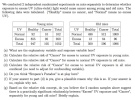 We conducted 2 independent randomised experiments on mice separately to determine whether exposure to excess UV (ultra-violet) light would cause cancer among young and old mice. The following data were tabulated. ("Healthy" means no cancer, and "Normal" means no excess UV) Young mice Old mice UV Healthy Cancer Total Normal92 Excess855 Total UV Healthy Cancer Total Normal 488 Excess12 Tota500 512 1000 84 596 1096 102 10 95 105 1052 950 96 947 (a) What are the explanatory variable and...
GENETICS Exposure to UV light results in thymine dimers between adjacent thymines in a single DNA...
GENETICS Exposure to UV light results in thymine dimers between adjacent thymines in a single DNA strand. Describe how repair of this damage might lead to a mutation.
and Lab Exer n this experiment you will evaluate effect of UV light on bacterial growth. UV light affects growth by interfering with DNA, resulting in thymine dimer formation. The dimerization...
 and Lab Exer n this experiment you will evaluate effect of UV light on bacterial growth. UV light affects growth by interfering with DNA, resulting in thymine dimer formation. The dimerization is confined within adjacent thymine residues on same strand (intrastrand ). These dimmer lesions have consequence on DNA functions including interference in DNA replication, transcription etc, so UV exposure of cells can lead to lethal effects for bacterial multiplications. This forms the basis for UV method to control bacterial...
Which culture should be able to survive the longest exposure to UV (SA or BS)? Why?...
Which culture should be able to survive the longest exposure to UV (SA or BS)? Why? 7. Do you expect to see a difference between the growth on the side of the plate that was under the index card and the side that was open? If so, explain what you expect to see. 8. Some cells have a means of protecting themselves against radiation. Can you name a few structures that might help protect a cell from UV light?
One type of sunburn occurs on exposure to UV light of wavelength in the vicinity of...
One type of sunburn occurs on exposure to UV light of wavelength in the vicinity of 305 nm . (A) What is the energy of a photon of this wavelength? (B) What is the energy of a mole of these photons? (C) How many photons are in a 1.20 mJ burst of this radiation? (D) These UV photons can break chemical bonds in your skin to cause sunburn—a form of radiation damage. If the 305 nm radiation provides exactly the...
Please complete all questions (1-5). For question 5, construct a x-y scatter plot graph with UV...
 Please complete all questions (1-5). For question 5, construct
a x-y scatter plot graph with UV exposure time on x-axis and amount
of growth (0,1,2,3) on Y axis. use a different color or symbol per
organism and DO NOT connect the dots. Thank you!
answer questions 1-4 please.
2-12 The Effect of Ultraviolet Radiation on Microbial Growth OBSERVATIONS AND INTERPRETATIONS 1 Enter your class data in the table below using the following descriptions: 0 - no growth 1 individual colonies...
Please complete all questions (1-5). For question 5, construct
a x-y scatter plot graph with UV exposure time on x-axis and amount
of growth (0,1,2,3) on Y axis. use a different color or symbol per
organism and DO NOT connect the dots. Thank you!
answer questions 1-4 please.
2-12 The Effect of Ultraviolet Radiation on Microbial Growth OBSERVATIONS AND INTERPRETATIONS 1 Enter your class data in the table below using the following descriptions: 0 - no growth 1 individual colonies...
One type of sunburn occurs on exposure to UV light of wavelength in the vicinity of 300 nm . a)What is the energy of a...
One type of sunburn occurs on exposure to UV light of wavelength in the vicinity of 300 nm . a)What is the energy of a photon of this wavelength? E = 6.62×10⁻¹⁹ J B) What is the energy of a mole of these photons? E = C)How many photons are in a 1.10 mJburst of this radiation? N=_______ photons
For questions 13-16: Light exposure in mice Studies show that night-time light exposure is hamful to...
 For questions 13-16: Light exposure in mice Studies show that night-time light exposure is hamful to human health. A recent 6-week study randomly assigned lab mice to one of three conditions: LD (Group 1) had a standard light/dark cycle cach 24-hour period; (Group 2) LL had bright light all the time, and (Group 3) DM had dim light when there nomally would have been darkness. The rescarchers hoped to investigate how light exposure interacts with eating and sleeping cycles and...
One type of sunburn occurs on exposure to UV light of wave lengthin the vicinity of 325 nm. a.) What is the energy o...
One type of sunburn occurs on exposure to UV light of wave lengthin the vicinity of 325 nm. a.) What is the energy of a photon of this wavelength? b.) What is the energy of a mole of these photons? c.) How many photons are in 1.00mJ burst of thisradiation? d.) These UV photons can break chemical bonds in you skin tocause sunburn~a form of radiation damage. If the 325 nm radiationprovides exactly the energy to break an average chemical...
 Results A. Effect of UV Radiation Record the results for each plate at follows (see images below): (-) no growth 1+ light growth 2+ medium growth 3+ heavy growth Also, note any differences in appearance of growth on cach of the plates. 15 30 60 ates) Bacteria Lid off UV light exposure time Lid off Lid off Lid off 15 sec 30 sec 60 sec O sec Lid on 60 sec (control) Serratia marcescens Based on these results, answer the...
 We conducted 2 independent randomised experiments on mice separately to determine whether exposure to excess UV (ultra-violet) light would cause cancer among young and old mice. The following data were tabulated. ("Healthy" means no cancer, and "Normal" means no excess UV) Young mice Old mice UV Healthy Cancer Total Normal92 Excess855 Total UV Healthy Cancer Total Normal 488 Excess12 Tota500 512 1000 84 596 1096 102 10 95 105 1052 950 96 947 (a) What are the explanatory variable and...
 and Lab Exer n this experiment you will evaluate effect of UV light on bacterial growth. UV light affects growth by interfering with DNA, resulting in thymine dimer formation. The dimerization is confined within adjacent thymine residues on same strand (intrastrand ). These dimmer lesions have consequence on DNA functions including interference in DNA replication, transcription etc, so UV exposure of cells can lead to lethal effects for bacterial multiplications. This forms the basis for UV method to control bacterial...
 Please complete all questions (1-5). For question 5, construct
a x-y scatter plot graph with UV exposure time on x-axis and amount
of growth (0,1,2,3) on Y axis. use a different color or symbol per
organism and DO NOT connect the dots. Thank you!
answer questions 1-4 please.
2-12 The Effect of Ultraviolet Radiation on Microbial Growth OBSERVATIONS AND INTERPRETATIONS 1 Enter your class data in the table below using the following descriptions: 0 - no growth 1 individual colonies...
Please complete all questions (1-5). For question 5, construct
a x-y scatter plot graph with UV exposure time on x-axis and amount
of growth (0,1,2,3) on Y axis. use a different color or symbol per
organism and DO NOT connect the dots. Thank you!
answer questions 1-4 please.
2-12 The Effect of Ultraviolet Radiation on Microbial Growth OBSERVATIONS AND INTERPRETATIONS 1 Enter your class data in the table below using the following descriptions: 0 - no growth 1 individual colonies...
 For questions 13-16: Light exposure in mice Studies show that night-time light exposure is hamful to human health. A recent 6-week study randomly assigned lab mice to one of three conditions: LD (Group 1) had a standard light/dark cycle cach 24-hour period; (Group 2) LL had bright light all the time, and (Group 3) DM had dim light when there nomally would have been darkness. The rescarchers hoped to investigate how light exposure interacts with eating and sleeping cycles and...
Most questions answered within 3 hours.
-
Where is the error in this code sequence?
String s1 = "Hello";
String s2 = "ello";...
asked 10 months ago -
Financial data for Joel de Paris, Inc., for last year
follow:
Joel de Paris, Inc.
Balance...
asked 10 months ago -
Consider this reaction:
Al2(SO4)3 (aq)+ BaCl3
(aq) Al2Cl6 (aq)- +
3BaSO4(s) . What is the...
asked 10 months ago -
Suppose that Savneet is considering increasing her
recent random sample from 20 car rentals to 40...
asked 10 months ago -
Trucks arrive at an unloading terminal at an average rate of 120
per hour.
Trucks arrive...
asked 10 months ago -
Why are methanol and ethanol completely soluble in water while
octanol is not very little soluble....
asked 10 months ago -
A facilities manager at a university reads in a research report
that the mean amount of...
asked 10 months ago -
When the CuSO4 is rehydrated by adding water to the anhydrous
compound, is this an endothermic...
asked 10 months ago -
A ray of sunlight is passing from diamond into crown glass; the
angle of incidence is...
asked 10 months ago -
A block of mass 0.249 kg is placed on top of a light, vertical
spring of...
asked 10 months ago -
how do the kidneys compensate in the presences of acidosis
a) trigger hyperventilate
b) reserve acid...
asked 10 months ago -
Question 501 pts
The rental rate of capital to the firm increases. Which of the
following...
asked 10 months ago