The gaseous reaction between hydrogen gas and elemental phosphorus to form phosphor was studied, and the...
The gaseous reaction between hydrogen gas and
elemental phosphorus to form phosphor was studied, and the
following data were obtained:
0.120 0.180 1.60x10^-2
0.060 0.120 4.36x10^-3
0.030 0.090 1.42x10^-3
0.240 0.090 1.13x10^-2
Determine the rate law for the reaction and calculate the value of
the rate constant.
Homework Answers
Consider a rate law for the reaction
Rate = K[H2]^x [P]^y -----(1)
K = rate constant, x is order of reaction with respect to hydrogen gas, y is order of reaction with respect to elemental phosphorous
Note :- you have not mentioned, in which column concentration of reactants exist. I am considering, hydrogen gas data is in 1st column and elemental phosphorous data is in 2nd column.
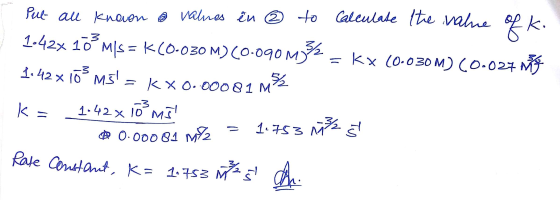
Given:- [H2] = 0.030 M, [P] = 0.090 M, rate = 1.42 * 10^-3 M/s
From(1). 1.42 * 10^-3 M/s = K(0.030 M)^x(0.090 M)^y ---(2)
Given:- [H2] = 0.240 M, [P] = 0.090 M, Rate = 1.13 * 10^-2 M/s
From(1) 1.13 * 10^-2 M/s = K(0.240 M)^x (0.090 M)^y -----(3)
Divide (3) by (2)
1.13 * 10^-2 M/s / 1.42 * 10^-3 M/s = K(0.240 M)^x(0.090 M)^y / K(0.030 M)^x(0.090 M)^y
~ 8.0 = 8.0^x
x = 1
Given:- [H2] = 0.060 M, [P] = 0.120 M, Rate = 4.36 * 10^-3 M/s
From(1) 4.36 * 10^-3 M/s = K(0.060 M)^x(0.120 M)^y ---(4)
Divide (4) by (2)
4.36 * 10^-3 M/s / 1.42 * 10^-3 M/s = K(0.060 M)^x(0.120 M)^y / K(0.030 M)^x(0.090 M)^y
3.07 = 2^x * 1.33^y
3.07 = 2^1 * 1.33^y
3.07 / 2 = 1.33^y
1.535 = 1.33^y
1.33^1.5 = 1.33^y
y = 1.5 = 3/2
From(1) Rate law for the reaction
Rate = K[H2][P]^3/2
Add Answer to:
The gaseous reaction between hydrogen gas and
elemental phosphorus to form phosphor was studied, and the...
Solid carbon can react with gaseous water to form carbon monoxide gas and hydrogen gas. The...
Solid carbon can react with gaseous water to form carbon monoxide gas and hydrogen gas. The equilibrium constant for the reaction at 700.0 KK is Kp=1.60×10⁻³Kp=1.60×10⁻³. If a 1.55-LL reaction vessel initially contains 249 torr of water at 700.0 K in contact with excess solid carbon, find the percent by mass of hydrogen gas of the gaseous reaction mixture at equilibrium.
Solid carbon can react with gaseous water to form carbon monoxide gas and hydrogen gas. The...
Solid carbon can react with gaseous water to form carbon monoxide gas and hydrogen gas. The equilibrium constant for the reaction at 700.0 K is Kp=1.60×10⁻³. If a 1.55-L reaction vessel initially contains 174 torr of water at 700.0 K in contact with excess solid carbon, find the percent by mass of hydrogen gas of the gaseous reaction mixture at equilibrium. Please show step by step solutions. Thank you!
Question 11. Hydrogen reacts with nitrogen to form ammonia. This reaction has been studied in the...
 Question 11. Hydrogen reacts with nitrogen to form ammonia. This reaction has been studied in the laboratory, and the following rate data were determined at 25 °C 3H2 N 2NH Rate (mol L's) [H:l (mol/L) N (mol/L) Trial 1.00 x 10 4.00x 10 2.61x10 9.00x 10 2.00x 10 3.96 x 10 1.00 x 10 2.00 x 10 3 6.60 x 10 5.94 x10 3.00x 10 9.00x 10 4 Detemine the order of the reaction with respect to Nz gas (S...
Hydrogen iodide, HI, is formed in an equilibrium reaction when gaseous hydrogen and gaseous iodine gas...
Hydrogen iodide, HI, is formed in an equilibrium reaction when gaseous hydrogen and gaseous iodine gas are heated together. First, write the equilibrium reaction and balance it. The volume of the reactor is not changing during the process. Now, if 24.2 g of H2 and 24.2 g of I2 are heated, they form 9.9 g of hydrogen iodide, what mass of hydrogen remains unreacted? No unit is needed. At least 3 sig fig is needed. Avoid too much rounding! You...
Please help with these two questions 1.) Consider the reaction between hydrogen gas and oxygen gas...
 Please help with these two questions
1.) Consider the reaction between hydrogen gas and oxygen gas to
form water:
2 H2(g) + O2(g) → 2 H2O(g).
How many grams of water could be produced by the reaction of
4.28 liters of hydrogen with 4.11 liters of oxygen at STP?
2.) Automobile airbags use the decomposition of sodium azide,
NaN3, to provide gas for rapid inflation:
2 NaN3(s) → 2 Na(s) + 3 N2(g).
Using stoichiometry and the ideal gas law,...
Please help with these two questions
1.) Consider the reaction between hydrogen gas and oxygen gas to
form water:
2 H2(g) + O2(g) → 2 H2O(g).
How many grams of water could be produced by the reaction of
4.28 liters of hydrogen with 4.11 liters of oxygen at STP?
2.) Automobile airbags use the decomposition of sodium azide,
NaN3, to provide gas for rapid inflation:
2 NaN3(s) → 2 Na(s) + 3 N2(g).
Using stoichiometry and the ideal gas law,...
Question Completion Status: Consider this chemical reaction at 25 °C: ClO2(aq) + 2OH(aq) + C1O3(aq) +...
 Question Completion Status: Consider this chemical reaction at 25 °C: ClO2(aq) + 2OH(aq) + C1O3(aq) + CO2(aq) The following experimental data were collected (M=mol/L): Experiment Initial [CIO2] (M) Initial [OH^](M) 0.060 0.030 2 0.020 0.030 3 0.020 0.090 Initial rate (M/s) 0.0248 0.00276 0.00828 Determine the rate law. Suggested time: 6 min rate = k[CIO2][OH-]2 none of these rate = k[CIO2](OH) 1 rate = K[C1021?[OH-]2 rate - k[CI0212[OH-] rate = k[Clo21°OH)
Review | Constants Periodic Table Solid carbon can react with gaseous water to form carbon monoxide...
 Review | Constants Periodic Table Solid carbon can react with gaseous water to form carbon monoxide gas and hydrogen gas. The equilibrium constant for the reaction at 700.0 K is 1.6x10⁻³Kp. Part A If a 1.55-L reaction vessel initially contains 120 torr of water at 700.0 K in contact with excess solid carbon, find the percent by mass of hydrogen gas of the gaseous reaction mixture at equilibrium. VO ALQ * 0 2 ? m H2 MHz +mco+mH2O Submit Previous...
In a reversible reaction, carbon monoxide gas and hydrogen gas are mixed to produce methanol gas...
 In a reversible reaction, carbon monoxide gas and hydrogen gas are mixed to produce methanol gas (CH3OH). The enthalpy change of this reaction is AH = 90 kJ mol A mixture of 0.360 moles of CO and 0.640 moles of H2 were allowed to reach equilibrium at 150°C in a 10 dm' sealed container. At equilibrium the mixture contained 0.120 moles of CH,OH. (a) Calculate the K for this reaction (to 1.d.p). (10 marks) Similarly to Ko, K is an...
2. Consider the reaction below between nitric oxide and hydrogen gas: 2 NO(g) + 2 H2(g)...
 2. Consider the reaction below between nitric oxide and hydrogen gas: 2 NO(g) + 2 H2(g) - N2 + 2 H2009) Upon being studied experimentally, it has been determined that the rate law expression for this reaction is first order in Hz and second order in NO(g). With this information in mind, answer the following: [Tip: You can assume that the steady-state approximation is valid for any intermediate here.) a. As written, is the reaction above a valid mechanism? In...
QUESTION 4 Consider the reaction between hydrogen gas and oxygen gas to form water 2 H2(g)...
 QUESTION 4 Consider the reaction between hydrogen gas and oxygen gas to form water 2 H2(g) + O2(9) - 2 H20(9) How many grams of water could be produced by the reaction of 7.01 liters of hydrogen with 4.11 liters of oxygen at STP? (Hint: check for limiting reagent).
 Question 11. Hydrogen reacts with nitrogen to form ammonia. This reaction has been studied in the laboratory, and the following rate data were determined at 25 °C 3H2 N 2NH Rate (mol L's) [H:l (mol/L) N (mol/L) Trial 1.00 x 10 4.00x 10 2.61x10 9.00x 10 2.00x 10 3.96 x 10 1.00 x 10 2.00 x 10 3 6.60 x 10 5.94 x10 3.00x 10 9.00x 10 4 Detemine the order of the reaction with respect to Nz gas (S...
 Please help with these two questions
1.) Consider the reaction between hydrogen gas and oxygen gas to
form water:
2 H2(g) + O2(g) → 2 H2O(g).
How many grams of water could be produced by the reaction of
4.28 liters of hydrogen with 4.11 liters of oxygen at STP?
2.) Automobile airbags use the decomposition of sodium azide,
NaN3, to provide gas for rapid inflation:
2 NaN3(s) → 2 Na(s) + 3 N2(g).
Using stoichiometry and the ideal gas law,...
Please help with these two questions
1.) Consider the reaction between hydrogen gas and oxygen gas to
form water:
2 H2(g) + O2(g) → 2 H2O(g).
How many grams of water could be produced by the reaction of
4.28 liters of hydrogen with 4.11 liters of oxygen at STP?
2.) Automobile airbags use the decomposition of sodium azide,
NaN3, to provide gas for rapid inflation:
2 NaN3(s) → 2 Na(s) + 3 N2(g).
Using stoichiometry and the ideal gas law,...
 Question Completion Status: Consider this chemical reaction at 25 °C: ClO2(aq) + 2OH(aq) + C1O3(aq) + CO2(aq) The following experimental data were collected (M=mol/L): Experiment Initial [CIO2] (M) Initial [OH^](M) 0.060 0.030 2 0.020 0.030 3 0.020 0.090 Initial rate (M/s) 0.0248 0.00276 0.00828 Determine the rate law. Suggested time: 6 min rate = k[CIO2][OH-]2 none of these rate = k[CIO2](OH) 1 rate = K[C1021?[OH-]2 rate - k[CI0212[OH-] rate = k[Clo21°OH)
 Review | Constants Periodic Table Solid carbon can react with gaseous water to form carbon monoxide gas and hydrogen gas. The equilibrium constant for the reaction at 700.0 K is 1.6x10⁻³Kp. Part A If a 1.55-L reaction vessel initially contains 120 torr of water at 700.0 K in contact with excess solid carbon, find the percent by mass of hydrogen gas of the gaseous reaction mixture at equilibrium. VO ALQ * 0 2 ? m H2 MHz +mco+mH2O Submit Previous...
 In a reversible reaction, carbon monoxide gas and hydrogen gas are mixed to produce methanol gas (CH3OH). The enthalpy change of this reaction is AH = 90 kJ mol A mixture of 0.360 moles of CO and 0.640 moles of H2 were allowed to reach equilibrium at 150°C in a 10 dm' sealed container. At equilibrium the mixture contained 0.120 moles of CH,OH. (a) Calculate the K for this reaction (to 1.d.p). (10 marks) Similarly to Ko, K is an...
 2. Consider the reaction below between nitric oxide and hydrogen gas: 2 NO(g) + 2 H2(g) - N2 + 2 H2009) Upon being studied experimentally, it has been determined that the rate law expression for this reaction is first order in Hz and second order in NO(g). With this information in mind, answer the following: [Tip: You can assume that the steady-state approximation is valid for any intermediate here.) a. As written, is the reaction above a valid mechanism? In...
 QUESTION 4 Consider the reaction between hydrogen gas and oxygen gas to form water 2 H2(g) + O2(9) - 2 H20(9) How many grams of water could be produced by the reaction of 7.01 liters of hydrogen with 4.11 liters of oxygen at STP? (Hint: check for limiting reagent).
Most questions answered within 3 hours.
-
Where is the error in this code sequence?
String s1 = "Hello";
String s2 = "ello";...
asked 10 months ago -
Financial data for Joel de Paris, Inc., for last year
follow:
Joel de Paris, Inc.
Balance...
asked 10 months ago -
Consider this reaction:
Al2(SO4)3 (aq)+ BaCl3
(aq) Al2Cl6 (aq)- +
3BaSO4(s) . What is the...
asked 10 months ago -
Suppose that Savneet is considering increasing her
recent random sample from 20 car rentals to 40...
asked 10 months ago -
Trucks arrive at an unloading terminal at an average rate of 120
per hour.
Trucks arrive...
asked 10 months ago -
Why are methanol and ethanol completely soluble in water while
octanol is not very little soluble....
asked 10 months ago -
A facilities manager at a university reads in a research report
that the mean amount of...
asked 10 months ago -
When the CuSO4 is rehydrated by adding water to the anhydrous
compound, is this an endothermic...
asked 10 months ago -
A ray of sunlight is passing from diamond into crown glass; the
angle of incidence is...
asked 10 months ago -
A block of mass 0.249 kg is placed on top of a light, vertical
spring of...
asked 10 months ago -
how do the kidneys compensate in the presences of acidosis
a) trigger hyperventilate
b) reserve acid...
asked 10 months ago -
Question 501 pts
The rental rate of capital to the firm increases. Which of the
following...
asked 10 months ago