
Homework Answers

Add Answer to:
Question 11. Hydrogen reacts with nitrogen to form ammonia. This reaction has been studied in the...
From AHⓇ and AS 11. Hydrogen reacts with nitrogen to form ammonia (NH) according to the...
 From AHⓇ and AS 11. Hydrogen reacts with nitrogen to form ammonia (NH) according to the reaction 3H:(g) +Nz() 5 2NH,(g) The value of Alºis -92.38 kJ/mol, and that of AS is -198.2 J/mol K. Determine AG at 25°C. a. +5.897 x 10⁹ kJ/mol d. -16,66 kJ/mol b. +297.8 kJ/mol +49.5 kJ/mol c.-33.32 kJ/mol Free Energy, Entropy, Enthalpy 12. A reaction with a low enthalpy of reaction value is not spontaneous at low temperature but becomes spontaneous at high temperature....
The reaction NO(g) + 7/2 Cl_2(g) rightarrow NOCl(g) is first-order in [Cl2] and second order with...
 The reaction NO(g) + 7/2 Cl_2(g) rightarrow NOCl(g) is first-order in [Cl2] and second order with respect to [NO]. Under a given set of conditions, the initial rate of this reaction is 6.20 times 10^-6 mol/L s. What is the rate of this reaction if the concentration of NO is doubled and the concentration of Cl_2 is reduced to half the original value? 6.20 times 10^-6 mol/L s 2.48 X 10_5 mol/L s 1.24 times 10^-5 mol/L s 4.96 times...
Ammonia has been studied as an alternative "clean" fuel for internal combustion engines, since its reaction...
 Ammonia has been studied as an alternative "clean" fuel for internal combustion engines, since its reaction with oxygen produces only nitrogen and water vapor, and in the liquid form it is easily transported. An industrial chemist studying this reaction fills a 25.0L tank with 1.4 mol of ammonia gas and 1.7 mol of oxygen gas, and when the mixture has come to equilibrium measures the amount of nitrogen gas to be 0.21 mol Calculate the concentration equilibrium constant for the...
4. The rate of the reaction between hemoglobin (Hb) and carbon monoxide (CO) was studied at...
 4. The rate of the reaction between hemoglobin (Hb) and carbon monoxide (CO) was studied at 20°C. The following data were collected with all concentration units in umol/L. Note that a hemoglobin concentration of 2.21 umol/L is equal to 2.21 x 10 mol/L. Initial Hb Concentration Initial CO Concentration Initial Rate (umol/L) (umol/L) (umol/L-s) 2.21 1.00 0.619 1.24 4.42 3.00 3.71 3.36 2.40 4.42 100 a. Determine the order of the reaction with respect to hemoglobin and carbon monoxide. b....
8. In a reaction, 2A - Products, the concentration of A decreases from 0.5 mol L-1...
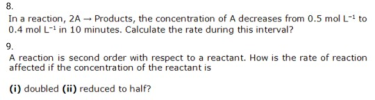 8. In a reaction, 2A - Products, the concentration of A decreases from 0.5 mol L-1 to 0.4 mol L- in 10 minutes. Calculate the rate during this interval? A reaction is second order with respect to a reactant. How is the rate of reaction affected if the concentration of the reactant is (i) doubled (ii) reduced to half?
NAME: 1. For the balanced reaction between nitrogen gas and hydrogen gas to produce ammonia gas:...
 NAME: 1. For the balanced reaction between nitrogen gas and hydrogen gas to produce ammonia gas: N, (g) + 3H2(g) - 2NH, (g) P= 540 torr V=425 ml T= 31 C P= 1.10 atm V1.15 L T = 23C a. For the given starting reactant values, determine the limiting and excess reactants and show your reasoning. Calculate the theoretical yield of NH3(g) in mol and gram terms. c. Determine the volume of this NH, (g) in liters at STP conditions....
1.The reaction of hydrogen and nitric oxide, shown below, is first order with respect to hydrogen...
1.The reaction of hydrogen and nitric oxide, shown below, is first order with respect to hydrogen and second order with respect to nitric oxide. Write the rate law for this reaction. (Rate expressions take the general form: rate = k . [A]a . [B]b.) 2 H2(g) + 2 NO(g) → N2(g) + 2 H2O(l) The rate law for a general reaction involving reactant A is given by the equation rate = k[A]2, 2. Where rate is the rate of the...
10 and 11 10. Nitrosyl chloride, NOCI, decomposes slowly to NO and Cl2, the reaction follows...
 10 and 11
10. Nitrosyl chloride, NOCI, decomposes slowly to NO and Cl2, the reaction follows second order kinetics with a rate constant of 0.020 L mol-' s at a certain temperature. 2 NOCI (g) → 2 NO(g) + Cl2(g) If the initial concentration of NOCI in a closed reaction vessel is 0.050 M, what will be the concentration be after 30 minutes? 11. The reaction 2 NO2 (g) → 2 NO(g) + O2(g), is second order with respect to...
10 and 11
10. Nitrosyl chloride, NOCI, decomposes slowly to NO and Cl2, the reaction follows second order kinetics with a rate constant of 0.020 L mol-' s at a certain temperature. 2 NOCI (g) → 2 NO(g) + Cl2(g) If the initial concentration of NOCI in a closed reaction vessel is 0.050 M, what will be the concentration be after 30 minutes? 11. The reaction 2 NO2 (g) → 2 NO(g) + O2(g), is second order with respect to...
A gas decomposes to form O2 and two other products, in a first-order reaction, with rate...
A gas decomposes to form O2 and two other products, in a first-order reaction, with rate constant k = 6.95 x 10 –4/s at 40oC. If the initial gas concentration = 4.80 x 10 –2 mol/L, what is the concentration (M) after 250 seconds have passed?
Please answer all, I rate, thank you. THE IODINE CLOCK- REACTION KINETICS EXPERIMENT 3 PRE-LABORATORY QUESTIONS...
 Please answer all, I rate, thank you.
THE IODINE CLOCK- REACTION KINETICS EXPERIMENT 3 PRE-LABORATORY QUESTIONS (WEEK 1) Fully answer these questions in your laboratory notebook before coming to lab. Show all work for numerical calculations. 1. If the rate law for a reaction is Rate [A][B What is the overall order of the reaction? a. b. If the concentration of A is doubled and the concentration of B is tripled, how will this affect the rate of the reaction?...
Please answer all, I rate, thank you.
THE IODINE CLOCK- REACTION KINETICS EXPERIMENT 3 PRE-LABORATORY QUESTIONS (WEEK 1) Fully answer these questions in your laboratory notebook before coming to lab. Show all work for numerical calculations. 1. If the rate law for a reaction is Rate [A][B What is the overall order of the reaction? a. b. If the concentration of A is doubled and the concentration of B is tripled, how will this affect the rate of the reaction?...
 From AHⓇ and AS 11. Hydrogen reacts with nitrogen to form ammonia (NH) according to the reaction 3H:(g) +Nz() 5 2NH,(g) The value of Alºis -92.38 kJ/mol, and that of AS is -198.2 J/mol K. Determine AG at 25°C. a. +5.897 x 10⁹ kJ/mol d. -16,66 kJ/mol b. +297.8 kJ/mol +49.5 kJ/mol c.-33.32 kJ/mol Free Energy, Entropy, Enthalpy 12. A reaction with a low enthalpy of reaction value is not spontaneous at low temperature but becomes spontaneous at high temperature....
 The reaction NO(g) + 7/2 Cl_2(g) rightarrow NOCl(g) is first-order in [Cl2] and second order with respect to [NO]. Under a given set of conditions, the initial rate of this reaction is 6.20 times 10^-6 mol/L s. What is the rate of this reaction if the concentration of NO is doubled and the concentration of Cl_2 is reduced to half the original value? 6.20 times 10^-6 mol/L s 2.48 X 10_5 mol/L s 1.24 times 10^-5 mol/L s 4.96 times...
 Ammonia has been studied as an alternative "clean" fuel for internal combustion engines, since its reaction with oxygen produces only nitrogen and water vapor, and in the liquid form it is easily transported. An industrial chemist studying this reaction fills a 25.0L tank with 1.4 mol of ammonia gas and 1.7 mol of oxygen gas, and when the mixture has come to equilibrium measures the amount of nitrogen gas to be 0.21 mol Calculate the concentration equilibrium constant for the...
 4. The rate of the reaction between hemoglobin (Hb) and carbon monoxide (CO) was studied at 20°C. The following data were collected with all concentration units in umol/L. Note that a hemoglobin concentration of 2.21 umol/L is equal to 2.21 x 10 mol/L. Initial Hb Concentration Initial CO Concentration Initial Rate (umol/L) (umol/L) (umol/L-s) 2.21 1.00 0.619 1.24 4.42 3.00 3.71 3.36 2.40 4.42 100 a. Determine the order of the reaction with respect to hemoglobin and carbon monoxide. b....
 8. In a reaction, 2A - Products, the concentration of A decreases from 0.5 mol L-1 to 0.4 mol L- in 10 minutes. Calculate the rate during this interval? A reaction is second order with respect to a reactant. How is the rate of reaction affected if the concentration of the reactant is (i) doubled (ii) reduced to half?
 NAME: 1. For the balanced reaction between nitrogen gas and hydrogen gas to produce ammonia gas: N, (g) + 3H2(g) - 2NH, (g) P= 540 torr V=425 ml T= 31 C P= 1.10 atm V1.15 L T = 23C a. For the given starting reactant values, determine the limiting and excess reactants and show your reasoning. Calculate the theoretical yield of NH3(g) in mol and gram terms. c. Determine the volume of this NH, (g) in liters at STP conditions....
 10 and 11
10. Nitrosyl chloride, NOCI, decomposes slowly to NO and Cl2, the reaction follows second order kinetics with a rate constant of 0.020 L mol-' s at a certain temperature. 2 NOCI (g) → 2 NO(g) + Cl2(g) If the initial concentration of NOCI in a closed reaction vessel is 0.050 M, what will be the concentration be after 30 minutes? 11. The reaction 2 NO2 (g) → 2 NO(g) + O2(g), is second order with respect to...
10 and 11
10. Nitrosyl chloride, NOCI, decomposes slowly to NO and Cl2, the reaction follows second order kinetics with a rate constant of 0.020 L mol-' s at a certain temperature. 2 NOCI (g) → 2 NO(g) + Cl2(g) If the initial concentration of NOCI in a closed reaction vessel is 0.050 M, what will be the concentration be after 30 minutes? 11. The reaction 2 NO2 (g) → 2 NO(g) + O2(g), is second order with respect to...
 Please answer all, I rate, thank you.
THE IODINE CLOCK- REACTION KINETICS EXPERIMENT 3 PRE-LABORATORY QUESTIONS (WEEK 1) Fully answer these questions in your laboratory notebook before coming to lab. Show all work for numerical calculations. 1. If the rate law for a reaction is Rate [A][B What is the overall order of the reaction? a. b. If the concentration of A is doubled and the concentration of B is tripled, how will this affect the rate of the reaction?...
Please answer all, I rate, thank you.
THE IODINE CLOCK- REACTION KINETICS EXPERIMENT 3 PRE-LABORATORY QUESTIONS (WEEK 1) Fully answer these questions in your laboratory notebook before coming to lab. Show all work for numerical calculations. 1. If the rate law for a reaction is Rate [A][B What is the overall order of the reaction? a. b. If the concentration of A is doubled and the concentration of B is tripled, how will this affect the rate of the reaction?...
Most questions answered within 3 hours.
-
Where is the error in this code sequence?
String s1 = "Hello";
String s2 = "ello";...
asked 10 months ago -
Financial data for Joel de Paris, Inc., for last year
follow:
Joel de Paris, Inc.
Balance...
asked 10 months ago -
Consider this reaction:
Al2(SO4)3 (aq)+ BaCl3
(aq) Al2Cl6 (aq)- +
3BaSO4(s) . What is the...
asked 10 months ago -
Suppose that Savneet is considering increasing her
recent random sample from 20 car rentals to 40...
asked 10 months ago -
Trucks arrive at an unloading terminal at an average rate of 120
per hour.
Trucks arrive...
asked 10 months ago -
Why are methanol and ethanol completely soluble in water while
octanol is not very little soluble....
asked 10 months ago -
A facilities manager at a university reads in a research report
that the mean amount of...
asked 10 months ago -
When the CuSO4 is rehydrated by adding water to the anhydrous
compound, is this an endothermic...
asked 10 months ago -
A ray of sunlight is passing from diamond into crown glass; the
angle of incidence is...
asked 10 months ago -
A block of mass 0.249 kg is placed on top of a light, vertical
spring of...
asked 10 months ago -
how do the kidneys compensate in the presences of acidosis
a) trigger hyperventilate
b) reserve acid...
asked 10 months ago -
Question 501 pts
The rental rate of capital to the firm increases. Which of the
following...
asked 10 months ago