Consider the ionization process as the reaction Qz → Qz+1 + e–, where the ionization potential...
Consider the ionization process as the reaction Qz → Qz+1 + e–, where the ionization potential is the minimum energy needed to remove the electron. This yields the relation
IP = E(Qz) – [E(Qz+1) + E(e–)], with the minimum energy of the free electron, E(e–) being zero, and the energy of each individual species, E(Qz) or E(Qz+1), defined as the total
energy of all the electrons bound in Qz or Qz+1, respectively.
a) Using this second approach, apply Slater’s rules to calculate the binding energy of the 2s electron in atomic boron.
b). How do the two approaches compare against the experimental observation, and why do they yield different results?
c) Using the orbital energies (find online) and the first (orbital energy) approach in problem 2, calculate Zeff for the valence s orbitals of the group 1 and group 18 elements through period 6. What is the general trend as a group is descended?
d). How do first ionization potentials trend as a group is descended? What is the physical origin of this trend?
Homework Answers
a)
 ________________________________________________________________________________
the effective nuclear charge can be calculated using the Slater's rule, which states that
- Step 1: Write the electron configuration of the atom in the following form:
(1s) (2s, 2p) (3s, 3p) (3d) (4s, 4p) (4d) (4f) (5s, 5p) . . .
- Step 2: Identify the electron of interest, and ignore all electrons in higher groups (to the right in the list from Step 1). These do not shield electrons in lower groups
- Step 3: Slater's Rules is now broken into two
cases:
- the shielding experienced by an s- or p- electron,
- electrons within same group shield 0.35, except the 1s which shield 0.30
- electrons within the n-1 group shield 0.85
- electrons within the n-2 or lower groups shield 1.00
- the shielding experienced by nd or nf valence
electrons
- electrons within same group shield 0.35
- electrons within the lower groups shield 1.00
- the shielding experienced by an s- or p- electron,
________________________________________________________________________________
the electronic configuration of boron is (1s2)(2s2 2p1)
we need to find the binding energy of the electron in 2s orbital. so this electron will experience shielding from the 1s orbital electron only.
the shielding constant  where ni is the number of electrons in a specific shell
and subshell and Si is the shielding of the electrons
subject to Slater's rules
where ni is the number of electrons in a specific shell
and subshell and Si is the shielding of the electrons
subject to Slater's rules
S = 1.00(0) + 0.85(2) + 0.30(2) = 2.3
 0r Zeff = 5 - 2.30 = 2.70
where Z = Atomic No. of Boron
The binding energy of the valence electron of a non-hydrogen type atom can be found out using the expression
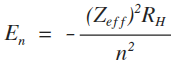
where RH = Rydberg's Constant = 2.18*10-18 J and n= Principal Quantum no.
En = 2.702 * 2.18*10-18/ 22 = 3.973*10-18 J
b) WHAT IS THE FIRST APPROACH ?? IT IS NOT MENTIONED IN THE QUESTION.
c) 2s orbital energy of boron is 14.0 eV or 22.4*10-19 J
2p electron is 8.30 eV or 13.28*10-19 J
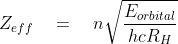
Zeff = 2.60
As one moves down the group the no of electron screening the effective pull on the electron increases, thus the effective pull on the electron decreases and so the Zeff values decreases. but as we move across a period no new orbitals/ shells are added thus the effective screening remains constant and so with the increasing atomic no the pull on the electrons increases. thus zeff remains constant across a period. but when the electron fill up in f or d subshell there is somewhat increase in the screening constants because the penultimate d- and antipenultimate f-orbitals are filled before the valence s and p orbital. but since the screening capacity of the d- and f- orbitla electrons are very less they will not have a dominating effect.
d) ionisation potential is the amount of energy required to remove a valence electron from an isolated atom. it is a function of the distance of electron from the core of the atom. the greater the distance of the electron from the core of the atom, the lesser will be ionisation potential and so easier will be the extraction of the electron from the atom. As we descend down a group we have new shells inserted into the electronic configuration, which in turn increases the distance of the valence electron fro the core of the atom. so, the resulting pull on the valence electron will be diminished and hence lesser energy will be required to pull of the electrons. Thus, the first ionisation energy decreases on moving down a group.
First period has only 1s orbital, second period has 2s and 2p, third period has 3s, 3p and 3d, etc. As the no. of period increases the valence electron enters a position that is farther away compared to the previous filling pattern. i.e. first period electron enters the 1s, in second period it enters into 2s or 2p, etc. thus effective pull on this electron also decreases as the valence electron moves away from the nucleus. thus the ionisation potential decreases on moving down a group.
Add Answer to:
Consider the ionization process as the reaction Qz → Qz+1 + e–,
where the ionization potential...
2A. Complete the following table. Element Zeff Atomic orbital designation for highest energy valence electron (i.e.,...
2A. Complete the following table. Element Zeff Atomic orbital designation for highest energy valence electron (i.e., 2s) Se Kr 2B. Which atom (Se or Kr) has the smaller first ionization energy? Enter the chemical symbol in the space provided. 2C. Which one of the following statements best explains the trend observed in part 2? Ionization energy decreases down a group. Elements lower in a group have larger atomic radii. The valence electrons are further from the nucleus so that the...
opic worksheet Electron Configuration and Periodic Table (c) Consider the process of removing electron from Na...
 opic worksheet Electron Configuration and Periodic Table (c) Consider the process of removing electron from Na atom as written by Na (g)-→ Na"(g) + e, (g) How do you predict the sign of energy change during the process? Do you need to supply energy or will release energy during the change? the system (d) After you remove the 1" electron from Na atom, if you are going to remove the second electron, which orbital this second electron would be in...
1. What is the maximum number of unpaired electrons that can occupy each of the following...
1. What is the maximum number of unpaired electrons that can occupy each of the following subshells? a. 3p, b. 5d c. 2s d. 4f 2. Identify the specific element that corresponds to each of the following electron configurations and indicate the number of unpaired electrons for each. a. 1s 2 2s 2 b. 1s 2 2s 2 2p 4 c. [Ar]4s 1 3d 5 d. [Kr]5s 2 4d 10 5p 4 3. Note: The atomic radius of an element...
Draw molecular orbital energy level diagram for CH3 by following the steps given below. Valance orbital...
 Draw molecular orbital energy level diagram for CH3 by following the steps given below. Valance orbital ionization potentials: H(1s) - 13.6 eV, C(2s) -19.5 eV, C(2p) -10.7 ev. (6C, 11) E x +y?,z? 1 1 1 203 3C on 1 1 1 1 1 1 1 T - 1 0 2 1 1 -1 | 1 -1 1 -1 -1 TOT- 2 25; 1 1 - 1 1 -1 1 -1 1 30, 1 1 1 -1 0 1 -1...
2. Consider the ionization energies of elements X and Y shown below in kJmol. X and...
 2. Consider the ionization energies of elements X and Y shown below in kJmol. X and Y are in the same period of the periodic table and are adjacent to one another in the table. 2nd 3rd 4th 5th th 117 1 8th 9th 1680 2080 33756050 8409 11022 15165 17868 3950612293701218015239 20000 92038106440 23068 115375 (a) in which group would one find element X? Explain. (b) Does element X lie to the right or the left of elementy in...
1: Choose the correct statements from the following concerning andCNS using K-TYPE answer format: Mark A.B.C...
 1: Choose the correct statements from the following concerning andCNS using K-TYPE answer format: Mark A.B.C are correct; b if A, C: c if B, D; d if D only: e otherwise. A: The distance between the atoms is greater in CN3- than in CN5- B: CNS- would be casier to break (would require less energy to break) than CN3- C: CNS- is held together by a triple bond. D: CN3- is held together by a double bond. 2: K-TYPE...
1) 2) 3) 4) 5) Use the molecular orbital energy diagram below to answer the questions...
 1)
2)
3)
4)
5)
Use the molecular orbital energy diagram below to answer the questions about bond order for the negative ion By. Number of Bonding Number of Antibonding B2 Valence Electrons Valence Electrons Bond Order This corresponds to: A. Single bond B. Double bond C. Triple bond D. Half of a bond E. Between a single and double bond F. Between a double and a triple bond G. No bond, B2" does not form. boron MO's boron 2p...
1)
2)
3)
4)
5)
Use the molecular orbital energy diagram below to answer the questions about bond order for the negative ion By. Number of Bonding Number of Antibonding B2 Valence Electrons Valence Electrons Bond Order This corresponds to: A. Single bond B. Double bond C. Triple bond D. Half of a bond E. Between a single and double bond F. Between a double and a triple bond G. No bond, B2" does not form. boron MO's boron 2p...
can someone help me to answer those questions N Ctrl Extension Questions Model 3 - Ionization...
 can someone help me to answer those questions
N Ctrl Extension Questions Model 3 - Ionization Energies 2400 2200 .. 1st lonization Energy (kJ/mol) .. Period 1 .- Period 2 - Period 3 Period 4 - 400 Part 1 Elect 1A 2A 7A 8A 3A4A SA 6A Column of Periodic Table 17. Refer to the graph in Model 3. a. What property of atoms does the graph illustrate? b. There are four lines on the graph. What do the lines...
can someone help me to answer those questions
N Ctrl Extension Questions Model 3 - Ionization Energies 2400 2200 .. 1st lonization Energy (kJ/mol) .. Period 1 .- Period 2 - Period 3 Period 4 - 400 Part 1 Elect 1A 2A 7A 8A 3A4A SA 6A Column of Periodic Table 17. Refer to the graph in Model 3. a. What property of atoms does the graph illustrate? b. There are four lines on the graph. What do the lines...
I got A,B,C and E right but need help with D,F, and G. Give the electron...
 I got A,B,C and E right but need help with D,F, and G.
Give the electron configuration of Br Use the buttons at the top of the tool to add orbitals. Click within the orbital to add electrons. 1s 2s 4p 2p 40 5s 5p 5d 5f 6s 6p 6d 7s 4p 4s 3p 3s 2p 2s t 1s Ar4 34°4p° Submit Previous Answers Correct Part B Give the electron configuration of Cl. Use the buttons at the top of...
I got A,B,C and E right but need help with D,F, and G.
Give the electron configuration of Br Use the buttons at the top of the tool to add orbitals. Click within the orbital to add electrons. 1s 2s 4p 2p 40 5s 5p 5d 5f 6s 6p 6d 7s 4p 4s 3p 3s 2p 2s t 1s Ar4 34°4p° Submit Previous Answers Correct Part B Give the electron configuration of Cl. Use the buttons at the top of...
1. Titanium metal requires a photon with a minimum energy of 6.94 x 10- J to...
 1. Titanium metal requires a photon with a minimum energy of 6.94 x 10- J to emit electrons. a. What is the minimum frequency of light necessary to emit electrons from titanium via the photoelectric effect? b. What is the wavelength of this light? c Is it possible to eject electrons from titanium metal using visible light? 2. Calculate the energies of an electron in the hydrogen atom when n=2 and when n=6. Calculate the wavelength of the radiation released...
 opic worksheet Electron Configuration and Periodic Table (c) Consider the process of removing electron from Na atom as written by Na (g)-→ Na"(g) + e, (g) How do you predict the sign of energy change during the process? Do you need to supply energy or will release energy during the change? the system (d) After you remove the 1" electron from Na atom, if you are going to remove the second electron, which orbital this second electron would be in...
 Draw molecular orbital energy level diagram for CH3 by following the steps given below. Valance orbital ionization potentials: H(1s) - 13.6 eV, C(2s) -19.5 eV, C(2p) -10.7 ev. (6C, 11) E x +y?,z? 1 1 1 203 3C on 1 1 1 1 1 1 1 T - 1 0 2 1 1 -1 | 1 -1 1 -1 -1 TOT- 2 25; 1 1 - 1 1 -1 1 -1 1 30, 1 1 1 -1 0 1 -1...
 2. Consider the ionization energies of elements X and Y shown below in kJmol. X and Y are in the same period of the periodic table and are adjacent to one another in the table. 2nd 3rd 4th 5th th 117 1 8th 9th 1680 2080 33756050 8409 11022 15165 17868 3950612293701218015239 20000 92038106440 23068 115375 (a) in which group would one find element X? Explain. (b) Does element X lie to the right or the left of elementy in...
 1: Choose the correct statements from the following concerning andCNS using K-TYPE answer format: Mark A.B.C are correct; b if A, C: c if B, D; d if D only: e otherwise. A: The distance between the atoms is greater in CN3- than in CN5- B: CNS- would be casier to break (would require less energy to break) than CN3- C: CNS- is held together by a triple bond. D: CN3- is held together by a double bond. 2: K-TYPE...
 1)
2)
3)
4)
5)
Use the molecular orbital energy diagram below to answer the questions about bond order for the negative ion By. Number of Bonding Number of Antibonding B2 Valence Electrons Valence Electrons Bond Order This corresponds to: A. Single bond B. Double bond C. Triple bond D. Half of a bond E. Between a single and double bond F. Between a double and a triple bond G. No bond, B2" does not form. boron MO's boron 2p...
1)
2)
3)
4)
5)
Use the molecular orbital energy diagram below to answer the questions about bond order for the negative ion By. Number of Bonding Number of Antibonding B2 Valence Electrons Valence Electrons Bond Order This corresponds to: A. Single bond B. Double bond C. Triple bond D. Half of a bond E. Between a single and double bond F. Between a double and a triple bond G. No bond, B2" does not form. boron MO's boron 2p...
 can someone help me to answer those questions
N Ctrl Extension Questions Model 3 - Ionization Energies 2400 2200 .. 1st lonization Energy (kJ/mol) .. Period 1 .- Period 2 - Period 3 Period 4 - 400 Part 1 Elect 1A 2A 7A 8A 3A4A SA 6A Column of Periodic Table 17. Refer to the graph in Model 3. a. What property of atoms does the graph illustrate? b. There are four lines on the graph. What do the lines...
can someone help me to answer those questions
N Ctrl Extension Questions Model 3 - Ionization Energies 2400 2200 .. 1st lonization Energy (kJ/mol) .. Period 1 .- Period 2 - Period 3 Period 4 - 400 Part 1 Elect 1A 2A 7A 8A 3A4A SA 6A Column of Periodic Table 17. Refer to the graph in Model 3. a. What property of atoms does the graph illustrate? b. There are four lines on the graph. What do the lines...
 I got A,B,C and E right but need help with D,F, and G.
Give the electron configuration of Br Use the buttons at the top of the tool to add orbitals. Click within the orbital to add electrons. 1s 2s 4p 2p 40 5s 5p 5d 5f 6s 6p 6d 7s 4p 4s 3p 3s 2p 2s t 1s Ar4 34°4p° Submit Previous Answers Correct Part B Give the electron configuration of Cl. Use the buttons at the top of...
I got A,B,C and E right but need help with D,F, and G.
Give the electron configuration of Br Use the buttons at the top of the tool to add orbitals. Click within the orbital to add electrons. 1s 2s 4p 2p 40 5s 5p 5d 5f 6s 6p 6d 7s 4p 4s 3p 3s 2p 2s t 1s Ar4 34°4p° Submit Previous Answers Correct Part B Give the electron configuration of Cl. Use the buttons at the top of...
 1. Titanium metal requires a photon with a minimum energy of 6.94 x 10- J to emit electrons. a. What is the minimum frequency of light necessary to emit electrons from titanium via the photoelectric effect? b. What is the wavelength of this light? c Is it possible to eject electrons from titanium metal using visible light? 2. Calculate the energies of an electron in the hydrogen atom when n=2 and when n=6. Calculate the wavelength of the radiation released...
Most questions answered within 3 hours.
-
Where is the error in this code sequence?
String s1 = "Hello";
String s2 = "ello";...
asked 10 months ago -
Financial data for Joel de Paris, Inc., for last year
follow:
Joel de Paris, Inc.
Balance...
asked 10 months ago -
Consider this reaction:
Al2(SO4)3 (aq)+ BaCl3
(aq) Al2Cl6 (aq)- +
3BaSO4(s) . What is the...
asked 10 months ago -
Suppose that Savneet is considering increasing her
recent random sample from 20 car rentals to 40...
asked 10 months ago -
Trucks arrive at an unloading terminal at an average rate of 120
per hour.
Trucks arrive...
asked 10 months ago -
Why are methanol and ethanol completely soluble in water while
octanol is not very little soluble....
asked 10 months ago -
A facilities manager at a university reads in a research report
that the mean amount of...
asked 10 months ago -
When the CuSO4 is rehydrated by adding water to the anhydrous
compound, is this an endothermic...
asked 10 months ago -
A ray of sunlight is passing from diamond into crown glass; the
angle of incidence is...
asked 10 months ago -
A block of mass 0.249 kg is placed on top of a light, vertical
spring of...
asked 10 months ago -
how do the kidneys compensate in the presences of acidosis
a) trigger hyperventilate
b) reserve acid...
asked 10 months ago -
Question 501 pts
The rental rate of capital to the firm increases. Which of the
following...
asked 10 months ago