show a flow chart explaining the MD5 Algorithm coded in java.
show a flow chart explaining the MD5 Algorithm coded in java.
Homework Answers
MD5 ( Message Digest Algorithm ): It was developed by Ronald L. Rivest in 1991. According to RFC 1321, "MD5 message-digest algorithm takes as input a message of arbitrary length and produces as output a 128-bit "fingerprint" or message digest of the input".
MD5 Algorithm Structure:
 MD5 Algorithm Steps:
Step1- The input message is "padded" so that its length equals to 448 mod 512. Padding is always performed, even if the length of the message is already 448 mod 512. A single "1" bit is appended to the message, and then "0" bits are appended so that the length in bits of the padded message becomes congruent to 448 mod 512. At least one bit and at most 512 bits are appended.
Step 2- A 64-bit representation of the length of the message is appended to the result of step1. If the length of the message is greater than 2^64, only the low-order64 bits will be used. The resulting message (after padding with bits and with b) has a length that is an exact multiple of 512 bits. The input message will have a length that is an exact multiple of 16 (32-bit) words.
Step 3- A4 word buffer (A, B, C, D) is used to compute the message digest. Each A, B, C, D is a 32- bit register. These registers are initialized to the following values in hexadecimal, low-order bytes first:
word A: 01 23 45 67
word B: 89 ab cd ef
word C: fe dc ba 98
word D: 76 54 32 10
Step 4: Four functions will be defined such that each function takes an input of three 32-bit words and produces a 32-bit word output.
F(X, Y, Z) = XY or not (X)Z
G(X, Y. Z) = XZ or Y not(Z)
H(X, Y, Z)=X xor Y xor Z
I(X, Y, Z) =Y xor (X or not(Z))
MD5 Algorithm implementation in Java:
import java.math.BigInteger;
import java.security.MessageDigest;
import java.security.NoSuchAlgorithmException;
public class MD5ProgramInJava {
public static void main(String[] args) {
System.out.println("For null Value : " + md5Call(""));
System.out.println("For simple text Value : "+ md5Call("text is here"));
System.out.println("For simple numbers Values : " + md5Call("54321"));
}
public static String md5Call(String input) {
String md5 = null;
if(null == input){ return null;}
try {
//Create MessageDigest object for MD5
MessageDigest digest = MessageDigest.getInstance("MD5");
//Update input string in message digest
digest.update(input.getBytes(), 0, input.length());
//Converts message digest value in base 16 (hex)
md5 = new BigInteger(1, digest.digest()).toString(16);
}
catch (NoSuchAlgorithmException e) {
System.out.pritnln(e);
}
return md5;
}
}
develop a algorithm to implement MD5 in Java to encrypt/hash passwords with salt.
develop a algorithm to implement MD5 in Java to encrypt/hash passwords with salt.
md5 hashing algorithm in cryptography must be in c++ format
md5 hashing algorithm in cryptography must be in c++ format
Java Program: Write an algorithm (steps) using pseudocode (no java code required) explaining steps for a...
Java Program: Write an algorithm (steps) using pseudocode (no java code required) explaining steps for a method which will reverse an integer array (Integer[]) without using any other data structure. The method should return the reversed integer array. E.g. If input array Integer[] integers = [1,2,3,4,5,6] should return [6,5,4,3,2,1]
3 Brute Force Attack vs Birthday Attack (50 pts) Message-Digest Algorithm (MD5) and Secure Hash Algorithm 1 (SHA...
 3 Brute Force Attack vs Birthday Attack (50 pts) Message-Digest Algorithm (MD5) and Secure Hash Algorithm 1 (SHA-1) are com- monly used cryptographic hash functions 1. Do research to find the numbers of bits used in MD5 and SHA-1. (8 pts) perform An adversary an attack to a hash algorithm by applying random inputs can and y (y) that satisfie Hx) and repeating until finding two inputs H(y) where H() denotes a hash code. This is called a "hash collision."...
3 Brute Force Attack vs. Birthday Attack (50 pts) Message-Digest Algorithm (MD5) and Secure Hash Algorithm 1 (SHA-1...
 3 Brute Force Attack vs. Birthday Attack (50 pts) Message-Digest Algorithm (MD5) and Secure Hash Algorithm 1 (SHA-1) are com- monly used cryptographic hash functions 1. Do research to find the mmbers of bits used in MDS and SHA-1. (8 pts)
3 Brute Force Attack vs. Birthday Attack (50 pts) Message-Digest Algorithm (MD5) and Secure Hash Algorithm 1 (SHA-1) are com- monly used cryptographic hash functions 1. Do research to find the mmbers of bits used in MDS and SHA-1....
3 Brute Force Attack vs. Birthday Attack (50 pts) Message-Digest Algorithm (MD5) and Secure Hash Algorithm 1 (SHA-1) are com- monly used cryptographic hash functions 1. Do research to find the mmbers of bits used in MDS and SHA-1. (8 pts)
3 Brute Force Attack vs. Birthday Attack (50 pts) Message-Digest Algorithm (MD5) and Secure Hash Algorithm 1 (SHA-1) are com- monly used cryptographic hash functions 1. Do research to find the mmbers of bits used in MDS and SHA-1....
2. (5 marks) Write an algorithm as a flow chart that reads in values for a...
 2. (5 marks) Write an algorithm as a flow chart that reads in values for a series of numbers (so you will have to read in inside a loop, and test for EOF to end the loop). For each number, if it is the algorithm will print out "Positive". The algorithm should stop when five negative numbers have been found.
you have to show both algorithm and flowchart you can just do the flow chart 1...
 you
have to show both algorithm and flowchart
you
can just do the flow chart
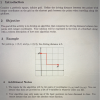
1 Introduction Consider a perfectly square, infinite grid. Define the driving distance between two points with integer coordinates on the grid as the shortest path between the points when traveling along the gridlines. 2 Objective The goal of this activity is to develop an algorithm that computes the driving distance between two points with integer coordinates. Your solution will be expressed in the form of...
you
have to show both algorithm and flowchart
you
can just do the flow chart
1 Introduction Consider a perfectly square, infinite grid. Define the driving distance between two points with integer coordinates on the grid as the shortest path between the points when traveling along the gridlines. 2 Objective The goal of this activity is to develop an algorithm that computes the driving distance between two points with integer coordinates. Your solution will be expressed in the form of...
Java 4) Shortest Paths a) Dijkstra's Algorithm Run Dijkstra's algorithm on the following graph. Show the interm...
 Java
4) Shortest Paths a) Dijkstra's Algorithm Run Dijkstra's algorithm on the following graph. Show the intermediate cost values after each iteration of the algorithm, and show the final shortest path tree and cost
4) Shortest Paths a) Dijkstra's Algorithm Run Dijkstra's algorithm on the following graph. Show the intermediate cost values after each iteration of the algorithm, and show the final shortest path tree and cost
Java
4) Shortest Paths a) Dijkstra's Algorithm Run Dijkstra's algorithm on the following graph. Show the intermediate cost values after each iteration of the algorithm, and show the final shortest path tree and cost
4) Shortest Paths a) Dijkstra's Algorithm Run Dijkstra's algorithm on the following graph. Show the intermediate cost values after each iteration of the algorithm, and show the final shortest path tree and cost
Use C programe to : Develop an algorithm, flow chart and write a C program to...
Use C programe to : Develop an algorithm, flow chart and write a C program to read the name of a patient which has a multi word and display it and the acromatic string of the name. Sample Output : Name : Khamis Al Araimi Acromatic String: AKAA.
Java Language Question 22 Design an algorithm that will get a test score (0 to 40)...
 Java Language
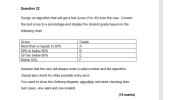
Question 22 Design an algorithm that will get a test score (0 to 40) from the user. Convert the test score to a percentage and display the student grade based on the following chart Grade Score More than or equals to 80% 60% to below 80% 50 %to below 60% Below 50% с Assume that the user will always enter a valid number and the algorithm You need to show the Defining diagram, algorithm and desk checking (two...
Java Language
Question 22 Design an algorithm that will get a test score (0 to 40) from the user. Convert the test score to a percentage and display the student grade based on the following chart Grade Score More than or equals to 80% 60% to below 80% 50 %to below 60% Below 50% с Assume that the user will always enter a valid number and the algorithm You need to show the Defining diagram, algorithm and desk checking (two...
 3 Brute Force Attack vs Birthday Attack (50 pts) Message-Digest Algorithm (MD5) and Secure Hash Algorithm 1 (SHA-1) are com- monly used cryptographic hash functions 1. Do research to find the numbers of bits used in MD5 and SHA-1. (8 pts) perform An adversary an attack to a hash algorithm by applying random inputs can and y (y) that satisfie Hx) and repeating until finding two inputs H(y) where H() denotes a hash code. This is called a "hash collision."...
 3 Brute Force Attack vs. Birthday Attack (50 pts) Message-Digest Algorithm (MD5) and Secure Hash Algorithm 1 (SHA-1) are com- monly used cryptographic hash functions 1. Do research to find the mmbers of bits used in MDS and SHA-1. (8 pts)
3 Brute Force Attack vs. Birthday Attack (50 pts) Message-Digest Algorithm (MD5) and Secure Hash Algorithm 1 (SHA-1) are com- monly used cryptographic hash functions 1. Do research to find the mmbers of bits used in MDS and SHA-1....
3 Brute Force Attack vs. Birthday Attack (50 pts) Message-Digest Algorithm (MD5) and Secure Hash Algorithm 1 (SHA-1) are com- monly used cryptographic hash functions 1. Do research to find the mmbers of bits used in MDS and SHA-1. (8 pts)
3 Brute Force Attack vs. Birthday Attack (50 pts) Message-Digest Algorithm (MD5) and Secure Hash Algorithm 1 (SHA-1) are com- monly used cryptographic hash functions 1. Do research to find the mmbers of bits used in MDS and SHA-1....
 2. (5 marks) Write an algorithm as a flow chart that reads in values for a series of numbers (so you will have to read in inside a loop, and test for EOF to end the loop). For each number, if it is the algorithm will print out "Positive". The algorithm should stop when five negative numbers have been found.
 you
have to show both algorithm and flowchart
you
can just do the flow chart
1 Introduction Consider a perfectly square, infinite grid. Define the driving distance between two points with integer coordinates on the grid as the shortest path between the points when traveling along the gridlines. 2 Objective The goal of this activity is to develop an algorithm that computes the driving distance between two points with integer coordinates. Your solution will be expressed in the form of...
you
have to show both algorithm and flowchart
you
can just do the flow chart
1 Introduction Consider a perfectly square, infinite grid. Define the driving distance between two points with integer coordinates on the grid as the shortest path between the points when traveling along the gridlines. 2 Objective The goal of this activity is to develop an algorithm that computes the driving distance between two points with integer coordinates. Your solution will be expressed in the form of...
 Java
4) Shortest Paths a) Dijkstra's Algorithm Run Dijkstra's algorithm on the following graph. Show the intermediate cost values after each iteration of the algorithm, and show the final shortest path tree and cost
4) Shortest Paths a) Dijkstra's Algorithm Run Dijkstra's algorithm on the following graph. Show the intermediate cost values after each iteration of the algorithm, and show the final shortest path tree and cost
Java
4) Shortest Paths a) Dijkstra's Algorithm Run Dijkstra's algorithm on the following graph. Show the intermediate cost values after each iteration of the algorithm, and show the final shortest path tree and cost
4) Shortest Paths a) Dijkstra's Algorithm Run Dijkstra's algorithm on the following graph. Show the intermediate cost values after each iteration of the algorithm, and show the final shortest path tree and cost
 Java Language
Question 22 Design an algorithm that will get a test score (0 to 40) from the user. Convert the test score to a percentage and display the student grade based on the following chart Grade Score More than or equals to 80% 60% to below 80% 50 %to below 60% Below 50% с Assume that the user will always enter a valid number and the algorithm You need to show the Defining diagram, algorithm and desk checking (two...
Java Language
Question 22 Design an algorithm that will get a test score (0 to 40) from the user. Convert the test score to a percentage and display the student grade based on the following chart Grade Score More than or equals to 80% 60% to below 80% 50 %to below 60% Below 50% с Assume that the user will always enter a valid number and the algorithm You need to show the Defining diagram, algorithm and desk checking (two...
Most questions answered within 3 hours.
-
Where is the error in this code sequence?
String s1 = "Hello";
String s2 = "ello";...
asked 10 months ago -
Financial data for Joel de Paris, Inc., for last year
follow:
Joel de Paris, Inc.
Balance...
asked 10 months ago -
Consider this reaction:
Al2(SO4)3 (aq)+ BaCl3
(aq) Al2Cl6 (aq)- +
3BaSO4(s) . What is the...
asked 10 months ago -
Suppose that Savneet is considering increasing her
recent random sample from 20 car rentals to 40...
asked 10 months ago -
Trucks arrive at an unloading terminal at an average rate of 120
per hour.
Trucks arrive...
asked 10 months ago -
Why are methanol and ethanol completely soluble in water while
octanol is not very little soluble....
asked 10 months ago -
A facilities manager at a university reads in a research report
that the mean amount of...
asked 10 months ago -
When the CuSO4 is rehydrated by adding water to the anhydrous
compound, is this an endothermic...
asked 10 months ago -
A ray of sunlight is passing from diamond into crown glass; the
angle of incidence is...
asked 10 months ago -
A block of mass 0.249 kg is placed on top of a light, vertical
spring of...
asked 10 months ago -
how do the kidneys compensate in the presences of acidosis
a) trigger hyperventilate
b) reserve acid...
asked 10 months ago -
Question 501 pts
The rental rate of capital to the firm increases. Which of the
following...
asked 10 months ago