8.4 A light, rigid rod is 62.8 cm long. Its top end is pivoted on a...
8.4
A light, rigid rod is 62.8 cm long. Its top end is pivoted on a
frictionless horizontal axle. The rod hangs straight down at rest
with a small, massive ball attached to its bottom end. You strike
the ball, suddenly giving it a horizontal velocity so that it
swings around in a full circle. What minimum speed at the bottom is
required to make the ball go over the top of the circle?
________________m/s
Homework Answers

Add Answer to:
8.4
A light, rigid rod is 62.8 cm long. Its top end is pivoted on a...
A light rigid rod is 76.7 cm long. Its top end is pivoted on a low-friction...
A light rigid rod is 76.7 cm long. Its top end is pivoted on a low-friction horizontal axle. The rod hangs straight down at rest with a small massive ball attached to its bottom end. You strike the ball, suddenly giving it a horizontal velocity so that it swings around in a full circle. What minimum speed at the bottom is required to make the ball go over the top of the circle
A 79g , 40-cm-long rod hangs vertically on a frictionless, horizontal axle passing through its center....
A 79g , 40-cm-long rod hangs vertically on a frictionless, horizontal axle passing through its center. A 15g ball of clay traveling horizontally at 2.0m/s hits and sticks to the very bottom tip of the rod. To what maximum angle, measured from vertical, does the rod (with the attached ball of clay) rotate?
A 76 g , 33-cm-long rod hangs vertically on a frictionless, horizontal axle passing through its...
A 76 g , 33-cm-long rod hangs vertically on a frictionless, horizontal axle passing through its center. A 13 g ball of clay traveling horizontally at 2.7 m/s hits and sticks to the very bottom tip of the rod. To what maximum angle, measured from vertical, does the rod (with the attached ball of clay) rotate? Please show all steps!
A long, uniform rod of mass 20.00 kg is pivoted at its top end. It is...
A long, uniform rod of mass 20.00 kg is pivoted at its top end. It is lifted a small angle and let go. When it reaches the very bottom of its swing, it is moving with angular speed ?o , and it has collision with a block of mass 3.000 kg that was originally at rest on a frictionless surface. After the collision the rod is seen to continue spinning in the same direction at 17.66 rad/s. As a result...
Review A 76 g , 40-cm-long rod hangs vertically on a frictionless, horizontal axle passing through...
Review A 76 g , 40-cm-long rod hangs vertically on a frictionless, horizontal axle passing through its center. A 11 g ball of clay traveling horizontally at 2.2 m/s hits and sticks to the very bottom tip of the rod. A) To what maximum angle, measured from vertical, does the rod (with the attached ball of clay) rotate? Express your answer to two significant figures and include the appropriate units.
A massless rigid rod whose length L = 21.0 cm has a ball of mass m...
 A massless rigid rod whose length L = 21.0 cm has a ball of mass
m = 0.079 kg attached to one end (see Figure). The other end is
pivoted in such a way that the ball will move in a vertical circle.
The system is launched from the horizontal position A with an
initial downward speed v0. The ball just reaches point D
and then stops. Calculate v0.
What is the tension in the rod at B?
· Rod...
A massless rigid rod whose length L = 21.0 cm has a ball of mass
m = 0.079 kg attached to one end (see Figure). The other end is
pivoted in such a way that the ball will move in a vertical circle.
The system is launched from the horizontal position A with an
initial downward speed v0. The ball just reaches point D
and then stops. Calculate v0.
What is the tension in the rod at B?
· Rod...
A mass of 16.19 g is attached to one end of a massless rod, 19.67 cm...
A mass of 16.19 g is attached to one end of a massless rod, 19.67 cm in length, which is pivoted about the opposite end. The rod is held vertical, with the mass at the top, and released. The rod swings. What is the speed of the mass at the instant that the rod is horizontal, in m/s? (g=9.80 m/s2)
Va rolling sliding string rod In the figures above, (a) shows a ball rolling without slipping...
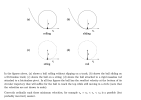 Va rolling sliding string rod In the figures above, (a) shows a ball rolling without slipping on a track; (b) shows the ball sliding on a frictionless track; (c) shows the ball on a string; (d) shows the ball attached to a rigid massless rod attached to a frictionless pivot. In all four figures the ball has the smallest velocity at the bottom of its circular trajectory that will suffice for the ball to reach the top while still moving...
A small ball of mass ? is attached to the bottom end a light string of...
A small ball of mass ? is attached to the bottom end a light string of length ?, while the top of the string is fixed to the ceiling. If the ball is moving in a horizontal circle of radius ?, derive an expression for the angular speed ? of the ball in terms of only ?, ?, ? and ?. Such a system is called a conical pendulum.
The assembly shown in the figure below consists of a thin rod of length l = 23.9 cm and mass m = 1.20 kg with a solid ball of diameter d = 10.0 cm and mass M = 2.00 kg attached to its top.
 The assembly shown in the figure below consists of a thin rod of length l = 23.9 cm and mass m = 1.20 kg with a solid ball of diameter d = 10.0 cm and mass M = 2.00 kg attached to its top. The assembly is free to pivot about a frictionless axle through the bottom of the rod. The assembly is initially vertical and at rest when it starts to rotate clockwise. (a) After the combination rotates through 90...
 A massless rigid rod whose length L = 21.0 cm has a ball of mass
m = 0.079 kg attached to one end (see Figure). The other end is
pivoted in such a way that the ball will move in a vertical circle.
The system is launched from the horizontal position A with an
initial downward speed v0. The ball just reaches point D
and then stops. Calculate v0.
What is the tension in the rod at B?
· Rod...
A massless rigid rod whose length L = 21.0 cm has a ball of mass
m = 0.079 kg attached to one end (see Figure). The other end is
pivoted in such a way that the ball will move in a vertical circle.
The system is launched from the horizontal position A with an
initial downward speed v0. The ball just reaches point D
and then stops. Calculate v0.
What is the tension in the rod at B?
· Rod...
 Va rolling sliding string rod In the figures above, (a) shows a ball rolling without slipping on a track; (b) shows the ball sliding on a frictionless track; (c) shows the ball on a string; (d) shows the ball attached to a rigid massless rod attached to a frictionless pivot. In all four figures the ball has the smallest velocity at the bottom of its circular trajectory that will suffice for the ball to reach the top while still moving...
Most questions answered within 3 hours.
-
Where is the error in this code sequence?
String s1 = "Hello";
String s2 = "ello";...
asked 10 months ago -
Financial data for Joel de Paris, Inc., for last year
follow:
Joel de Paris, Inc.
Balance...
asked 10 months ago -
Consider this reaction:
Al2(SO4)3 (aq)+ BaCl3
(aq) Al2Cl6 (aq)- +
3BaSO4(s) . What is the...
asked 10 months ago -
Suppose that Savneet is considering increasing her
recent random sample from 20 car rentals to 40...
asked 10 months ago -
Trucks arrive at an unloading terminal at an average rate of 120
per hour.
Trucks arrive...
asked 10 months ago -
Why are methanol and ethanol completely soluble in water while
octanol is not very little soluble....
asked 10 months ago -
A facilities manager at a university reads in a research report
that the mean amount of...
asked 10 months ago -
When the CuSO4 is rehydrated by adding water to the anhydrous
compound, is this an endothermic...
asked 10 months ago -
A ray of sunlight is passing from diamond into crown glass; the
angle of incidence is...
asked 10 months ago -
A block of mass 0.249 kg is placed on top of a light, vertical
spring of...
asked 10 months ago -
how do the kidneys compensate in the presences of acidosis
a) trigger hyperventilate
b) reserve acid...
asked 10 months ago -
Question 501 pts
The rental rate of capital to the firm increases. Which of the
following...
asked 10 months ago