In the following answer for the given question how specific heat of aluminium is equal to...
In the following answer for the given question how specific heat of aluminium is equal to 900J/kg K?
A 5-kg aluminum block sits in your lab, which is at 21 C. You wish to increase the temperature of the block to 50 C. How much heat in joules must be supplied?
Q=msdT
specific heat for Al=900J/Kg K
Q=5*900*(50-21)
Q=130.5*10^3J
Homework Answers
Solution:
Specific heat is defined as amount of energy added in the form of heat to one unit of mass of substance in order to increase in temperature of one unit. Every metals having its own value of specific heat value. Its unit is j/kg k or kJ/kgK. Using calorimeter specific heats of different materials are determined.
The value of specific heat for aluminium is equal to 900 J/kg K at specified standard conditions of pressure and temperature. It is standard value for aluminium which is directly taken for calculation. No any calculations or specifications is needed for the specific heat calculation it is directly calculated from calorimeter. Hence in the given answer direct value of specific heat is used to calculate heat supplied.
Add Answer to:
In the following answer for the given question how specific heat
of aluminium is equal to...
In an experiment to measure the specific heat capacity of aluminium, identical size copper and aluminium...
In an experiment to measure the specific heat capacity of aluminium, identical size copper and aluminium blocks were alternately placed in an insulated calorimeter and heated by an electrical heater. The electrical heater supplied an identical energy E to the metal blocks. It was assumed that the heat loss (h) from both calorimeter measurements was identical. The measured masses were 530 g for the aluminium block and 1700 g for the copper block. The temperature rises were 15.3oC for the...
please answer all questions Temperature Change and Heat Capacity - Calorimetry- Two substances The quantitative relationship...
 please answer all questions
Temperature Change and Heat Capacity - Calorimetry- Two substances The quantitative relationship between heat transfer and temperature change is Q = mcAT, where Q is heat transfer, m is the mass of the substance, and AT is the change in temperature. The symbol c stands for specific heat and depends on the material and phase. The specific heat c is the amount of heat necessary to change the temperature of 1.00 kg of mass by 1.00°C....
please answer all questions
Temperature Change and Heat Capacity - Calorimetry- Two substances The quantitative relationship between heat transfer and temperature change is Q = mcAT, where Q is heat transfer, m is the mass of the substance, and AT is the change in temperature. The symbol c stands for specific heat and depends on the material and phase. The specific heat c is the amount of heat necessary to change the temperature of 1.00 kg of mass by 1.00°C....
Write a complete lab report on how to determine an unknown sample in a lab using...
 Write a complete lab report on how to determine an unknown sample in a lab using the data below. You must specify the error made and how they were corrected. (8 points) A calorimeter is made from 0.15 kg of aluminum and contains 0.2 kg of water. Initially, the calorimeter and water are at 18°C. A 0.04 kg mass of unknown material is heated to 97°C and added to the water. At equilibrium, everything is at 22°C. What is the...
Question 1 1 pts A 50 g block of aluminum is dropped into a beaker with...
 Question 1 1 pts A 50 g block of aluminum is dropped into a beaker with 300 g of water. The initial temperature of the block is 200 °C, and the water is at room temperature (23 °C). (The specific heat of water and aluminum are 4186 J/kg K and 900 J/kg K, respectively.) The final temperature of the aluminum and the water is 29.1 °C, how much energy was transferred to the water? 36544 7660J O 1647J 7.66x 10⁶...
9 A student in a laboratory uses the apparatus shown in the figure to determine the...
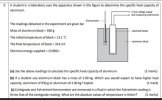 9 A student in a laboratory uses the apparatus shown in the figure to determine the specific heat capacity of aluminum to low voltage supply and measuring instruments thermometer electrical heater The readings obtained in the experiment are given be Mass of aluminum block = 930 g The initial temperature of block = 13.1 °C The final temperature of block = 314.3 K Electrical energy supplied = 23 800) aluminium block (a) Use the above readings to calculate the specific...
The specific heat capacity of solid copper metal is 0.385 J/gK. How many joules of heat...
The specific heat capacity of solid copper metal is 0.385 J/gK. How many joules of heat are needed to raise the temperature of a 2.12-kg block of copper from 25.0°C to 88.0°C?
The specific heat of aluminum is 0.900 j/g* C, how many joules of energy required to...
The specific heat of aluminum is 0.900 j/g* C, how many joules of energy required to raise the temperature of 20.0 g of Al from 10.0°C to 15.0°C ? 79 J 90.0 J 100.0 J 112 J
// Chemical potential/phases A substance has three phases: gas, liquid, and solid. The chemical potentials of various phases are illustrated below. T (K) 1) For a given temperature, which of the sta...
 //
Chemical potential/phases A substance has three phases: gas, liquid, and solid. The chemical potentials of various phases are illustrated below. T (K) 1) For a given temperature, which of the states represents an equilibrium condition? Submit 2) If the substance starts out in state Q and is held at constant temperature, what happens if it is allowed to reach equilibrium? The substance will freeze. The substance will evaporate The substance will melt and evaporate. The substance will sublime. Nothing...
//
Chemical potential/phases A substance has three phases: gas, liquid, and solid. The chemical potentials of various phases are illustrated below. T (K) 1) For a given temperature, which of the states represents an equilibrium condition? Submit 2) If the substance starts out in state Q and is held at constant temperature, what happens if it is allowed to reach equilibrium? The substance will freeze. The substance will evaporate The substance will melt and evaporate. The substance will sublime. Nothing...
please answer all questions Temperature Change and Phase Change - Specific Heat and Latent Heat -...
 please answer all questions
Temperature Change and Phase Change - Specific Heat and Latent Heat - From COLD ICE to Warm Water The quantitative relationship between heat transfer and temperature change is Q = mcAT, where Q is heat transfer, m is the mass of the substance, and AT is the change in temperature. The symbol c stands for specific heat which depends on the material and phase (for exmample, water and ice have different specific heat). The specific heat...
please answer all questions
Temperature Change and Phase Change - Specific Heat and Latent Heat - From COLD ICE to Warm Water The quantitative relationship between heat transfer and temperature change is Q = mcAT, where Q is heat transfer, m is the mass of the substance, and AT is the change in temperature. The symbol c stands for specific heat which depends on the material and phase (for exmample, water and ice have different specific heat). The specific heat...
Learning Goal: To understand specific heat and heat of transformation and how they are related to...
 Learning Goal: To understand specific heat and heat of transformation and how they are related to temperature versus time graphs Energy can be added to a system either by doing work w an it or by adding heat tot Energy transfer by work equires a force to act through some distance Energy ansfer in the form of heat occurs between objects that are different temperatures with onergy spontaneously aveling from the higher temperature object to the lower mperature one. When...
 please answer all questions
Temperature Change and Heat Capacity - Calorimetry- Two substances The quantitative relationship between heat transfer and temperature change is Q = mcAT, where Q is heat transfer, m is the mass of the substance, and AT is the change in temperature. The symbol c stands for specific heat and depends on the material and phase. The specific heat c is the amount of heat necessary to change the temperature of 1.00 kg of mass by 1.00°C....
please answer all questions
Temperature Change and Heat Capacity - Calorimetry- Two substances The quantitative relationship between heat transfer and temperature change is Q = mcAT, where Q is heat transfer, m is the mass of the substance, and AT is the change in temperature. The symbol c stands for specific heat and depends on the material and phase. The specific heat c is the amount of heat necessary to change the temperature of 1.00 kg of mass by 1.00°C....
 Write a complete lab report on how to determine an unknown sample in a lab using the data below. You must specify the error made and how they were corrected. (8 points) A calorimeter is made from 0.15 kg of aluminum and contains 0.2 kg of water. Initially, the calorimeter and water are at 18°C. A 0.04 kg mass of unknown material is heated to 97°C and added to the water. At equilibrium, everything is at 22°C. What is the...
 Question 1 1 pts A 50 g block of aluminum is dropped into a beaker with 300 g of water. The initial temperature of the block is 200 °C, and the water is at room temperature (23 °C). (The specific heat of water and aluminum are 4186 J/kg K and 900 J/kg K, respectively.) The final temperature of the aluminum and the water is 29.1 °C, how much energy was transferred to the water? 36544 7660J O 1647J 7.66x 10⁶...
 9 A student in a laboratory uses the apparatus shown in the figure to determine the specific heat capacity of aluminum to low voltage supply and measuring instruments thermometer electrical heater The readings obtained in the experiment are given be Mass of aluminum block = 930 g The initial temperature of block = 13.1 °C The final temperature of block = 314.3 K Electrical energy supplied = 23 800) aluminium block (a) Use the above readings to calculate the specific...
 //
Chemical potential/phases A substance has three phases: gas, liquid, and solid. The chemical potentials of various phases are illustrated below. T (K) 1) For a given temperature, which of the states represents an equilibrium condition? Submit 2) If the substance starts out in state Q and is held at constant temperature, what happens if it is allowed to reach equilibrium? The substance will freeze. The substance will evaporate The substance will melt and evaporate. The substance will sublime. Nothing...
//
Chemical potential/phases A substance has three phases: gas, liquid, and solid. The chemical potentials of various phases are illustrated below. T (K) 1) For a given temperature, which of the states represents an equilibrium condition? Submit 2) If the substance starts out in state Q and is held at constant temperature, what happens if it is allowed to reach equilibrium? The substance will freeze. The substance will evaporate The substance will melt and evaporate. The substance will sublime. Nothing...
 please answer all questions
Temperature Change and Phase Change - Specific Heat and Latent Heat - From COLD ICE to Warm Water The quantitative relationship between heat transfer and temperature change is Q = mcAT, where Q is heat transfer, m is the mass of the substance, and AT is the change in temperature. The symbol c stands for specific heat which depends on the material and phase (for exmample, water and ice have different specific heat). The specific heat...
please answer all questions
Temperature Change and Phase Change - Specific Heat and Latent Heat - From COLD ICE to Warm Water The quantitative relationship between heat transfer and temperature change is Q = mcAT, where Q is heat transfer, m is the mass of the substance, and AT is the change in temperature. The symbol c stands for specific heat which depends on the material and phase (for exmample, water and ice have different specific heat). The specific heat...
 Learning Goal: To understand specific heat and heat of transformation and how they are related to temperature versus time graphs Energy can be added to a system either by doing work w an it or by adding heat tot Energy transfer by work equires a force to act through some distance Energy ansfer in the form of heat occurs between objects that are different temperatures with onergy spontaneously aveling from the higher temperature object to the lower mperature one. When...
Most questions answered within 3 hours.
-
Where is the error in this code sequence?
String s1 = "Hello";
String s2 = "ello";...
asked 11 months ago -
Financial data for Joel de Paris, Inc., for last year
follow:
Joel de Paris, Inc.
Balance...
asked 11 months ago -
Consider this reaction:
Al2(SO4)3 (aq)+ BaCl3
(aq) Al2Cl6 (aq)- +
3BaSO4(s) . What is the...
asked 11 months ago -
Suppose that Savneet is considering increasing her
recent random sample from 20 car rentals to 40...
asked 11 months ago -
Trucks arrive at an unloading terminal at an average rate of 120
per hour.
Trucks arrive...
asked 11 months ago -
Why are methanol and ethanol completely soluble in water while
octanol is not very little soluble....
asked 11 months ago -
A facilities manager at a university reads in a research report
that the mean amount of...
asked 11 months ago -
When the CuSO4 is rehydrated by adding water to the anhydrous
compound, is this an endothermic...
asked 11 months ago -
A ray of sunlight is passing from diamond into crown glass; the
angle of incidence is...
asked 11 months ago -
A block of mass 0.249 kg is placed on top of a light, vertical
spring of...
asked 11 months ago -
how do the kidneys compensate in the presences of acidosis
a) trigger hyperventilate
b) reserve acid...
asked 11 months ago -
Question 501 pts
The rental rate of capital to the firm increases. Which of the
following...
asked 11 months ago