(a) How does the hydration of ions in aqueous solution affect their conductivity? Illustrate your answer...
(a) How does the hydration of ions in aqueous solution affect their conductivity? Illustrate your answer with examples and diagrams. [10 marks]
(b) The conductivity of a 0.01 mol dm–3 solution of a monobasic organic acid in water is 5.07 × 10⁻² S m–1. If the molar conductance at infinite dilution (Λ°) of aqueous sodium chloride, sodium formate and hydrochloric acid are 1.264 × 10⁻², 1.046 × 10⁻² and 4.261 × 10⁻² respectively at 25°C determine the acid dissociation constant and the pKa for the acid.
Homework Answers
answer (a):- Hydration of ion as a result of higher charge density decreases the mobility of ion because a hydrated ion has to drag along a shell of water as its move through the solution. As, Conductivity is proportional to mobility of ion & , the hydration of ion decreases its mobility. Hence, we can conclude that, Conductivity of ion in aqueous solution decreases with increase in hydration of ion.
For e.g. :- The ionic mobilities of Lithium and sodium ions become low due to hydration of ions as a result of higher charge density around the ion because of their smaller radii. As a result, conductivity of Li+ and Na+ ions decreases.
 Hydration of Na+ ion ( see
fig.)
Hydration of Na+ ion ( see
fig.)
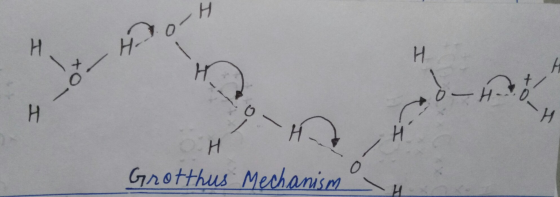
Exceptional case of H+ ion:-
However, conductivity of H+ ion, in spite of its small size and high charge density ( and it is also heavily hydrated. But its conductivity is very high rather than becoming low. This unexpected result can be explained by " Grotthus Type Mechanism" in which a proton moves rapidly from H3O+ to a H- bonded water molecule and is transferred further along a series of hydrogen bonded water molecules by a rearrangement of hydrogen bonds".
Answer (b):- Concentration (c) = 0.01 mol dm-3 = 10 mol m -3
Molar conductivity ( ) = Conductivity
/ concentration = 5.07 × 10⁻² S m-1/ 10 mol
m-3
) = Conductivity
/ concentration = 5.07 × 10⁻² S m-1/ 10 mol
m-3
= 5.07 × 10⁻³ S m2 mol-1
Molar conductivity at infinite dilution (0) =
0HCOONa
+ 0 HCl
- 0
NaCl
0
HCOOH = (1.046 + 4.261- 1.264) ×
10-2
0 (
HCOOH) = 4.043 × 10⁻² S m2
mol-1
Degree of dissociation (a) = /
0
a = 5.07 × 10⁻³/ 4.04 × 10⁻²
a = 0.1254
Dissociation constant (ka) of formic acid = C a2/ ( 1-a)
= 0.01 × (0.1254)2/0.99
ka = 1.589 × 10⁻⁴ mol/ dm-3
pka = - log10 ka
pka = - log10 1.589 × 10⁻⁴
pka of formic acid = 3.78 (approx)
Add Answer to:
(a) How does the hydration of ions in aqueous solution affect
their conductivity? Illustrate your answer...
H CE 0.03496 Na 0.00764 Ac 0.00501 0.00409 Questions 1. A conductivity cell has plane-parallel electrodes,...
 H CE 0.03496 Na 0.00764 Ac 0.00501 0.00409 Questions 1. A conductivity cell has plane-parallel electrodes, each 2.2 cm x 2.2 cm in area, spaced 2.2 cm apart. When the cell is filled with an electrolyte, the measured conductance is found to be 2,745HS What is the conductivity of the solution? 2. The molar conductances at infinite dilution, o, of aqueous solutions of the strong electrolyte sodium ethanoate (or sodium acetate as it is more commonly known), hydrochloric acid and...
t in the orams ts. Conductivity Chem 113 Reading Assignment 1. Read sections 8.2-8.3 in your...
 t in the orams ts. Conductivity Chem 113 Reading Assignment 1. Read sections 8.2-8.3 in your lecture text. 2. Review Sample Exercise 8.4 on pages 326-327 of your lecture text. Introduction Properties of Solutions: Electrolytes and Non-Electrolytes In this experiment, you will discover some properties of strong electrolytes, weak electrolytes, and non- electrolytes by observing the behavior of these substances in aqueous solutions. You will determine these properties using a conductivity Probe. When the probe is placed in a solution...
(6) Let's see how the spectator" ions present in solution affect the pH of a weak...
 (6) Let's see how the spectator" ions present in solution affect the pH of a weak acid (a) What is the pH of a 0.0200 M benzoic acid (Ka = 6.28 x 10) solution in water? (b) What is the % dissociation of the benzoic acid in pure water? Now we'll add some "spectator" ions to the solution. If the benzoic acid is dissolved in 0.10 M CaCl2 instead of pure water: (c) Calculate the ionic strength of the solution...
Does the pH of the solution increase, decrease, or stay the same when you add solid...
Does the pH of the solution increase, decrease, or stay the same when you add solid sodium hydrogen oxalate, NaHC2O4 to a dilute aqueous solution of oxalic acid, H2C2O4? Explain your answer using the equation below. H2C2O4 (aq) + H2O (l)⇌ HC2O41– (aq) + H3O+ (aq) 2)Why a solution of sodium chloride and hydrochloric acid cannot act as a buffer? (b) Propose a conjugate acid/base pair which can function as a buffer. 3) (a) Calculate the pH of a buffer...
Provide a flow chart detailing the acid/base extraction/separation of the compounds show below. Your answer must...
 Provide a flow chart detailing the acid/base extraction/separation of the compounds show below. Your answer must employ the following reagents: methylene chloride, hydrochloric acid (1M & 6M), sodium hydroxide (1M & 6M), 10% sodium bicarbonate (aq). Clearly indicate the product(s) and layers formed following each step of your separation scheme. IMPORTANT: p-cresol is soluble in sodium hydroxide solution but insoluble in neutral water or sodium bicarbonate solution. 2-ethylbenzoic acid is soluble in both sodium hydroxide and sodium bicarbonate solutions. Use...
Titration: Acids and Bases 2. How can you determine which acid is diprotic? 3. using the...
 Titration: Acids and Bases
2. How can you determine which acid is diprotic?
3. using the answers to questions one and two, which acid is
diprotic?
4. Which base has more hydroxide ions per molecule?
Acid Volume Base Base Initial Volume (mL) Base Final Volume (mL) Volume of Base Used (mL) Acid: Base Ratio Acid 1 20 mL Base 1 50 mL 34.5 15.5 4:3 Acid 2 20 mL Base 1 Acid 1 20 mL Base 2 Acid 2 20...
Titration: Acids and Bases
2. How can you determine which acid is diprotic?
3. using the answers to questions one and two, which acid is
diprotic?
4. Which base has more hydroxide ions per molecule?
Acid Volume Base Base Initial Volume (mL) Base Final Volume (mL) Volume of Base Used (mL) Acid: Base Ratio Acid 1 20 mL Base 1 50 mL 34.5 15.5 4:3 Acid 2 20 mL Base 1 Acid 1 20 mL Base 2 Acid 2 20...
Answer all 3M. The Which statement is correct for this reaction (A) CH,acts as a base....
 Answer all
3M. The Which statement is correct for this reaction (A) CH,acts as a base. (C) NH, acts as a base 25. In which set are both compounds soluble in water? 29. (A) magnesium chioride (MgCl) and octane (C.H (B) ethanol (CH,CHJOH) and propane (CH,CH/CH 10s ) carbon tetrachloride (CCL) chloride (MgCl)and magnesium chlorideB) CH, is the conjugate acid of CH. D) magnesium chloride (MgCl) and ethano! (D) NH, is the conjugase acid of NH, (CH,CH OH) 30, which...
Answer all
3M. The Which statement is correct for this reaction (A) CH,acts as a base. (C) NH, acts as a base 25. In which set are both compounds soluble in water? 29. (A) magnesium chioride (MgCl) and octane (C.H (B) ethanol (CH,CHJOH) and propane (CH,CH/CH 10s ) carbon tetrachloride (CCL) chloride (MgCl)and magnesium chlorideB) CH, is the conjugate acid of CH. D) magnesium chloride (MgCl) and ethano! (D) NH, is the conjugase acid of NH, (CH,CH OH) 30, which...
Which of the following statements is true of weak acids dissolved in water: They...
Which of the following statements is true of weak acids dissolved in water: They are completely ionized in water They are totally unionized in water They are partially ionized in water The dissociation constant is a function of pH QUESTION 13 Which of the following is a hydroxide ion? H3O+ OH- HOOH CH3OH2+ QUESTION 14 The following molecule is an example of which class...
Conductivity of Solutions For Che 2A at RCC Introduction Electrolytes are compounds which conduct electricity when...
 Conductivity of Solutions For Che 2A at RCC Introduction Electrolytes are compounds which conduct electricity when dissolved in water. Strong electrolytes consist of ionic compounds which dissociate completely when dissolved in water, AND molecular compounds which completely ionize when dissolved in water. The reactions below illustrate the dissociation reaction of strong electrolytes: Na (aq) + Cl(aq) но NaCl(s) H30 CaBra(s) HO HCl(e) Ca(aq) + 2Br (aa) H*(aq) + C'(aq) Conductivity is a measure of the ability of water to pass...
Would the methylene chloride layer be above or below the experiment? Justify your answer. 1. aqueous layer in today...
 Would the methylene chloride layer be above or below the experiment? Justify your answer. 1. aqueous layer in today's ium carbonate used in the isolation of caffeine? Be specific as to the 2. Why is potass chemical species the carbonate may act on. Why was sodium sulfate used? 3. 4. After introducing 1.0 g of potassium carbonate into the centri hot water extract, it was capped, shaken, and then cooled to room temperature. Following this, roug minute. Why wasn't the...
 H CE 0.03496 Na 0.00764 Ac 0.00501 0.00409 Questions 1. A conductivity cell has plane-parallel electrodes, each 2.2 cm x 2.2 cm in area, spaced 2.2 cm apart. When the cell is filled with an electrolyte, the measured conductance is found to be 2,745HS What is the conductivity of the solution? 2. The molar conductances at infinite dilution, o, of aqueous solutions of the strong electrolyte sodium ethanoate (or sodium acetate as it is more commonly known), hydrochloric acid and...
 t in the orams ts. Conductivity Chem 113 Reading Assignment 1. Read sections 8.2-8.3 in your lecture text. 2. Review Sample Exercise 8.4 on pages 326-327 of your lecture text. Introduction Properties of Solutions: Electrolytes and Non-Electrolytes In this experiment, you will discover some properties of strong electrolytes, weak electrolytes, and non- electrolytes by observing the behavior of these substances in aqueous solutions. You will determine these properties using a conductivity Probe. When the probe is placed in a solution...
 (6) Let's see how the spectator" ions present in solution affect the pH of a weak acid (a) What is the pH of a 0.0200 M benzoic acid (Ka = 6.28 x 10) solution in water? (b) What is the % dissociation of the benzoic acid in pure water? Now we'll add some "spectator" ions to the solution. If the benzoic acid is dissolved in 0.10 M CaCl2 instead of pure water: (c) Calculate the ionic strength of the solution...
 Provide a flow chart detailing the acid/base extraction/separation of the compounds show below. Your answer must employ the following reagents: methylene chloride, hydrochloric acid (1M & 6M), sodium hydroxide (1M & 6M), 10% sodium bicarbonate (aq). Clearly indicate the product(s) and layers formed following each step of your separation scheme. IMPORTANT: p-cresol is soluble in sodium hydroxide solution but insoluble in neutral water or sodium bicarbonate solution. 2-ethylbenzoic acid is soluble in both sodium hydroxide and sodium bicarbonate solutions. Use...
 Titration: Acids and Bases
2. How can you determine which acid is diprotic?
3. using the answers to questions one and two, which acid is
diprotic?
4. Which base has more hydroxide ions per molecule?
Acid Volume Base Base Initial Volume (mL) Base Final Volume (mL) Volume of Base Used (mL) Acid: Base Ratio Acid 1 20 mL Base 1 50 mL 34.5 15.5 4:3 Acid 2 20 mL Base 1 Acid 1 20 mL Base 2 Acid 2 20...
Titration: Acids and Bases
2. How can you determine which acid is diprotic?
3. using the answers to questions one and two, which acid is
diprotic?
4. Which base has more hydroxide ions per molecule?
Acid Volume Base Base Initial Volume (mL) Base Final Volume (mL) Volume of Base Used (mL) Acid: Base Ratio Acid 1 20 mL Base 1 50 mL 34.5 15.5 4:3 Acid 2 20 mL Base 1 Acid 1 20 mL Base 2 Acid 2 20...
 Answer all
3M. The Which statement is correct for this reaction (A) CH,acts as a base. (C) NH, acts as a base 25. In which set are both compounds soluble in water? 29. (A) magnesium chioride (MgCl) and octane (C.H (B) ethanol (CH,CHJOH) and propane (CH,CH/CH 10s ) carbon tetrachloride (CCL) chloride (MgCl)and magnesium chlorideB) CH, is the conjugate acid of CH. D) magnesium chloride (MgCl) and ethano! (D) NH, is the conjugase acid of NH, (CH,CH OH) 30, which...
Answer all
3M. The Which statement is correct for this reaction (A) CH,acts as a base. (C) NH, acts as a base 25. In which set are both compounds soluble in water? 29. (A) magnesium chioride (MgCl) and octane (C.H (B) ethanol (CH,CHJOH) and propane (CH,CH/CH 10s ) carbon tetrachloride (CCL) chloride (MgCl)and magnesium chlorideB) CH, is the conjugate acid of CH. D) magnesium chloride (MgCl) and ethano! (D) NH, is the conjugase acid of NH, (CH,CH OH) 30, which...
 Conductivity of Solutions For Che 2A at RCC Introduction Electrolytes are compounds which conduct electricity when dissolved in water. Strong electrolytes consist of ionic compounds which dissociate completely when dissolved in water, AND molecular compounds which completely ionize when dissolved in water. The reactions below illustrate the dissociation reaction of strong electrolytes: Na (aq) + Cl(aq) но NaCl(s) H30 CaBra(s) HO HCl(e) Ca(aq) + 2Br (aa) H*(aq) + C'(aq) Conductivity is a measure of the ability of water to pass...
 Would the methylene chloride layer be above or below the experiment? Justify your answer. 1. aqueous layer in today's ium carbonate used in the isolation of caffeine? Be specific as to the 2. Why is potass chemical species the carbonate may act on. Why was sodium sulfate used? 3. 4. After introducing 1.0 g of potassium carbonate into the centri hot water extract, it was capped, shaken, and then cooled to room temperature. Following this, roug minute. Why wasn't the...
Most questions answered within 3 hours.
-
Where is the error in this code sequence?
String s1 = "Hello";
String s2 = "ello";...
asked 11 months ago -
Financial data for Joel de Paris, Inc., for last year
follow:
Joel de Paris, Inc.
Balance...
asked 11 months ago -
Consider this reaction:
Al2(SO4)3 (aq)+ BaCl3
(aq) Al2Cl6 (aq)- +
3BaSO4(s) . What is the...
asked 11 months ago -
Suppose that Savneet is considering increasing her
recent random sample from 20 car rentals to 40...
asked 11 months ago -
Trucks arrive at an unloading terminal at an average rate of 120
per hour.
Trucks arrive...
asked 11 months ago -
Why are methanol and ethanol completely soluble in water while
octanol is not very little soluble....
asked 11 months ago -
A facilities manager at a university reads in a research report
that the mean amount of...
asked 11 months ago -
When the CuSO4 is rehydrated by adding water to the anhydrous
compound, is this an endothermic...
asked 11 months ago -
A ray of sunlight is passing from diamond into crown glass; the
angle of incidence is...
asked 11 months ago -
A block of mass 0.249 kg is placed on top of a light, vertical
spring of...
asked 11 months ago -
how do the kidneys compensate in the presences of acidosis
a) trigger hyperventilate
b) reserve acid...
asked 11 months ago -
Question 501 pts
The rental rate of capital to the firm increases. Which of the
following...
asked 11 months ago