A geranium plant (A) is placed in the dark for six days. A second plant (B)...
A geranium plant (A) is placed in the dark for six days. A second plant (B) is exposed to continuous blue light for six days. A third plant (C) is exposed to continuous green light for six days. All are watered. At the end of the six days, leaves are removed and tested for the presence of starch (made from glucose). Which of the following results do you expect?)
Group of answer choices
A) A will have more starch than B or C.
B) A, B and C have the same amount of starch
C) C will have more starch than A or B
D) B will have more starch than A or C
Homework Answers
Question
The plants need sunlight for the process known as photosyntheisis through which they prepare their food in the form of starch. Not all wavelength of light are equally important for photosyntheis. Blue light is the most effective, in performing photosyntheis as they have right amount of energy to energise chlorophyll molecule. Green light wavelength is not so good for photosyntheis. Therefore, the plant B which is exposed for blue light would produce more starch, followed by green light and least in the plant kept in dark. Hence, option d is correct.
Add Answer to:
A geranium plant (A) is placed in the dark for six days. A
second plant (B)...
(1) The hardy geranium, Geranium lanuginosum, is native to the Himalayas and is widely cultivated due...
 (1) The hardy geranium, Geranium lanuginosum, is native to the Himalayas and is widely cultivated due to its brilliant blue flowers, but flowers can be dark blue, light blue, speckled blue, and white. You have identified 2 genes involved in flower color. The alabaster gene catalyzes the conversion of a colorless precursor into a light blue pigment. The amount of pigment that is produced is determined by the number of functional copies of the alabaster gene. Normally, the pigment is...
E 3 Normal No spacing Heading 1 Heading 1. Plants sometimes store carbohydrates in their roots...
 E 3 Normal No spacing Heading 1 Heading 1. Plants sometimes store carbohydrates in their roots or leaves in the form of which you tested for with iodine solution. 2. Which color of light (red, green or blue) resulted in the least amount ofphotosynthesis in th Geranium leaves? 3. What are the 2 products of photosynthesis? and 4. TRUE or FALSE: Plant cells get their ATP from photosynthesis and do not use cellular respiration. 5 TRUE or FALSE: Polar molecules...
QUESTION 1 One hundred samples of several different plant parts were placed in each of six...
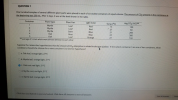 QUESTION 1 One hundred samples of several different plant parts were placed in each of six sealed containers of equal the beginning was 250 mL. After 2 days, it was at the level shown in the table. volume. The amount of CO2 present in the containers at Plant Part Light ColorTemp(oO Container Plant Type Avg CO2 (mL)** Leaf Leaf Stem Root Leaf Red Red Blue ue 15 27 21 27 27 50 200 300 150 Oak Oak Orange ** average...
Three plant genes, A, B, and C, are linked and occur in the following order. Genetic...
Three plant genes, A, B, and C, are linked and occur in the following order. Genetic distances are given as map units (m.u.): A________10 m.u.______B_____0 m.u.__C The genes underlie the following phenotypes: A/_ = blue flowers, a/a = white flowers B/_ = tall stems, b/b = short stems C/_ = green leaves, c/c = red leaves You cross two individuals with the following genotypes: AbC/AbC x aBc/aBc If you self the resulting F1 the proportion of the offspring that will...
Which of the following DO NOT promote stomatal opening in plants that do not use CAM...
Which of the following DO NOT promote stomatal opening in plants that do not use CAM metabolism (choose all that are correct) CHOOSE MORE THAN ONE!! A Increased levels of the plant hormone ABA (abscisic acid) B Blue light C Red light D Low levels of CO2 E Darkness F Drought Leaves exposed to full sunlight absorb a lot of energy and need to dissipate heat effectively to prevent damage. Which of the following are used by leaves to dissipate...
Hello can you answer the incorrect question ? X Incorrect 1) What group does the Benedict's...
 Hello can you answer the incorrect question ?
X Incorrect 1) What group does the Benedict's test oxidize? A. A ketone B. More than one of these C. An ether D. An aldehyde X (Your Answer) X Incorrect 3) If you have a polysaccharide, what color is it when mixed with lodina? A. Deep brown X (Your Answer) B. Deep violet C. Light Brown D. Prussian red X Incorrect 4) What sugar was negative to the Benedict's test? A. Fructose...
Hello can you answer the incorrect question ?
X Incorrect 1) What group does the Benedict's test oxidize? A. A ketone B. More than one of these C. An ether D. An aldehyde X (Your Answer) X Incorrect 3) If you have a polysaccharide, what color is it when mixed with lodina? A. Deep brown X (Your Answer) B. Deep violet C. Light Brown D. Prussian red X Incorrect 4) What sugar was negative to the Benedict's test? A. Fructose...
ab-Photosynthesis - Go X o Use iodine to test a leaf for star x + ab=rm&ogbl#inbox?projector=1...
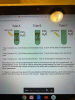 ab-Photosynthesis - Go X o Use iodine to test a leaf for star x + ab=rm&ogbl#inbox?projector=1 Tube A Tube B Tube C Light Energy CO2 Light Energy CO2 HO Tube A contains co., H,0, Elodea and bromothymol blue. Tube A will be place in the light for 40 mins. Tube B contains co., H,0, Elodea and bromothymol blue. Tube B will be place in the dark for 40 mins. Tube C contains co., H,0, and bromothymol blue. Tube C will...
In order to measure the rate of this reaction, we utilized the fact that starch -...
 In order to measure the rate of this reaction, we utilized the fact that starch - in the presence of iodine has a distinct dark blue color while the conversion of starch to its monomer leads to a more transparent/amber colored solution. While you used a simple visual analysis to verify the conversion, it is also possible to quantify the change in (starch) using a spectrophotometer. 1. Why/how was a spectrophotometer used for this purpose? EXPLAIN what this machine does...
Experiment 2: Diffusion Concentration Gradients and Membrane Permeability Data Tables Table 2: Indicator Reagent Data Indicator...
 Experiment 2: Diffusion Concentration Gradients and Membrane
Permeability
Data Tables
Table 2: Indicator Reagent Data
Indicator
Starch Positive
Starch Negative
Glucose Positive
Glucose Negative
Glucose Test Strip
n/a
n/a
green
yellow
IKI Solution
dark blue
light brown
n/a
n/a
Table 3: Diffusion of Starch and Glucose Over
Time
Indicator
Dialysis Bag After 60 Minutes
Beaker Water After 60 Minutes
Glucose Test Strip
yellow
green ( if all glucose passed to the beaker from the bag)
IKI
from incolore changed to...
Experiment 2: Diffusion Concentration Gradients and Membrane
Permeability
Data Tables
Table 2: Indicator Reagent Data
Indicator
Starch Positive
Starch Negative
Glucose Positive
Glucose Negative
Glucose Test Strip
n/a
n/a
green
yellow
IKI Solution
dark blue
light brown
n/a
n/a
Table 3: Diffusion of Starch and Glucose Over
Time
Indicator
Dialysis Bag After 60 Minutes
Beaker Water After 60 Minutes
Glucose Test Strip
yellow
green ( if all glucose passed to the beaker from the bag)
IKI
from incolore changed to...
om 4. In the structural features of sw a welch of the following was to distinguish...
 om 4. In the structural features of sw a welch of the following was to distinguish reducing monosaccharides freeding disaccharides? (a) Benedict's Test (e) ladine Test (b) Molisch Test (d) Barfoed's Test is indicate 3. In the Seliwanoll's test, a positive result for the presence of ketohexos what color? (a) purple (c) dark reddish brown (b) red-orange (d) greenish-blue 6. Vitamin C is also known as (a) sodium hydroxide (b) sulfuric acid (e) ascorbic acid (d) glucose 7. The oxidation...
 (1) The hardy geranium, Geranium lanuginosum, is native to the Himalayas and is widely cultivated due to its brilliant blue flowers, but flowers can be dark blue, light blue, speckled blue, and white. You have identified 2 genes involved in flower color. The alabaster gene catalyzes the conversion of a colorless precursor into a light blue pigment. The amount of pigment that is produced is determined by the number of functional copies of the alabaster gene. Normally, the pigment is...
 E 3 Normal No spacing Heading 1 Heading 1. Plants sometimes store carbohydrates in their roots or leaves in the form of which you tested for with iodine solution. 2. Which color of light (red, green or blue) resulted in the least amount ofphotosynthesis in th Geranium leaves? 3. What are the 2 products of photosynthesis? and 4. TRUE or FALSE: Plant cells get their ATP from photosynthesis and do not use cellular respiration. 5 TRUE or FALSE: Polar molecules...
 QUESTION 1 One hundred samples of several different plant parts were placed in each of six sealed containers of equal the beginning was 250 mL. After 2 days, it was at the level shown in the table. volume. The amount of CO2 present in the containers at Plant Part Light ColorTemp(oO Container Plant Type Avg CO2 (mL)** Leaf Leaf Stem Root Leaf Red Red Blue ue 15 27 21 27 27 50 200 300 150 Oak Oak Orange ** average...
 Hello can you answer the incorrect question ?
X Incorrect 1) What group does the Benedict's test oxidize? A. A ketone B. More than one of these C. An ether D. An aldehyde X (Your Answer) X Incorrect 3) If you have a polysaccharide, what color is it when mixed with lodina? A. Deep brown X (Your Answer) B. Deep violet C. Light Brown D. Prussian red X Incorrect 4) What sugar was negative to the Benedict's test? A. Fructose...
Hello can you answer the incorrect question ?
X Incorrect 1) What group does the Benedict's test oxidize? A. A ketone B. More than one of these C. An ether D. An aldehyde X (Your Answer) X Incorrect 3) If you have a polysaccharide, what color is it when mixed with lodina? A. Deep brown X (Your Answer) B. Deep violet C. Light Brown D. Prussian red X Incorrect 4) What sugar was negative to the Benedict's test? A. Fructose...
 ab-Photosynthesis - Go X o Use iodine to test a leaf for star x + ab=rm&ogbl#inbox?projector=1 Tube A Tube B Tube C Light Energy CO2 Light Energy CO2 HO Tube A contains co., H,0, Elodea and bromothymol blue. Tube A will be place in the light for 40 mins. Tube B contains co., H,0, Elodea and bromothymol blue. Tube B will be place in the dark for 40 mins. Tube C contains co., H,0, and bromothymol blue. Tube C will...
 In order to measure the rate of this reaction, we utilized the fact that starch - in the presence of iodine has a distinct dark blue color while the conversion of starch to its monomer leads to a more transparent/amber colored solution. While you used a simple visual analysis to verify the conversion, it is also possible to quantify the change in (starch) using a spectrophotometer. 1. Why/how was a spectrophotometer used for this purpose? EXPLAIN what this machine does...
 Experiment 2: Diffusion Concentration Gradients and Membrane
Permeability
Data Tables
Table 2: Indicator Reagent Data
Indicator
Starch Positive
Starch Negative
Glucose Positive
Glucose Negative
Glucose Test Strip
n/a
n/a
green
yellow
IKI Solution
dark blue
light brown
n/a
n/a
Table 3: Diffusion of Starch and Glucose Over
Time
Indicator
Dialysis Bag After 60 Minutes
Beaker Water After 60 Minutes
Glucose Test Strip
yellow
green ( if all glucose passed to the beaker from the bag)
IKI
from incolore changed to...
Experiment 2: Diffusion Concentration Gradients and Membrane
Permeability
Data Tables
Table 2: Indicator Reagent Data
Indicator
Starch Positive
Starch Negative
Glucose Positive
Glucose Negative
Glucose Test Strip
n/a
n/a
green
yellow
IKI Solution
dark blue
light brown
n/a
n/a
Table 3: Diffusion of Starch and Glucose Over
Time
Indicator
Dialysis Bag After 60 Minutes
Beaker Water After 60 Minutes
Glucose Test Strip
yellow
green ( if all glucose passed to the beaker from the bag)
IKI
from incolore changed to...
 om 4. In the structural features of sw a welch of the following was to distinguish reducing monosaccharides freeding disaccharides? (a) Benedict's Test (e) ladine Test (b) Molisch Test (d) Barfoed's Test is indicate 3. In the Seliwanoll's test, a positive result for the presence of ketohexos what color? (a) purple (c) dark reddish brown (b) red-orange (d) greenish-blue 6. Vitamin C is also known as (a) sodium hydroxide (b) sulfuric acid (e) ascorbic acid (d) glucose 7. The oxidation...
Most questions answered within 3 hours.
-
Where is the error in this code sequence?
String s1 = "Hello";
String s2 = "ello";...
asked 10 months ago -
Financial data for Joel de Paris, Inc., for last year
follow:
Joel de Paris, Inc.
Balance...
asked 10 months ago -
Consider this reaction:
Al2(SO4)3 (aq)+ BaCl3
(aq) Al2Cl6 (aq)- +
3BaSO4(s) . What is the...
asked 10 months ago -
Suppose that Savneet is considering increasing her
recent random sample from 20 car rentals to 40...
asked 10 months ago -
Trucks arrive at an unloading terminal at an average rate of 120
per hour.
Trucks arrive...
asked 10 months ago -
Why are methanol and ethanol completely soluble in water while
octanol is not very little soluble....
asked 10 months ago -
A facilities manager at a university reads in a research report
that the mean amount of...
asked 10 months ago -
When the CuSO4 is rehydrated by adding water to the anhydrous
compound, is this an endothermic...
asked 10 months ago -
A ray of sunlight is passing from diamond into crown glass; the
angle of incidence is...
asked 10 months ago -
A block of mass 0.249 kg is placed on top of a light, vertical
spring of...
asked 10 months ago -
how do the kidneys compensate in the presences of acidosis
a) trigger hyperventilate
b) reserve acid...
asked 10 months ago -
Question 501 pts
The rental rate of capital to the firm increases. Which of the
following...
asked 10 months ago