write a program to compute an approximate value for the derivative of a function using the...
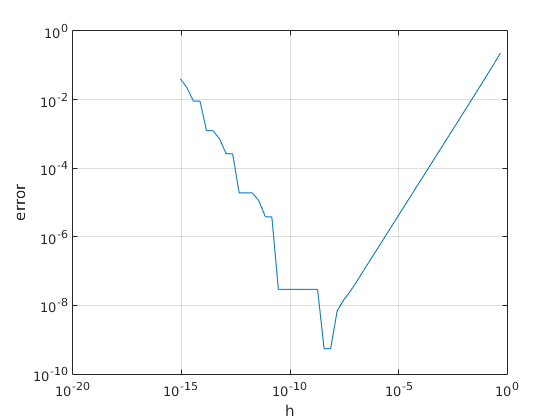
write a program to compute an approximate value for the derivative of a function using the finite difference formula f ′ (x) ≈ f(x + h) − f(x) h . (2) Test your program using the function sin(x) for x = 1. Determine the error by comparing with the built-in function cos(x). Plot the magnitude of the error as a function of h, for h = 1 2 , 1 4 , 1 8 , . . . You should use a log scale for h and the magnitude of the error. Is there a minimum value for the magnitude of the error? b) (5 points) Check if the corresponding value of h to the minimum value for the magnitude of the error can be approximately equal to √ eps ? Why?
Homework Answers
Hey,
Note: Brother in case of any queries, just comment in box I would be very happy to assist all your queries
clc;
close all
clear all
f = @(x) sin(x); % function handler for The function sin(x)
x = 1;% The point at which the function computing the
derivative
k = 1:50;% number of h values tested
h = 2.^(-k);% creating a vector of h of various values as mentioned
in problem
df = (f(x+h) - f(x))./h;% finding the derivative
err = abs(df - cos(x));% finding the error
loglog(h,err) % plotting the figure in log x and log y graph
grid on % grid on command
xlabel('h');% x axis lable
ylabel('error');% y axis label
for i=1:50
if(err(i) == min(err))
H = h(i); % h corresponding to minimum error
end
end
ApproxH = sqrt(abs(3*(4/3-1)-1))*abs(x); % h approx sqrt(exs
mach)
fprintf(' h corresponding to minumum error %e rule of thum h = %e
',H,ApproxH);
OUTPUT
h corresponding to minumum error 3.725290e-09
rule of thum h = 1.490116e-08
Kindly revert for any queries
Thanks.
Add Answer to:
write a program to compute an approximate value for the
derivative of a function using the...
1. Approximate the derivative of each of the following functions using the forward, backward, and...
 1. Approximate the derivative of each of the following functions using the forward, backward, and centered differ- ence formulas on the grid linspace (-5,5,100) (x+h)-f(z thforward, (r)-fr-h ckward th)-fle-h centered. For each part, make a single plot (with three curves) showing the absolute error at each grid point. (Note that the approximations are undefined at one or both endpoints.) Also state which approximations are exact (within roundoff error) (b) f:x→z? (d) f:Hsin(x) 2. Use the centered difference formula to approximate...
#7. [Extra Credit] is calculus wrong?! Consider f(x) = ex (a) Calculate the derivative of fx) atx...
 #7. [Extra Credit] is calculus wrong?! Consider f(x) = ex (a) Calculate the derivative of fx) atx 0 using O(h) finite difference (forward and backward) and O(h2) centered finite difference. Vary h in the following manner: 1, 101,102... 1015. (Write a MATLAB script for this purpose and call it pset5_prob7) (b) Modify your script to plot (log-log) the the true percent error in all three cases as a function of h in one plot. (c) In calculus we learned that...
Design and construct a computer program in Java. The following is a plot of the function...
Design and construct a computer program in Java. The following is a plot of the function f(x) = sin(x3) + x2 : In order to illustrate the effects of the two major error sources, rounding and truncation, attempt to determine an approximation to the derivative of f(x) at x = 2.0 radians using the difference approximation given below. (The true answer is 4 + 12 cos(8) or about 2.2539995942966376896). Use the formula: f'(x) ≃ (f(x+h) - f(x)) / h with...
(10 pts) Write a function to call python modules (either re-write or re-use the program you...
 (10 pts) Write a function to call python modules (either re-write or re-use the program you developed before) to calculate the derivative of In(1+x) at X = 1 using the forward difference, central difference and extrapolated dif- ference methods. Also use this function to create a similar log-log plot that compares the absolute value of the approximation error (you can ignore the rounding error) as a function of the size of the intervals used for these three methods. Choose the...
-4 using Estimate the minimum number of subintervals to approximate the value of 5 sin (x9)dx...
 -4 using Estimate the minimum number of subintervals to approximate the value of 5 sin (x9)dx with an error of magnitude less than 2x 10 -6 a. the error estimate formula for the Trapezoidal Rule. b. the error estimate formula for Simpson's Rule. The minimum number of subintervals using the trapezoidal rule is (Round up to the nearest whole number.) The minimum number of subintervals using Simpson's rule is (Round up to the nearest even whole number.)
-4 using Estimate...
-4 using Estimate the minimum number of subintervals to approximate the value of 5 sin (x9)dx with an error of magnitude less than 2x 10 -6 a. the error estimate formula for the Trapezoidal Rule. b. the error estimate formula for Simpson's Rule. The minimum number of subintervals using the trapezoidal rule is (Round up to the nearest whole number.) The minimum number of subintervals using Simpson's rule is (Round up to the nearest even whole number.)
-4 using Estimate...
please show me a Matlab script that will compute the total errors of the approximation due...
 please show me a Matlab script that will compute the
total errors of the approximation due to the given function, also
include the panel plot as well, thank you.
1) This problem studies the errors due to the approximation of the first derivative of a given function f(x) using the forward and centered difference methods. For this problem, we consider f(x)=sin(x). a) First, we will investigate the effect of the step size h on the first derivative approximation. Set h=10',...
please show me a Matlab script that will compute the
total errors of the approximation due to the given function, also
include the panel plot as well, thank you.
1) This problem studies the errors due to the approximation of the first derivative of a given function f(x) using the forward and centered difference methods. For this problem, we consider f(x)=sin(x). a) First, we will investigate the effect of the step size h on the first derivative approximation. Set h=10',...
Classes and Methods: A class for estimating the derivative of a function f) at the form: takes wh...
 In Python 3.6
Classes and Methods: A class for estimating the derivative of a function f) at the form: takes where h is a small change in x. The goal of this exercise is to use the formula above to differentinte a mat hematical function f(x) implemented as a Python function f(x) Implement class Diff with two special methods. The--init--() method takes in function object and also an optional argument h. The default value of h is le-4. Implement also...
In Python 3.6
Classes and Methods: A class for estimating the derivative of a function f) at the form: takes where h is a small change in x. The goal of this exercise is to use the formula above to differentinte a mat hematical function f(x) implemented as a Python function f(x) Implement class Diff with two special methods. The--init--() method takes in function object and also an optional argument h. The default value of h is le-4. Implement also...
3. Consider the function f(x) = -0.1.24 – 0.15x3 – 0.522 – 0.25x + 1.2. (a)...
 3. Consider the function f(x) = -0.1.24 – 0.15x3 – 0.522 – 0.25x + 1.2. (a) Obtain the analytical expression (i.e. True or Exact Solution) for the first derivative, Eval- uate its value at 1 =0.5. Box your answer and label it as fexact- (b) Now assume the function is discretized on a grid with uniform spacing of h. Evaluate your finite difference approximation at x = 0.5 using central differencing with step sizes starting at 1 and re- duced...
C++/Computational Physics: Write a program that implements the forward difference routine to calculate a derivative. Use...
C++/Computational Physics: Write a program that implements the forward difference routine to calculate a derivative. Use it to evaulate the derivative of the following function at x=0.8 f(x)=sin(cos(x^2))
2. Use the centered difference formula to approximate f(z) for f sin and z1, using h 1, 1/10, 1/1...
 2. Use the centered difference formula to approximate f(z) for f sin and z1, using h 1, 1/10, 1/100, ...., 1 /1015. Plot the absolute error. Explain the behavior as h decreases. (Hint: Read the last subsection of §11 concerning roundoff error.) Why does this instability not arise with -0?
2. Use the centered difference formula to approximate f(z) for f sin and z1, using h 1, 1/10, 1/100, ...., 1 /1015. Plot the absolute error. Explain the behavior as...
2. Use the centered difference formula to approximate f(z) for f sin and z1, using h 1, 1/10, 1/100, ...., 1 /1015. Plot the absolute error. Explain the behavior as h decreases. (Hint: Read the last subsection of §11 concerning roundoff error.) Why does this instability not arise with -0?
2. Use the centered difference formula to approximate f(z) for f sin and z1, using h 1, 1/10, 1/100, ...., 1 /1015. Plot the absolute error. Explain the behavior as...
 1. Approximate the derivative of each of the following functions using the forward, backward, and centered differ- ence formulas on the grid linspace (-5,5,100) (x+h)-f(z thforward, (r)-fr-h ckward th)-fle-h centered. For each part, make a single plot (with three curves) showing the absolute error at each grid point. (Note that the approximations are undefined at one or both endpoints.) Also state which approximations are exact (within roundoff error) (b) f:x→z? (d) f:Hsin(x) 2. Use the centered difference formula to approximate...
 #7. [Extra Credit] is calculus wrong?! Consider f(x) = ex (a) Calculate the derivative of fx) atx 0 using O(h) finite difference (forward and backward) and O(h2) centered finite difference. Vary h in the following manner: 1, 101,102... 1015. (Write a MATLAB script for this purpose and call it pset5_prob7) (b) Modify your script to plot (log-log) the the true percent error in all three cases as a function of h in one plot. (c) In calculus we learned that...
 (10 pts) Write a function to call python modules (either re-write or re-use the program you developed before) to calculate the derivative of In(1+x) at X = 1 using the forward difference, central difference and extrapolated dif- ference methods. Also use this function to create a similar log-log plot that compares the absolute value of the approximation error (you can ignore the rounding error) as a function of the size of the intervals used for these three methods. Choose the...
 -4 using Estimate the minimum number of subintervals to approximate the value of 5 sin (x9)dx with an error of magnitude less than 2x 10 -6 a. the error estimate formula for the Trapezoidal Rule. b. the error estimate formula for Simpson's Rule. The minimum number of subintervals using the trapezoidal rule is (Round up to the nearest whole number.) The minimum number of subintervals using Simpson's rule is (Round up to the nearest even whole number.)
-4 using Estimate...
-4 using Estimate the minimum number of subintervals to approximate the value of 5 sin (x9)dx with an error of magnitude less than 2x 10 -6 a. the error estimate formula for the Trapezoidal Rule. b. the error estimate formula for Simpson's Rule. The minimum number of subintervals using the trapezoidal rule is (Round up to the nearest whole number.) The minimum number of subintervals using Simpson's rule is (Round up to the nearest even whole number.)
-4 using Estimate...
 please show me a Matlab script that will compute the
total errors of the approximation due to the given function, also
include the panel plot as well, thank you.
1) This problem studies the errors due to the approximation of the first derivative of a given function f(x) using the forward and centered difference methods. For this problem, we consider f(x)=sin(x). a) First, we will investigate the effect of the step size h on the first derivative approximation. Set h=10',...
please show me a Matlab script that will compute the
total errors of the approximation due to the given function, also
include the panel plot as well, thank you.
1) This problem studies the errors due to the approximation of the first derivative of a given function f(x) using the forward and centered difference methods. For this problem, we consider f(x)=sin(x). a) First, we will investigate the effect of the step size h on the first derivative approximation. Set h=10',...
 In Python 3.6
Classes and Methods: A class for estimating the derivative of a function f) at the form: takes where h is a small change in x. The goal of this exercise is to use the formula above to differentinte a mat hematical function f(x) implemented as a Python function f(x) Implement class Diff with two special methods. The--init--() method takes in function object and also an optional argument h. The default value of h is le-4. Implement also...
In Python 3.6
Classes and Methods: A class for estimating the derivative of a function f) at the form: takes where h is a small change in x. The goal of this exercise is to use the formula above to differentinte a mat hematical function f(x) implemented as a Python function f(x) Implement class Diff with two special methods. The--init--() method takes in function object and also an optional argument h. The default value of h is le-4. Implement also...
 3. Consider the function f(x) = -0.1.24 – 0.15x3 – 0.522 – 0.25x + 1.2. (a) Obtain the analytical expression (i.e. True or Exact Solution) for the first derivative, Eval- uate its value at 1 =0.5. Box your answer and label it as fexact- (b) Now assume the function is discretized on a grid with uniform spacing of h. Evaluate your finite difference approximation at x = 0.5 using central differencing with step sizes starting at 1 and re- duced...
 2. Use the centered difference formula to approximate f(z) for f sin and z1, using h 1, 1/10, 1/100, ...., 1 /1015. Plot the absolute error. Explain the behavior as h decreases. (Hint: Read the last subsection of §11 concerning roundoff error.) Why does this instability not arise with -0?
2. Use the centered difference formula to approximate f(z) for f sin and z1, using h 1, 1/10, 1/100, ...., 1 /1015. Plot the absolute error. Explain the behavior as...
2. Use the centered difference formula to approximate f(z) for f sin and z1, using h 1, 1/10, 1/100, ...., 1 /1015. Plot the absolute error. Explain the behavior as h decreases. (Hint: Read the last subsection of §11 concerning roundoff error.) Why does this instability not arise with -0?
2. Use the centered difference formula to approximate f(z) for f sin and z1, using h 1, 1/10, 1/100, ...., 1 /1015. Plot the absolute error. Explain the behavior as...
Most questions answered within 3 hours.
-
Where is the error in this code sequence?
String s1 = "Hello";
String s2 = "ello";...
asked 11 months ago -
Financial data for Joel de Paris, Inc., for last year
follow:
Joel de Paris, Inc.
Balance...
asked 11 months ago -
Consider this reaction:
Al2(SO4)3 (aq)+ BaCl3
(aq) Al2Cl6 (aq)- +
3BaSO4(s) . What is the...
asked 11 months ago -
Suppose that Savneet is considering increasing her
recent random sample from 20 car rentals to 40...
asked 11 months ago -
Trucks arrive at an unloading terminal at an average rate of 120
per hour.
Trucks arrive...
asked 11 months ago -
Why are methanol and ethanol completely soluble in water while
octanol is not very little soluble....
asked 11 months ago -
A facilities manager at a university reads in a research report
that the mean amount of...
asked 11 months ago -
When the CuSO4 is rehydrated by adding water to the anhydrous
compound, is this an endothermic...
asked 11 months ago -
A ray of sunlight is passing from diamond into crown glass; the
angle of incidence is...
asked 11 months ago -
A block of mass 0.249 kg is placed on top of a light, vertical
spring of...
asked 11 months ago -
how do the kidneys compensate in the presences of acidosis
a) trigger hyperventilate
b) reserve acid...
asked 11 months ago -
Question 501 pts
The rental rate of capital to the firm increases. Which of the
following...
asked 11 months ago