In Python 3.6
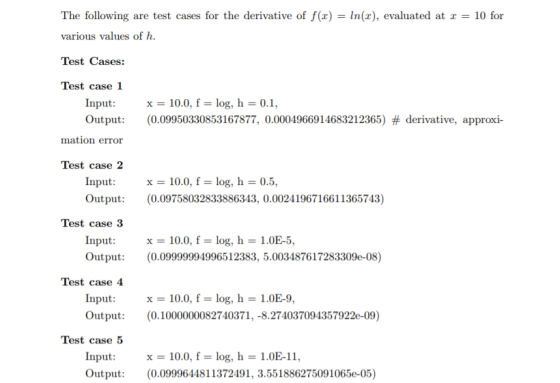
The following are test cases for the derivative of f()In(x), evaluated at r various values of h Test Cases: Test case 1 10 for Input Output: (0.09950330853167877, 0.000496691468321 2365) # derivative, approxi- mation erro Test case 2 x = 10.0, f = log, h = 0.5, Input Output: (0.09758032833886343, 0.0024196716611365743) Test case 3 10.0, f = log, h 1.0E-5, Input Output: (0.09999994996512383, 5.003487617283309e-08) x Test case 4 10.0, f= log, h = 1.0E-9. Input Output: (0.1000000082740371, -8.274037094357922e-09) Test case 5 x-10.0, f= log, h = 1.0E-11, Input Output: (0.0999644811372491, 3.551886275091065e-05)
Homework Answers
Code for the implementation of class Diff:
import math
class Diff:
def __init__(self,f,h=math.exp(-4)):
self.f=f;
self.h=h;
def __call__(self,x):
return (self.f(x+self.h)-self.f(x))/self.h;
----------------------------------------------------
please provide positive feedback if it helped
Add Answer to:
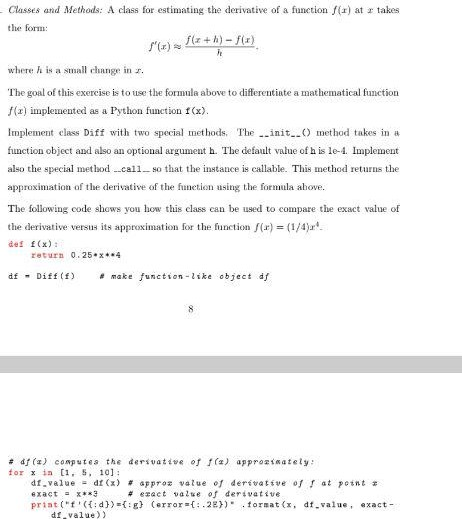
Classes and Methods: A class for estimating the derivative of a function f) at the form: takes wh...
4. (a) A function f has first derivative f (r) - and second derivative f"(z) It is also known that the function f h...
 4. (a) A function f has first derivative f (r) - and second derivative f"(z) It is also known that the function f has r-intercept at (-3,0), and a y-intercept at (0,0) (i) Find all critical points, and use them to identify the intervals over which you will examine the behaviour of the first derivative (ii) Use the f'(x), and the First Derivative Test to classify each critical point. (iii) Use the second derivative to examine the concavity around critical...
Use Mat Lab to write a function called forwarddiff.m that takes data sample locations and function...
 Use Mat Lab to write a function called forwarddiff.m that takes data sample locations and function samplings at those locations as inputs and returns an approximation of the derivative at the sample points based on forward finite difference method with order of accuracy O(h^3). The function should display nothing to the screen unless an error or warning occurs. The detailed specification is as follows: The approximation of derivative by forward difference method (for O(h^3) is given as: f' (x_1) =...
)and second derivative 4. (a) A function f has first derivative f'(x) f(E) It is also known that the function f has...
 )and second derivative 4. (a) A function f has first derivative f'(x) f(E) It is also known that the function f has r-intercept at (-3,0), and a y-intercept at (0, Q) (i) Find all critical points, and use them to identify the intervals over which you will examine the behaviour of the first derivative [3 marks] (ii) Use the f(x), and the First Derivative Test to classify each critical point.[3 marks] (ii) Use the second derivative to examine the concavity...
4. (a) A function f has first derivative f') and second derivative It is also known that the function f has r-i...
 4. (a) A function f has first derivative f') and second derivative It is also known that the function f has r-intercept at (-3,0) and a y-intercept at (0,0) 0) Find all critical points, and use them to identify the intervals over which you will examine the behaviour of the first derivative. (ii) Use the f'(x), and the First Derivative Test to classify each critical point. (ii) Use the second derivative to examine the concavity around critical points that are...
4. (a) A function f has first derivative f' (x) - and second derivative f"(x) It is also known that the functio...
 4. (a) A function f has first derivative f' (x) - and second derivative f"(x) It is also known that the function f has r-intercept at (-3,0), and a y-intercept at (0,0) (i) Find all critical points, and use them to identify the intervals over which you will examine the behaviour of the first derivative. 3 marks] (ii) Use the f'(x), and the First Derivative Test to classify each critical point. 3 marks (iii) Use the second derivative to examine...
4. (a) A function f has first derivative f'(x) and second derivative 2 f" (x) It is also known that the functio...
 4. (a) A function f has first derivative f'(x) and second derivative 2 f" (x) It is also known that the function f has r-intercept at (-3,0), and a y-intercept at (0,0) (i) Find all critical points, and use them to identify the intervals over which you will examine the behaviour of the first derivative. 3 marks] (ii) Use the f(x), and the First Derivative Test to classify each critical point.[3 marks] (iii) Use the second derivative to examine the...
4. (a) A function f has first derivative f'(r) and second derivative It is also known that the function f has r-int...
 4. (a) A function f has first derivative f'(r) and second derivative It is also known that the function f has r-intercept at (-3,0), and a y-intercept at (0, 0) i) Find all critical points, and use them to identify the intervals over which you will examine the behaviour of the first derivative 3 marks (İİ) Úse the f,(x), and the First Derivative Test to classify each critical point. [3 marks] Iİİ) Úse the second derivative to examine the concavity...
write a program to compute an approximate value for the derivative of a function using the...
write a program to compute an approximate value for the derivative of a function using the finite difference formula f ′ (x) ≈ f(x + h) − f(x) h . (2) Test your program using the function sin(x) for x = 1. Determine the error by comparing with the built-in function cos(x). Plot the magnitude of the error as a function of h, for h = 1 2 , 1 4 , 1 8 , . . . You should...
4. The first derivative of a function f(x) at a point x = xo can be approximated with the four-po...
 Solve using MATLAB and provide code please
4. The first derivative of a function f(x) at a point x = xo can be approximated with the four-point central difference formula: dx 12h where h is a small number relative to xo. Write a user-defined function function that calculates the derivative of a math function fx) by using the four-point central difference formula. For the user-defined function name, use dfax-FoPrder(Fun, x0), where Fun is a name for the function that is...
Solve using MATLAB and provide code please
4. The first derivative of a function f(x) at a point x = xo can be approximated with the four-point central difference formula: dx 12h where h is a small number relative to xo. Write a user-defined function function that calculates the derivative of a math function fx) by using the four-point central difference formula. For the user-defined function name, use dfax-FoPrder(Fun, x0), where Fun is a name for the function that is...
question starts at let. than one variable. Let f:R? → R3 be the function given by...
 question starts at let.
than one variable. Let f:R? → R3 be the function given by f(x, y) = (cos(x3 - y2), sin(y2 – x), e3x2-x-2y). (a) Let P be a point in the domain of f. As we saw in class, for (x, y) near P, we have f(x, y) f(P) + (Dpf)(h), where h = (x, y) - P. The expression on the right hand side is called the linear approximation of f around P. Compute the linear...
question starts at let.
than one variable. Let f:R? → R3 be the function given by f(x, y) = (cos(x3 - y2), sin(y2 – x), e3x2-x-2y). (a) Let P be a point in the domain of f. As we saw in class, for (x, y) near P, we have f(x, y) f(P) + (Dpf)(h), where h = (x, y) - P. The expression on the right hand side is called the linear approximation of f around P. Compute the linear...
 4. (a) A function f has first derivative f (r) - and second derivative f"(z) It is also known that the function f has r-intercept at (-3,0), and a y-intercept at (0,0) (i) Find all critical points, and use them to identify the intervals over which you will examine the behaviour of the first derivative (ii) Use the f'(x), and the First Derivative Test to classify each critical point. (iii) Use the second derivative to examine the concavity around critical...
 Use Mat Lab to write a function called forwarddiff.m that takes data sample locations and function samplings at those locations as inputs and returns an approximation of the derivative at the sample points based on forward finite difference method with order of accuracy O(h^3). The function should display nothing to the screen unless an error or warning occurs. The detailed specification is as follows: The approximation of derivative by forward difference method (for O(h^3) is given as: f' (x_1) =...
 )and second derivative 4. (a) A function f has first derivative f'(x) f(E) It is also known that the function f has r-intercept at (-3,0), and a y-intercept at (0, Q) (i) Find all critical points, and use them to identify the intervals over which you will examine the behaviour of the first derivative [3 marks] (ii) Use the f(x), and the First Derivative Test to classify each critical point.[3 marks] (ii) Use the second derivative to examine the concavity...
 4. (a) A function f has first derivative f') and second derivative It is also known that the function f has r-intercept at (-3,0) and a y-intercept at (0,0) 0) Find all critical points, and use them to identify the intervals over which you will examine the behaviour of the first derivative. (ii) Use the f'(x), and the First Derivative Test to classify each critical point. (ii) Use the second derivative to examine the concavity around critical points that are...
 4. (a) A function f has first derivative f' (x) - and second derivative f"(x) It is also known that the function f has r-intercept at (-3,0), and a y-intercept at (0,0) (i) Find all critical points, and use them to identify the intervals over which you will examine the behaviour of the first derivative. 3 marks] (ii) Use the f'(x), and the First Derivative Test to classify each critical point. 3 marks (iii) Use the second derivative to examine...
 4. (a) A function f has first derivative f'(x) and second derivative 2 f" (x) It is also known that the function f has r-intercept at (-3,0), and a y-intercept at (0,0) (i) Find all critical points, and use them to identify the intervals over which you will examine the behaviour of the first derivative. 3 marks] (ii) Use the f(x), and the First Derivative Test to classify each critical point.[3 marks] (iii) Use the second derivative to examine the...
 4. (a) A function f has first derivative f'(r) and second derivative It is also known that the function f has r-intercept at (-3,0), and a y-intercept at (0, 0) i) Find all critical points, and use them to identify the intervals over which you will examine the behaviour of the first derivative 3 marks (İİ) Úse the f,(x), and the First Derivative Test to classify each critical point. [3 marks] Iİİ) Úse the second derivative to examine the concavity...
 Solve using MATLAB and provide code please
4. The first derivative of a function f(x) at a point x = xo can be approximated with the four-point central difference formula: dx 12h where h is a small number relative to xo. Write a user-defined function function that calculates the derivative of a math function fx) by using the four-point central difference formula. For the user-defined function name, use dfax-FoPrder(Fun, x0), where Fun is a name for the function that is...
Solve using MATLAB and provide code please
4. The first derivative of a function f(x) at a point x = xo can be approximated with the four-point central difference formula: dx 12h where h is a small number relative to xo. Write a user-defined function function that calculates the derivative of a math function fx) by using the four-point central difference formula. For the user-defined function name, use dfax-FoPrder(Fun, x0), where Fun is a name for the function that is...
 question starts at let.
than one variable. Let f:R? → R3 be the function given by f(x, y) = (cos(x3 - y2), sin(y2 – x), e3x2-x-2y). (a) Let P be a point in the domain of f. As we saw in class, for (x, y) near P, we have f(x, y) f(P) + (Dpf)(h), where h = (x, y) - P. The expression on the right hand side is called the linear approximation of f around P. Compute the linear...
question starts at let.
than one variable. Let f:R? → R3 be the function given by f(x, y) = (cos(x3 - y2), sin(y2 – x), e3x2-x-2y). (a) Let P be a point in the domain of f. As we saw in class, for (x, y) near P, we have f(x, y) f(P) + (Dpf)(h), where h = (x, y) - P. The expression on the right hand side is called the linear approximation of f around P. Compute the linear...
Most questions answered within 3 hours.
-
Where is the error in this code sequence?
String s1 = "Hello";
String s2 = "ello";...
asked 11 months ago -
Financial data for Joel de Paris, Inc., for last year
follow:
Joel de Paris, Inc.
Balance...
asked 11 months ago -
Consider this reaction:
Al2(SO4)3 (aq)+ BaCl3
(aq) Al2Cl6 (aq)- +
3BaSO4(s) . What is the...
asked 11 months ago -
Suppose that Savneet is considering increasing her
recent random sample from 20 car rentals to 40...
asked 11 months ago -
Trucks arrive at an unloading terminal at an average rate of 120
per hour.
Trucks arrive...
asked 11 months ago -
Why are methanol and ethanol completely soluble in water while
octanol is not very little soluble....
asked 11 months ago -
A facilities manager at a university reads in a research report
that the mean amount of...
asked 11 months ago -
When the CuSO4 is rehydrated by adding water to the anhydrous
compound, is this an endothermic...
asked 11 months ago -
A ray of sunlight is passing from diamond into crown glass; the
angle of incidence is...
asked 11 months ago -
A block of mass 0.249 kg is placed on top of a light, vertical
spring of...
asked 11 months ago -
how do the kidneys compensate in the presences of acidosis
a) trigger hyperventilate
b) reserve acid...
asked 11 months ago -
Question 501 pts
The rental rate of capital to the firm increases. Which of the
following...
asked 11 months ago