show the decomposition reaction of AAPH (2,2' azobis (2-aminodinopropame) dichloride) that results in the formation of...
show the decomposition reaction of AAPH (2,2' azobis (2-aminodinopropame) dichloride) that results in the formation of a radical. this initiates formation of the ABTS (2,2-aziono-bis(3-ethylbenzthiazoline-6suphonic acid) show the structure and explain why the radical is exceptionally stable.
Homework Answers


Add Answer to:
show the decomposition reaction of AAPH (2,2' azobis
(2-aminodinopropame) dichloride) that results in the formation of...
Give the complete mechanism for each reaction. 1. The formation of aspirin. 2. The formation of...
Give the complete mechanism for each reaction. 1. The formation of aspirin. 2. The formation of methyl salicylate from salicylic acid and methanol. 3. The hydrolysis reaction (decomposition) of aspirin.
0112012 WCF4 | 19) When 2,2-dimethylbutane is subjected to free radical chlorination distinct monochlorinated products are...
 0112012 WCF4 | 19) When 2,2-dimethylbutane is subjected to free radical chlorination distinct monochlorinated products are possible and_ _of these contain asymmetric carbon atoms. A) 4,2 B) 5,0 (13,0 D) 5,2 €) 4,0 c 20) Arrange the - cr. ILUULELO 1. Was the major product of this reaction the cis or the trans isomer? Explain. 2. Determine the percent yield of each isomer. (The weight of the other isomer is the difference between the mass of the product and the...
12. (a) Write the structure of Vitamin C (ascorbic acid). [1] (b) Show the structure of...
 12. (a) Write the structure of Vitamin C (ascorbic acid). [1] (b) Show the structure of the specie which exist at pH 7.4. [1] (c) Show how this specie formed reacts with a free radical R.[1] (d) What two products are formed as a result? [1+1] (e) Show (with the help of a chemical equation) why the radical chain reaction does not proceed any further? [1] (1) Explain why Vitamin C acts as a radical scavenger? [1]
Write the mechanism for the formation of Malachite Green from methyl benzoate. Be sure to show...
 Write the mechanism for the formation of Malachite Green from methyl benzoate. Be sure to show all steps, including the loss of water. 1. 2. Write the mechanism for the formation of Crystal violet from diethyl carbonate. 3. Methyl benzoate is an ester, but is technically a carboxylate ester. Diethyl carbonate is a 4. Why is the green dye in this experiment called "Malachite Green"? Hint: Try looking in a 5. Write the balanced equation for the reaction of hydrochloric...
Consider the preparation of an addition polymer by a radical chain reaction Q. 2 (a) Give...
 Consider the preparation of an addition polymer by a radical chain reaction Q. 2 (a) Give the polymers that can be formed from each of the following monomers and show the repeating unit in each case CI OMe (b) Describe the key steps in a radical chain growth polymerisation. What is "head to tail" addition and explain why it preferentially occurs (c) (d) Show the resonance stabilisation for the radical formed where possible for each of the monomers given in...
nzaldehyde via the aldol condensation. 2. What is the role of sodium hydroxide in this reaction?...
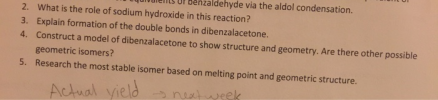 nzaldehyde via the aldol condensation. 2. What is the role of sodium hydroxide in this reaction? 3. Explain formation of the double bonds in dibenzalacetone. 4. Construct a model of dibenzalacetone to show structure and geometry. Are there other possible geometric isomers? 5. Research the most stable isomer based on melting point and geometric structure. cluas vield next week
What type of reaction(s) is this: acid-base, gas formation, Precipitation, Combination,decomposition,redox or single displacement? lotal lonie...
 What type of reaction(s) is this: acid-base, gas formation,
Precipitation, Combination,decomposition,redox or single
displacement?
lotal lonie Equation 2 Al(OH),(6) + [6 H* +359-laq) → [2 AP® +3597-1aq) + 6 H,00) Net Ionic Equation 2 ALCOH)3 (5) + 6H* c992 = 2 A10*caq) + 6 Hz O(l) Reaction Type(s) Unbalanced Chemical Reaction Al, (SO )3(aq) + K,S0(aq) + 24 H,0(l) → 2 KAI(SO )2 · 12 H,0(s) Reaction Type(s)
What type of reaction(s) is this: acid-base, gas formation,
Precipitation, Combination,decomposition,redox or single
displacement?
lotal lonie Equation 2 Al(OH),(6) + [6 H* +359-laq) → [2 AP® +3597-1aq) + 6 H,00) Net Ionic Equation 2 ALCOH)3 (5) + 6H* c992 = 2 A10*caq) + 6 Hz O(l) Reaction Type(s) Unbalanced Chemical Reaction Al, (SO )3(aq) + K,S0(aq) + 24 H,0(l) → 2 KAI(SO )2 · 12 H,0(s) Reaction Type(s)
For the reaction below: Draw the complete electron pushing arrow mechanism to show the formation of...
 For the reaction below: Draw the complete electron pushing arrow mechanism to show the formation of the final product shown. Explain every step of your mechanism. Explain why this is a product favored reaction. ii. H30* H20 OH A
2. [10 pts] Of the following 2-step synthesis, the first step is the reaction utilizing organometallic...
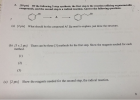 2. [10 pts] Of the following 2-step synthesis, the first step is the reaction utilizing organometallic compounds, and the second step is a radical reaction. Answer the following questions. Br Br (a) [2 pts] What should be the compound A? No need to explain; just draw the structure. (b) [3 x 2 pts] method. There can be three [3] methods for the first step. Show the reagents needed for each (1) (2) (3) Show the reagents needed for the second...
 0112012 WCF4 | 19) When 2,2-dimethylbutane is subjected to free radical chlorination distinct monochlorinated products are possible and_ _of these contain asymmetric carbon atoms. A) 4,2 B) 5,0 (13,0 D) 5,2 €) 4,0 c 20) Arrange the - cr. ILUULELO 1. Was the major product of this reaction the cis or the trans isomer? Explain. 2. Determine the percent yield of each isomer. (The weight of the other isomer is the difference between the mass of the product and the...
 12. (a) Write the structure of Vitamin C (ascorbic acid). [1] (b) Show the structure of the specie which exist at pH 7.4. [1] (c) Show how this specie formed reacts with a free radical R.[1] (d) What two products are formed as a result? [1+1] (e) Show (with the help of a chemical equation) why the radical chain reaction does not proceed any further? [1] (1) Explain why Vitamin C acts as a radical scavenger? [1]
 Write the mechanism for the formation of Malachite Green from methyl benzoate. Be sure to show all steps, including the loss of water. 1. 2. Write the mechanism for the formation of Crystal violet from diethyl carbonate. 3. Methyl benzoate is an ester, but is technically a carboxylate ester. Diethyl carbonate is a 4. Why is the green dye in this experiment called "Malachite Green"? Hint: Try looking in a 5. Write the balanced equation for the reaction of hydrochloric...
 Consider the preparation of an addition polymer by a radical chain reaction Q. 2 (a) Give the polymers that can be formed from each of the following monomers and show the repeating unit in each case CI OMe (b) Describe the key steps in a radical chain growth polymerisation. What is "head to tail" addition and explain why it preferentially occurs (c) (d) Show the resonance stabilisation for the radical formed where possible for each of the monomers given in...
 nzaldehyde via the aldol condensation. 2. What is the role of sodium hydroxide in this reaction? 3. Explain formation of the double bonds in dibenzalacetone. 4. Construct a model of dibenzalacetone to show structure and geometry. Are there other possible geometric isomers? 5. Research the most stable isomer based on melting point and geometric structure. cluas vield next week
 What type of reaction(s) is this: acid-base, gas formation,
Precipitation, Combination,decomposition,redox or single
displacement?
lotal lonie Equation 2 Al(OH),(6) + [6 H* +359-laq) → [2 AP® +3597-1aq) + 6 H,00) Net Ionic Equation 2 ALCOH)3 (5) + 6H* c992 = 2 A10*caq) + 6 Hz O(l) Reaction Type(s) Unbalanced Chemical Reaction Al, (SO )3(aq) + K,S0(aq) + 24 H,0(l) → 2 KAI(SO )2 · 12 H,0(s) Reaction Type(s)
What type of reaction(s) is this: acid-base, gas formation,
Precipitation, Combination,decomposition,redox or single
displacement?
lotal lonie Equation 2 Al(OH),(6) + [6 H* +359-laq) → [2 AP® +3597-1aq) + 6 H,00) Net Ionic Equation 2 ALCOH)3 (5) + 6H* c992 = 2 A10*caq) + 6 Hz O(l) Reaction Type(s) Unbalanced Chemical Reaction Al, (SO )3(aq) + K,S0(aq) + 24 H,0(l) → 2 KAI(SO )2 · 12 H,0(s) Reaction Type(s)
 For the reaction below: Draw the complete electron pushing arrow mechanism to show the formation of the final product shown. Explain every step of your mechanism. Explain why this is a product favored reaction. ii. H30* H20 OH A
 2. [10 pts] Of the following 2-step synthesis, the first step is the reaction utilizing organometallic compounds, and the second step is a radical reaction. Answer the following questions. Br Br (a) [2 pts] What should be the compound A? No need to explain; just draw the structure. (b) [3 x 2 pts] method. There can be three [3] methods for the first step. Show the reagents needed for each (1) (2) (3) Show the reagents needed for the second...
Most questions answered within 3 hours.
-
Where is the error in this code sequence?
String s1 = "Hello";
String s2 = "ello";...
asked 11 months ago -
Financial data for Joel de Paris, Inc., for last year
follow:
Joel de Paris, Inc.
Balance...
asked 11 months ago -
Consider this reaction:
Al2(SO4)3 (aq)+ BaCl3
(aq) Al2Cl6 (aq)- +
3BaSO4(s) . What is the...
asked 11 months ago -
Suppose that Savneet is considering increasing her
recent random sample from 20 car rentals to 40...
asked 11 months ago -
Trucks arrive at an unloading terminal at an average rate of 120
per hour.
Trucks arrive...
asked 11 months ago -
Why are methanol and ethanol completely soluble in water while
octanol is not very little soluble....
asked 11 months ago -
A facilities manager at a university reads in a research report
that the mean amount of...
asked 11 months ago -
When the CuSO4 is rehydrated by adding water to the anhydrous
compound, is this an endothermic...
asked 11 months ago -
A ray of sunlight is passing from diamond into crown glass; the
angle of incidence is...
asked 11 months ago -
A block of mass 0.249 kg is placed on top of a light, vertical
spring of...
asked 11 months ago -
how do the kidneys compensate in the presences of acidosis
a) trigger hyperventilate
b) reserve acid...
asked 11 months ago -
Question 501 pts
The rental rate of capital to the firm increases. Which of the
following...
asked 11 months ago