2. Let Σ={0,1}be the alphabet for this part. Draw an FSM bubble diagram which accepts the...
2. Let Σ={0,1}be the alphabet for this part. Draw an FSM bubble diagram which accepts the language of all binary strings which represent integers evenly divisible by 3. Thus, your machine should accept 0, 11, 110, 1001, 1100, 1111, 10010, etc. We won't be fussy about leading 0's on your integers, so you have the option to accept or reject 00, 011, and also empty string {?}.
Homework Answers

Add Answer to:
2. Let Σ={0,1}be the alphabet for this part. Draw an FSM bubble
diagram which accepts the...
Draw a DFA which accepts the following language over the alphabet of {0,1}: the set of...
Draw a DFA which accepts the following language over the alphabet of {0,1}: the set of all strings such that there are two consecutive 0s or the number of 1s is not divisible by 5. Your DFA must handle all intput strings in {0,1}*. (Hint: look at solution of previous question)
Part B - Automata Construction Draw a DFA which accepts the following language over the alphabet...
Part B - Automata Construction Draw a DFA which accepts the following language over the alphabet of {0,1}: the set of all strings such that the number of 0s is divisible by 2 and the number of 1s is divisible by 5. Your DFA must handle all intput strings in {0,1}*. Here is a methodical way to do this: Figure out all the final states and label each with the shortest string it accepts, work backwards from these states to...
Draw a DFA which accepts the following language over the alphabet of {0,1}: the set of...
Draw a DFA which accepts the following language over the alphabet of {0,1}: the set of all strings such that there are no consecutive 0s, and the number of 1s is divisible by 5. Your DFA must handle all intput strings in {0,1}*. Here is a way to approach the problem: First focus only building the DFA which accepts the language: As you build your DFA, label your states with an explanation of what the state actually represents in terms...
Can you please thoroughly explain part B? Let Σ {0,1} be an alphabet. Suppose the language...
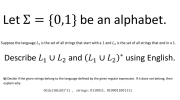 Can you please thoroughly explain part B?
Let Σ {0,1} be an alphabet. Suppose the language Ly is the set of all strings that start with a 1 and L2 is the set of all strings that end in a 1. Describe Lj U L2 and (L1 UL2)* using English. b) Decide if the given strings belong to the language defined by the given regular expression. If it does not belong, then explain why. 0(1|€)10(e|0)*11 , strings: 0110011, 0100011001111
Can you please thoroughly explain part B?
Let Σ {0,1} be an alphabet. Suppose the language Ly is the set of all strings that start with a 1 and L2 is the set of all strings that end in a 1. Describe Lj U L2 and (L1 UL2)* using English. b) Decide if the given strings belong to the language defined by the given regular expression. If it does not belong, then explain why. 0(1|€)10(e|0)*11 , strings: 0110011, 0100011001111
 Can you please thoroughly explain part B?
Let Σ {0,1} be an alphabet. Suppose the language Ly is the set of all strings that start with a 1 and L2 is the set of all strings that end in a 1. Describe Lj U L2 and (L1 UL2)* using English. b) Decide if the given strings belong to the language defined by the given regular expression. If it does not belong, then explain why. 0(1|€)10(e|0)*11 , strings: 0110011, 0100011001111
Can you please thoroughly explain part B?
Let Σ {0,1} be an alphabet. Suppose the language Ly is the set of all strings that start with a 1 and L2 is the set of all strings that end in a 1. Describe Lj U L2 and (L1 UL2)* using English. b) Decide if the given strings belong to the language defined by the given regular expression. If it does not belong, then explain why. 0(1|€)10(e|0)*11 , strings: 0110011, 0100011001111
Most questions answered within 3 hours.
-
Where is the error in this code sequence?
String s1 = "Hello";
String s2 = "ello";...
asked 11 months ago -
Financial data for Joel de Paris, Inc., for last year
follow:
Joel de Paris, Inc.
Balance...
asked 11 months ago -
Consider this reaction:
Al2(SO4)3 (aq)+ BaCl3
(aq) Al2Cl6 (aq)- +
3BaSO4(s) . What is the...
asked 11 months ago -
Suppose that Savneet is considering increasing her
recent random sample from 20 car rentals to 40...
asked 11 months ago -
Trucks arrive at an unloading terminal at an average rate of 120
per hour.
Trucks arrive...
asked 11 months ago -
Why are methanol and ethanol completely soluble in water while
octanol is not very little soluble....
asked 11 months ago -
A facilities manager at a university reads in a research report
that the mean amount of...
asked 11 months ago -
When the CuSO4 is rehydrated by adding water to the anhydrous
compound, is this an endothermic...
asked 11 months ago -
A ray of sunlight is passing from diamond into crown glass; the
angle of incidence is...
asked 11 months ago -
A block of mass 0.249 kg is placed on top of a light, vertical
spring of...
asked 11 months ago -
how do the kidneys compensate in the presences of acidosis
a) trigger hyperventilate
b) reserve acid...
asked 11 months ago -
Question 501 pts
The rental rate of capital to the firm increases. Which of the
following...
asked 11 months ago