Perfectly Competitive Market Model a. Draw a diagram depicting the perfectly competitive market for aspirin. b....
Perfectly Competitive Market Model
a. Draw a diagram depicting the perfectly competitive market for aspirin.
b. Identify the equilibrium price and quantity.
c. Define consumer surplus. Identify the area of consumer surplus of the graph, provide reference points, and label it.
Homework Answers

Add Answer to:
Perfectly Competitive Market Model
a. Draw a diagram depicting the perfectly competitive market for
aspirin.
b....
The perfectly competitive firm and market in the short run Consider a perfectly competitive market where...
The perfectly competitive firm and market in the short run Consider a perfectly competitive market where demand is QD = 2,000 - 40P and quantity is measured in units while price is measured in dollars per unit. The long run supply is QS = 100P - 800. a) Find the equilibrium price and the equilibrium quantity. b) When the market is in equilibrium, what is the total expenditure in this market? c) When the market is in equilibrium, what is...
4. The diagram below shows supply and demand in a perfectly competitive local market for cubic...
 4. The diagram below shows supply and demand in a perfectly competitive local market for cubic metres (m3) of garden soil. Price is per LLL LLD 10 20 30 40 50 60 70 NO90 100 110 120 Quantity (m' day) a. At the equilibrium market price, determine the following values: - total revenue received by sellers -consumer surplus producer surplus total economic surplus b. Now suppose that sellers in this market cooperate and restrict their total output to 30m3 per...
DEMAND & SUPPLY: Consider the market for bananas which is known to be perfectly competitive. The...
DEMAND & SUPPLY: Consider the market for bananas which is known to be perfectly competitive. The market is characterized by the following relationships: QD = 10,000 – 140P QS = 7500 + 125P Plot the demand curve and the supply curve on a graph. Clearly label the axes and the intercepts. Why is the demand-curve downward-sloping? What is the slope of the demand curve? Why is the supply-curve upward-sloping? What is the slope of the supply curve? What is the...
Draw and label a graph depicting world trade in which the world price is perfectly elastic...
Draw and label a graph depicting world trade in which the world price is perfectly elastic and higher than the country price. Start with a graph depicting market equilibrium with the demand curve and supply curves having slopes of approximately 1 (negative 1 for demand). Modify the graph to demonstrate the world market price being lower than the country market price.
The graph shows the consumer surplus for a perfectly competitive industry. The industry is taken over...
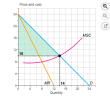 The graph shows the consumer surplus for a perfectly competitive
industry.
The industry is taken over by a monopoly.
Draw the new consumer surplus. Label it
CS1.
Draw and label the consumer surplus that is
transferred to the monopoly. Label it monopoly's
gain.
Price and cost MSC MR 14 12 16 20 24 Quantity
The graph shows the consumer surplus for a perfectly competitive
industry.
The industry is taken over by a monopoly.
Draw the new consumer surplus. Label it
CS1.
Draw and label the consumer surplus that is
transferred to the monopoly. Label it monopoly's
gain.
Price and cost MSC MR 14 12 16 20 24 Quantity
Problem 1: a. Draw a situation where a perfectly competitive firm is making a loss, make sure to label loss. When should the firm shut down? (Make sure to include a market diagram). b. State and draw...
Problem 1: a. Draw a situation where a perfectly competitive firm is making a loss, make sure to label loss. When should the firm shut down? (Make sure to include a market diagram). b. State and draw a graph explaining the long run equilibrium in a perfectly competitive market. Why does the market come to rest at this point? Explain.
Draw a perfectly competitive market disequilibrium position. If the market moves from disequilibrium to equilibrium, what...
Draw a perfectly competitive market disequilibrium position. If the market moves from disequilibrium to equilibrium, what happens to consumer and producer surplus?
3) Assume that the market for energy efficient window installations in San Diego is perfectly competitive. Quarterly inverse supply and inverse demand are: P 1200 3Q (Private MB) P 440Qs (Private...
 3) Assume that the market for energy efficient window installations in San Diego is perfectly competitive. Quarterly inverse supply and inverse demand are: P 1200 3Q (Private MB) P 440Qs (Private MC) neighbors (lowering the overall price of electricity, reducing pollution, and so on) These external benefits to consumers are estimated to be EMB 2Q (the more windows installed, the more external benefit to installing more windows). a) Find the equilibrium price and quantity that will be produced in a...
Draw and label a graph depicting a monopolistic market from the perspective of a single firm....
Draw and label a graph depicting a monopolistic market from the perspective of a single firm. Make sure you illustrate the profit maximizing price and quantity . Start with a graph depicting market equilibrium for the monopolistic market . Modify the graph to demonstrate that the price at the profit maximizing level of output is below the average variable cost curve . Discuss the following characteristics of a the firm depicted in part 1 : Is the firm making a...
Consider an economy where rice is the staple food and the rice market is perfectly competitive....
Consider an economy where rice is the staple food and the rice market is perfectly competitive. Initially the consumers paid the market equilibrium price for rice. (i) Using a diagram for the rice market, analyse the market equilibrium, the consumer surplus and the producer surplus. Your diagram needs to have a proper shape of the demand and supply curve that correctly reflects the demand and supply elasticities.
 4. The diagram below shows supply and demand in a perfectly competitive local market for cubic metres (m3) of garden soil. Price is per LLL LLD 10 20 30 40 50 60 70 NO90 100 110 120 Quantity (m' day) a. At the equilibrium market price, determine the following values: - total revenue received by sellers -consumer surplus producer surplus total economic surplus b. Now suppose that sellers in this market cooperate and restrict their total output to 30m3 per...
 The graph shows the consumer surplus for a perfectly competitive
industry.
The industry is taken over by a monopoly.
Draw the new consumer surplus. Label it
CS1.
Draw and label the consumer surplus that is
transferred to the monopoly. Label it monopoly's
gain.
Price and cost MSC MR 14 12 16 20 24 Quantity
The graph shows the consumer surplus for a perfectly competitive
industry.
The industry is taken over by a monopoly.
Draw the new consumer surplus. Label it
CS1.
Draw and label the consumer surplus that is
transferred to the monopoly. Label it monopoly's
gain.
Price and cost MSC MR 14 12 16 20 24 Quantity
 3) Assume that the market for energy efficient window installations in San Diego is perfectly competitive. Quarterly inverse supply and inverse demand are: P 1200 3Q (Private MB) P 440Qs (Private MC) neighbors (lowering the overall price of electricity, reducing pollution, and so on) These external benefits to consumers are estimated to be EMB 2Q (the more windows installed, the more external benefit to installing more windows). a) Find the equilibrium price and quantity that will be produced in a...
Most questions answered within 3 hours.
-
Where is the error in this code sequence?
String s1 = "Hello";
String s2 = "ello";...
asked 10 months ago -
Financial data for Joel de Paris, Inc., for last year
follow:
Joel de Paris, Inc.
Balance...
asked 10 months ago -
Consider this reaction:
Al2(SO4)3 (aq)+ BaCl3
(aq) Al2Cl6 (aq)- +
3BaSO4(s) . What is the...
asked 10 months ago -
Suppose that Savneet is considering increasing her
recent random sample from 20 car rentals to 40...
asked 10 months ago -
Trucks arrive at an unloading terminal at an average rate of 120
per hour.
Trucks arrive...
asked 10 months ago -
Why are methanol and ethanol completely soluble in water while
octanol is not very little soluble....
asked 10 months ago -
A facilities manager at a university reads in a research report
that the mean amount of...
asked 10 months ago -
When the CuSO4 is rehydrated by adding water to the anhydrous
compound, is this an endothermic...
asked 10 months ago -
A ray of sunlight is passing from diamond into crown glass; the
angle of incidence is...
asked 10 months ago -
A block of mass 0.249 kg is placed on top of a light, vertical
spring of...
asked 10 months ago -
how do the kidneys compensate in the presences of acidosis
a) trigger hyperventilate
b) reserve acid...
asked 10 months ago -
Question 501 pts
The rental rate of capital to the firm increases. Which of the
following...
asked 10 months ago