Problem 1: a. Draw a situation where a perfectly competitive firm is making a loss, make sure to label loss. When should the firm shut down? (Make sure to include a market diagram). b. State and draw...
Problem 1:
a. Draw a situation where a perfectly competitive firm is making a loss, make sure to label loss. When should the firm shut down? (Make sure to include a market diagram).
b. State and draw a graph explaining the long run equilibrium in a perfectly competitive market. Why does the market come to rest at this point? Explain.
Homework Answers
a)
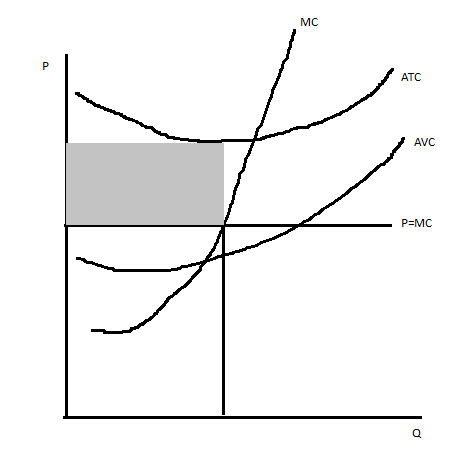
The firm in the perfectly competitive market will produce by setting P=MC at which ATC is more than the price so the firm is making losses, however, since the P>minimum AVC,the firm will continue to produce. The shaded region represents the loss.The firm will shut down when the price falls down below the minimum AVC.
b)
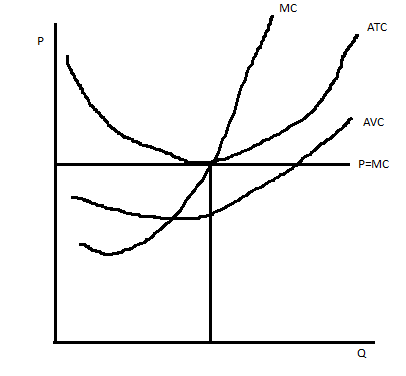
In the long run,since the firms are making losses,some firms will exit the market in the long run which will decrease the supply and increase the price to the minimum of ATC so,the P=MC=ATC in the long run and all the firms will breakeven and earn zero profits in the long run.
Add Answer to:
Problem 1: a. Draw a situation where a perfectly competitive firm is making a loss, make sure to label loss. When should the firm shut down? (Make sure to include a market diagram). b. State and draw...
Problem 1: a. Draw a situation where a perfectly competitive firm is making a loss, make...
Problem 1: a. Draw a situation where a perfectly competitive firm is making a loss, make sure to label loss. When should the firm shut down? (Make sure to include a market diagram). b. State and draw a graph explaining the long run equilibrium in a perfectly competitive market. Why does the market come to rest at this point? Explain.
Name 1. Describe a perfectly competitive market structure in terms of number of firms, ease of...
 Name 1. Describe a perfectly competitive market structure in terms of number of firms, ease of entry a and product differentiation. 2. Draw the short-ran cost and revenue curves for a firm making an economic profit in a perfectly petitive industry. Show the firm's short-run supply curve. 3. Why might a firm continue to produce at a loss in the short na instead of shutting down? a perfectly competitive firm will make an economie profit in the short b. fP-...
2.A. Draw a perfectly competitive firm in the soybean market, in a short run equilibrium. Identify...
2.A. Draw a perfectly competitive firm in the soybean market, in a short run equilibrium. Identify the market price, MR, Total Revenue, Total Cost Variable Cost, and Fixed Cost. B. For your diagram(s), is the firm earning, a profit or a loss (identify it)? C. Explain, and show this market will move toward a long run equilibrium, state any needed assumptions.
Perfectly Competitive Market Model a. Draw a diagram depicting the perfectly competitive market for aspirin. b....
Perfectly Competitive Market Model a. Draw a diagram depicting the perfectly competitive market for aspirin. b. Identify the equilibrium price and quantity. c. Define consumer surplus. Identify the area of consumer surplus of the graph, provide reference points, and label it.
Question 2: Consider a firm in a perfectly competitive market that should produce a positive quantity...
Question 2: Consider a firm in a perfectly competitive market that should produce a positive quantity in the short-run, but is still earning a loss. A.) Draw the cost curves (ATC, AVC, MC, MR) for the firm. Clearly label the quantity this firm would produce. Label the loss the firm would incur. B.) Briefly explain why the MR looks the way it does and why you placed it where you did on your diagram. (How do we determine MR for...
8. In the short run, a perfectly competitive firm will shut down if it is producing...
 8. In the short run, a perfectly competitive firm will shut down if it is producing a level of output where marginal revenue is equal to short-run marginal cost and price is A. Greater than average total cost. B. Less than average total cost. C. Greater than average variable cost. D. Less than average variable cost E. None of the above 10. Given your answer to Question 8, what can you say about Hanna's firm: A. It should continue operating...
Draw and label a graph depicting a monopolistic market from perspective of a single firm. Make...
Draw and label a graph depicting a monopolistic market from perspective of a single firm. Make sure you illustrate the profit maximizing price and quantity. a. Start with a graph depicting market equilibrium for the monopolistic market b. Modify the graph to demonstrate that the price at the profit maximizing level of output is above the average variable cost curve,but below the average cost curve c. Is the firm making a profit or loss? d. Will the firm decide to...
a) Using both market and firm graphs for a perfectly competitive industry, show the effect of...
a) Using both market and firm graphs for a perfectly competitive industry, show the effect of an increase in consumers’ income taxes. Assume the representative firm and market begin in long run equilibrium. Illustrate the short run effect on price, output, and profits, assuming this firm does not shut down. Label your graphs and explain your answer. b) Assuming the representative firm does not withdraw from the market, show the long run effect on price, output, and profits. Label your...
2. A perfectly competitive potato farm is currently in long run equilibrium. a. Graph the firm...
2. A perfectly competitive potato farm is currently in long run equilibrium. a. Graph the firm in long run equilibrium. Be sure to label all of the curves and the profit maximizing price and quantity. b. The demand for potatoes increases. Draw a new graph that shows the impact on an individual firm. Be sure to shade the area of loss or profit. c. Draw a new graph that shows how the firm and the industry adjusts to a new...
QUESTION 1 Consider a firm in a perfectly competitive market that faces the situation depicted in...
 QUESTION 1 Consider a firm in a perfectly competitive market that faces the situation depicted in the figure below: MC AC Vhat should the firm do? Sit on some short term economic profits and wait for the market price to adjust downward. Nothing. The market is in equilibrium. Wait out the temporary losses, but still produce in hopes that other firms drop out of the market. Shut down temporarily and wait for better economic conditions.
 Name 1. Describe a perfectly competitive market structure in terms of number of firms, ease of entry a and product differentiation. 2. Draw the short-ran cost and revenue curves for a firm making an economic profit in a perfectly petitive industry. Show the firm's short-run supply curve. 3. Why might a firm continue to produce at a loss in the short na instead of shutting down? a perfectly competitive firm will make an economie profit in the short b. fP-...
 8. In the short run, a perfectly competitive firm will shut down if it is producing a level of output where marginal revenue is equal to short-run marginal cost and price is A. Greater than average total cost. B. Less than average total cost. C. Greater than average variable cost. D. Less than average variable cost E. None of the above 10. Given your answer to Question 8, what can you say about Hanna's firm: A. It should continue operating...
 QUESTION 1 Consider a firm in a perfectly competitive market that faces the situation depicted in the figure below: MC AC Vhat should the firm do? Sit on some short term economic profits and wait for the market price to adjust downward. Nothing. The market is in equilibrium. Wait out the temporary losses, but still produce in hopes that other firms drop out of the market. Shut down temporarily and wait for better economic conditions.
Most questions answered within 3 hours.
-
Where is the error in this code sequence?
String s1 = "Hello";
String s2 = "ello";...
asked 11 months ago -
Financial data for Joel de Paris, Inc., for last year
follow:
Joel de Paris, Inc.
Balance...
asked 11 months ago -
Consider this reaction:
Al2(SO4)3 (aq)+ BaCl3
(aq) Al2Cl6 (aq)- +
3BaSO4(s) . What is the...
asked 11 months ago -
Suppose that Savneet is considering increasing her
recent random sample from 20 car rentals to 40...
asked 11 months ago -
Trucks arrive at an unloading terminal at an average rate of 120
per hour.
Trucks arrive...
asked 11 months ago -
Why are methanol and ethanol completely soluble in water while
octanol is not very little soluble....
asked 11 months ago -
A facilities manager at a university reads in a research report
that the mean amount of...
asked 11 months ago -
When the CuSO4 is rehydrated by adding water to the anhydrous
compound, is this an endothermic...
asked 11 months ago -
A ray of sunlight is passing from diamond into crown glass; the
angle of incidence is...
asked 11 months ago -
A block of mass 0.249 kg is placed on top of a light, vertical
spring of...
asked 11 months ago -
how do the kidneys compensate in the presences of acidosis
a) trigger hyperventilate
b) reserve acid...
asked 11 months ago -
Question 501 pts
The rental rate of capital to the firm increases. Which of the
following...
asked 11 months ago