Suppose that an investor with a 3-year investment horizon is considering purchasing a seven-year 6% coupon...
Suppose that an investor with a 3-year investment horizon is considering purchasing a seven-year 6% coupon bond selling at par (semi-annual coupon payments). The investor expects that she can reinvest the coupon payments at an annual interest rate of 8% and that at the end of the investment horizon all bonds will be selling to offer a yield to maturity of 5%. What is the (annualized) expected holding period return for this bond?
Homework Answers
=(((1000*3%/4%*(1.04^6-1)+1000*3%/2.5%*(1-1/1.025^8)+1000/1.025^8)/(1000))-1)*1/3
=7.83%
Add Answer to:
Suppose that an investor with a 3-year investment horizon is
considering purchasing a seven-year 6% coupon...
Suppose that an investor with a 3-year investment horizon is considering buying an 8-year 6% coupon...
Suppose that an investor with a 3-year investment horizon is considering buying an 8-year 6% coupon bond selling at par (semi-annual coupon payments). The investor expects that she can reinvest the coupin payments at an annual interest rate of 7% and that at the end of the investment horizon all bonds will be selling to offer a YTM of 9%. What is the (annualized) expected holding period return for this bond?
Suppose that an investor with a 10-year investment horizon is considering purchasing Bond A, a 15-year...
Suppose that an investor with a 10-year investment horizon is considering purchasing Bond A, a 15-year 8% semiannual coupon bond selling at par. The investor expects to be able to reinvest the coupon payments at a rate of 7.4% over the first six years and then at a rate of 7.8% over the subsequent four years, and that at the end of the investment horizon, similar 5-year 8% semiannual coupon bonds will be selling to offer a yield of 7%...
3. An investor with a 5-year investment horizon is considering the purchase of 30-year 6%coupon bond...
 3. An investor with a 5-year investment horizon is considering the purchase of 30-year 6%coupon bond selling for $850 and a par value of $1000. The vield to maturity for the bond is 7.2%. Suppose the investor faces a reinvestment rate of 5% per year and anticipates selling the bond in 5 years to yield 6% on the 25-year remaining maturity in 5 years. Calculate his total return from the investment. (17 pt.)
#5. Suppose that we invest in a bond with a 3-year horizon. We consider purchasing a...
#5. Suppose that we invest in a bond with a 3-year horizon. We consider purchasing a bond with the face value of $1,000, the maturity of 20 years, and the coupon rate of 8%. The bond pays the coupons semi-annually. The price of the bond is $907.99 and the YTM is 9%. We expect that we can reinvest the coupon payments at an annual rate of 6%. At the end of the horizon, the 17-year bond will be selling to...
An investor is considering purchasing a 20-year 7% coupon bond selling for $816 and a par...
An investor is considering purchasing a 20-year 7% coupon bond selling for $816 and a par value of $1,000. Calculate the interest on interest from the bond assuming that the semi-annual coupon payments can be reinvested at 4½% every six months.
An investor is considering the purchase of a 20-year 7% coupon bond selling for $816 and...
An investor is considering the purchase of a 20-year 7% coupon bond selling for $816 and a par value of $1,000. The yield to maturity for this bond is 9%. Assume the investor’s horizon is 15 years. Market participants expect the yield rate for comparable issues to be 10% for the first 10 years and 6% for years 11 to 20. 1. What is the projected sale price at the end of five years? 2. What is total coupon payments...
An investor is considering the purchase of a 20-year 7% coupon bond selling for $816 and...
An investor is considering the purchase of a 20-year 7% coupon bond selling for $816 and a par value of $1,000. The yield to maturity for this bond is 9%. Assume the investor’s horizon is 15 years. Market participants expect the yield rate for comparable issues to be 10% for the first 10 years and 6% for years 11 to 20. 1. What is the projected sale price at the end of 15 years? 2. What is total coupon payments...
Coupon is paid semi-annually and your investment horizon is 1.5 years. A) What is the modified...
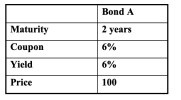 Coupon is paid semi-annually and your
investment horizon is 1.5 years. A) What is the modified duration
of this bond? B) What is the convexity of this bond? C) If the
yield after 6 months is expected to fall to 5.5% and then to 4.5%
from the beginning of year 2, what would be your holding period
return, price appreciation/depreciation, re-investment income and
coupon income from this bond?
Bond A Maturity Coupon Yield 2 years 6% 6% Price 100
Coupon is paid semi-annually and your
investment horizon is 1.5 years. A) What is the modified duration
of this bond? B) What is the convexity of this bond? C) If the
yield after 6 months is expected to fall to 5.5% and then to 4.5%
from the beginning of year 2, what would be your holding period
return, price appreciation/depreciation, re-investment income and
coupon income from this bond?
Bond A Maturity Coupon Yield 2 years 6% 6% Price 100
An investor is considering purchasing a bond with a 7.45 percent coupon interest rate, a par...
An investor is considering purchasing a bond with a 7.45 percent coupon interest rate, a par value of $1,000, and a market price of $1,033.31. The bond will mature in nine years. Based on this information, answer the followingquestions: a. What is the bond's current yield? b. What is the bond's approximate yield to maturity? c. What is the bond's yield to maturity using a financial calculator? Note: Assume coupon payments are paid annually a. The bond's current yield is...
1. An investor purchases an annual coupon bond with a 6% coupon rate and exactly 20...
1. An investor purchases an annual coupon bond with a 6% coupon rate and exactly 20 years remaining until maturity at a price equal to par value. The investor’s investment horizon is eight years. The approximate modified duration of the bond is 11.470 years. What is the duration gap at the time of purchase? (Hint: use approximate Macaulay duration to calculate the duration gap) 2. An investor plans to retire in 10 years. As part of the retirement portfolio, the...
 3. An investor with a 5-year investment horizon is considering the purchase of 30-year 6%coupon bond selling for $850 and a par value of $1000. The vield to maturity for the bond is 7.2%. Suppose the investor faces a reinvestment rate of 5% per year and anticipates selling the bond in 5 years to yield 6% on the 25-year remaining maturity in 5 years. Calculate his total return from the investment. (17 pt.)
 Coupon is paid semi-annually and your
investment horizon is 1.5 years. A) What is the modified duration
of this bond? B) What is the convexity of this bond? C) If the
yield after 6 months is expected to fall to 5.5% and then to 4.5%
from the beginning of year 2, what would be your holding period
return, price appreciation/depreciation, re-investment income and
coupon income from this bond?
Bond A Maturity Coupon Yield 2 years 6% 6% Price 100
Coupon is paid semi-annually and your
investment horizon is 1.5 years. A) What is the modified duration
of this bond? B) What is the convexity of this bond? C) If the
yield after 6 months is expected to fall to 5.5% and then to 4.5%
from the beginning of year 2, what would be your holding period
return, price appreciation/depreciation, re-investment income and
coupon income from this bond?
Bond A Maturity Coupon Yield 2 years 6% 6% Price 100
Most questions answered within 3 hours.
-
Where is the error in this code sequence?
String s1 = "Hello";
String s2 = "ello";...
asked 11 months ago -
Financial data for Joel de Paris, Inc., for last year
follow:
Joel de Paris, Inc.
Balance...
asked 11 months ago -
Consider this reaction:
Al2(SO4)3 (aq)+ BaCl3
(aq) Al2Cl6 (aq)- +
3BaSO4(s) . What is the...
asked 11 months ago -
Suppose that Savneet is considering increasing her
recent random sample from 20 car rentals to 40...
asked 11 months ago -
Trucks arrive at an unloading terminal at an average rate of 120
per hour.
Trucks arrive...
asked 11 months ago -
Why are methanol and ethanol completely soluble in water while
octanol is not very little soluble....
asked 11 months ago -
A facilities manager at a university reads in a research report
that the mean amount of...
asked 11 months ago -
When the CuSO4 is rehydrated by adding water to the anhydrous
compound, is this an endothermic...
asked 11 months ago -
A ray of sunlight is passing from diamond into crown glass; the
angle of incidence is...
asked 11 months ago -
A block of mass 0.249 kg is placed on top of a light, vertical
spring of...
asked 11 months ago -
how do the kidneys compensate in the presences of acidosis
a) trigger hyperventilate
b) reserve acid...
asked 11 months ago -
Question 501 pts
The rental rate of capital to the firm increases. Which of the
following...
asked 11 months ago