Developmental Psychology: Provide two shapes of idealized developmental change and an example of each.
Developmental Psychology:
Provide two shapes of idealized developmental change and an example of each.
Homework Answers
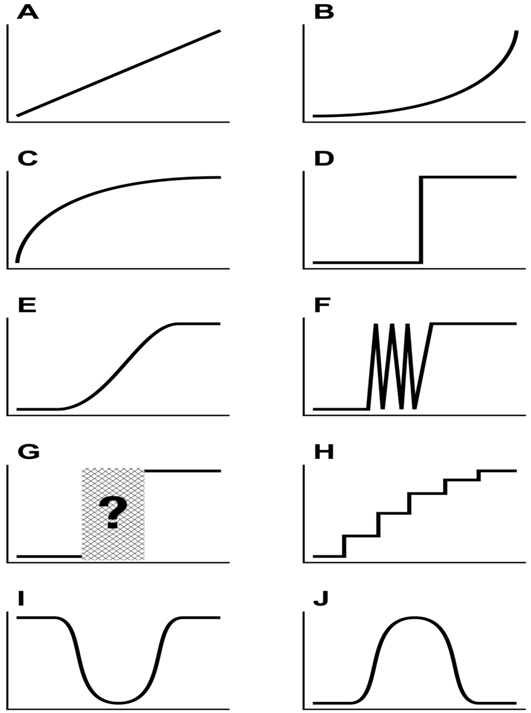
Idealized shapes of developmental change, with age shown on the X-axis and an index of behavioral expression or level of performance on the Y-axis. (a) Linear, (b) Accelerating, (c) Asymptotic, (d) Step-like, (e) S-shaped, (f), Variable, (g) Unsystematic, (h) Stair-climbing, (i) U-shaped, (j) Inverted-U-shaped.
Few examples of developmental research have systematically assessed the empirical costs and benefits of large and small sampling intervals on descriptions of developmental change. Anotable exception is Lampl and colleagues’ research on patterns of physical growth (Johnson,Veldhuis, & Lampl, 1996; Lampl, Johnson, & Frongillo, 2001; Lampl, Veldhuis, & Johnson,1992). Traditionally, children’s growth is characterized as a continuous function from birth to adulthood, with more rapid growth rates during infancy and adolescence. However, when children’s height is measured every day, growth appears to be episodic. Infants’ height, for example, can increase 1.65 cm in the course of a single day, separated by long periods of days or weeks during which no growth occurs. Sampling at weekly intervals results in developmental trajectories that preserve the episodic nature of children’s growth but reduce the observed number of growth spurts, increase the amplitude of the spurts, and prolong the periods of stasis.And sampling at quarterly or yearly intervals, as in traditional studies of growth, results in the smooth, continuous growth curves on standard growth charts.Even within a 24-hour period, growth is not continuous. In a tour de force of micro-measurement, Lampl and colleagues (Noonan et al., 2004) demonstrated episodic growth on two time scales: brief periods of substantial growth on a scale of minutes and days, flanked by long periods of no growth on an hourly and weekly scale. Leg growth in freely moving lambs was measured with a micro transducer surgically implanted across the tibial growth plate. Bonelength was sampled at 167-sec intervals over a period of 3 weeks, synchronized with video recordings of the lambs’ activity. Periods of bone growth revealed by the micro transducercoincided with periods of recumbency revealed by the video recordings, and periods when bones did not grow coincided with periods of loading the limbs in stance or locomotion. Theauthors calculated that 90% of bone growth occurs while lying down, even though lambs spend just over 50% of their time in a recumbent position, and little or no growth occurs while standing or walking. Clearly, tradition, intuition, and convenience that informed traditional studies of physical growth have been inadequate for capturing the richness of the actual trajectory.The case of physical growth shows how increased sampling resolution from years to days to minutes can provide novel insights into developmental process. The episodic growth pattern from minute to minute indicates that bones lengthen only when compressive forces on the leg are absent. Paradoxically, other research has demonstrated that the presence of physical forces applied to bone promote growth by stimulating the expression of genes that regulate cartilage and bone formation (Muller, 2003). Together, these research findings imply that cellular processes involved in regulating physical growth must be coordinated and synchronized on atemporal scale previously unsuspected.As exemplified by the research on physical growth, overly large sampling intervals will cause interval data to appear smooth and continuous, regardless of whether the underlying trajectoryis episodic or U-shaped. Similarly, overly large sampling intervals will distort the shape of change for binary data (skills that are indexed as absent or present). Figure 2 shows the potential impact of sampling at monthly intervals on characterizing patterns of development using actual data from daily observations of two infants’ progress in balancing upright. The top panel (A)shows a step function, where the infant exhibited a single transition from not-standing to standing, from one day to the next. The bottom panel (B) shows a variable developmental function, where standing was expressed intermittently (21 times) over a protracted transition period of several weeks. For skills with variable trajectories and reversals, interpolating over the existing data points—which is what all developmental researchers do when measurements are collected at weekly, monthly, and yearly intervals—can distort the shape of the developmental trajectory. Infrequent observations will cause binary data to appear as a step function, with a single abrupt transition, regardless of whether the underlying trajectory is variable, with a series of reversals. As illustrated by the gray curves in the figure, the variable data in (B) will appear to follow the same developmental path as the stage-like data in (A)
Add Answer to:
Developmental Psychology:
Provide two shapes of idealized developmental change and an
example of each.
introduction developmental psychology crossword puzzle Introduction to Developmental Psychology Crossword Puzzle Across 3. mass media is...
 introduction developmental psychology crossword puzzle
Introduction to Developmental Psychology Crossword Puzzle Across 3. mass media is contained in this system 4. optimal development 5. scientific word for development 8. the variable that is affected in a study Down 1. weight gain is this type of change 2. people the child interacts with daily 6. the variable that is manipulated in a study 7. type of study that follows a group over time
introduction developmental psychology crossword puzzle
Introduction to Developmental Psychology Crossword Puzzle Across 3. mass media is contained in this system 4. optimal development 5. scientific word for development 8. the variable that is affected in a study Down 1. weight gain is this type of change 2. people the child interacts with daily 6. the variable that is manipulated in a study 7. type of study that follows a group over time
Describe the two types of change: Reactive and proactive. Provide one example of each that may...
Describe the two types of change: Reactive and proactive. Provide one example of each that may cause reactive and proactive change initiatives in an organization.
Provide a real world example of where geometric isomers, having different shapes and properties are used.
Provide a real world example of where geometric isomers, having different shapes and properties are used.
Provide three example of inconsistent choice over time. . The marrying of the fields of psychology...
 Provide three example of inconsistent choice over time. . The marrying of the fields of psychology and economics has led to an explosion in the field of behavioural ecor omics. Give three explanatiors of some of the insights of behavioural economics and examples of when cach insight might apply.
1) Identify the developmental stages of adulthood, two (2) major activities related to each stage and...
1) Identify the developmental stages of adulthood, two (2) major activities related to each stage and 1 example of variation in health needs and ADLs. Developmental stage of adulthood Older adult (older than 65 years of age) 1.1)Major activities 1.2)Variation in health needs and ADLs
Do an Internet search using search terms such as "psychology" and "poster" to find an example...
Do an Internet search using search terms such as "psychology" and "poster" to find an example of a research poster from the field of psychology that has been presented at a conference. Based on information in this chapter, what are the main strengths and main weaknesses of the poster (list at least 2 of each)? Be sure to provide a link to the poster so other class members can access the poster.
Find an example of a child's game, book or toy that addresses a particular developmental stage...
Find an example of a child's game, book or toy that addresses a particular developmental stage or skill. For example, peek-a-boo teaches object permanence (do not use this example in your own Journal please). Then, complete the following tasks in your journal entry: Describe the toy, game, book or toy in as much detail as is needed for your instructor to understand what it is like. Feel free to provide links to webpages or videos to support your explanation. Provide...
2. Provide the following: a clean, clear, and neat sketch showing the idealized behavior of a...
 2. Provide the following: a clean, clear, and neat sketch showing the idealized behavior of a Newtonian, Bingham plastic, and a Power law fluids in a shear rate vs. shear stress plot. Identify clearly all variables and units. The constitutive equations representing each one of these three models. Name clearly each variable and provide appropriate units a. b.
Describe the levels of evidence and provide an example of the type of practice change that could result from each. Could...
Describe the levels of evidence and provide an example of the type of practice change that could result from each. Could you please provide an example for when a strong recommendation can be made from lower levels of evidence? Have you found an application of this in your own topic or practice?
Describe the levels of evidence and provide an example of the type of practice change that...
Describe the levels of evidence and provide an example of the type of practice change that could result from each..
 introduction developmental psychology crossword puzzle
Introduction to Developmental Psychology Crossword Puzzle Across 3. mass media is contained in this system 4. optimal development 5. scientific word for development 8. the variable that is affected in a study Down 1. weight gain is this type of change 2. people the child interacts with daily 6. the variable that is manipulated in a study 7. type of study that follows a group over time
introduction developmental psychology crossword puzzle
Introduction to Developmental Psychology Crossword Puzzle Across 3. mass media is contained in this system 4. optimal development 5. scientific word for development 8. the variable that is affected in a study Down 1. weight gain is this type of change 2. people the child interacts with daily 6. the variable that is manipulated in a study 7. type of study that follows a group over time
 Provide three example of inconsistent choice over time. . The marrying of the fields of psychology and economics has led to an explosion in the field of behavioural ecor omics. Give three explanatiors of some of the insights of behavioural economics and examples of when cach insight might apply.
 2. Provide the following: a clean, clear, and neat sketch showing the idealized behavior of a Newtonian, Bingham plastic, and a Power law fluids in a shear rate vs. shear stress plot. Identify clearly all variables and units. The constitutive equations representing each one of these three models. Name clearly each variable and provide appropriate units a. b.
Most questions answered within 3 hours.
-
Where is the error in this code sequence?
String s1 = "Hello";
String s2 = "ello";...
asked 10 months ago -
Financial data for Joel de Paris, Inc., for last year
follow:
Joel de Paris, Inc.
Balance...
asked 10 months ago -
Consider this reaction:
Al2(SO4)3 (aq)+ BaCl3
(aq) Al2Cl6 (aq)- +
3BaSO4(s) . What is the...
asked 10 months ago -
Suppose that Savneet is considering increasing her
recent random sample from 20 car rentals to 40...
asked 10 months ago -
Trucks arrive at an unloading terminal at an average rate of 120
per hour.
Trucks arrive...
asked 10 months ago -
Why are methanol and ethanol completely soluble in water while
octanol is not very little soluble....
asked 10 months ago -
A facilities manager at a university reads in a research report
that the mean amount of...
asked 10 months ago -
When the CuSO4 is rehydrated by adding water to the anhydrous
compound, is this an endothermic...
asked 10 months ago -
A ray of sunlight is passing from diamond into crown glass; the
angle of incidence is...
asked 10 months ago -
A block of mass 0.249 kg is placed on top of a light, vertical
spring of...
asked 10 months ago -
how do the kidneys compensate in the presences of acidosis
a) trigger hyperventilate
b) reserve acid...
asked 10 months ago -
Question 501 pts
The rental rate of capital to the firm increases. Which of the
following...
asked 10 months ago